
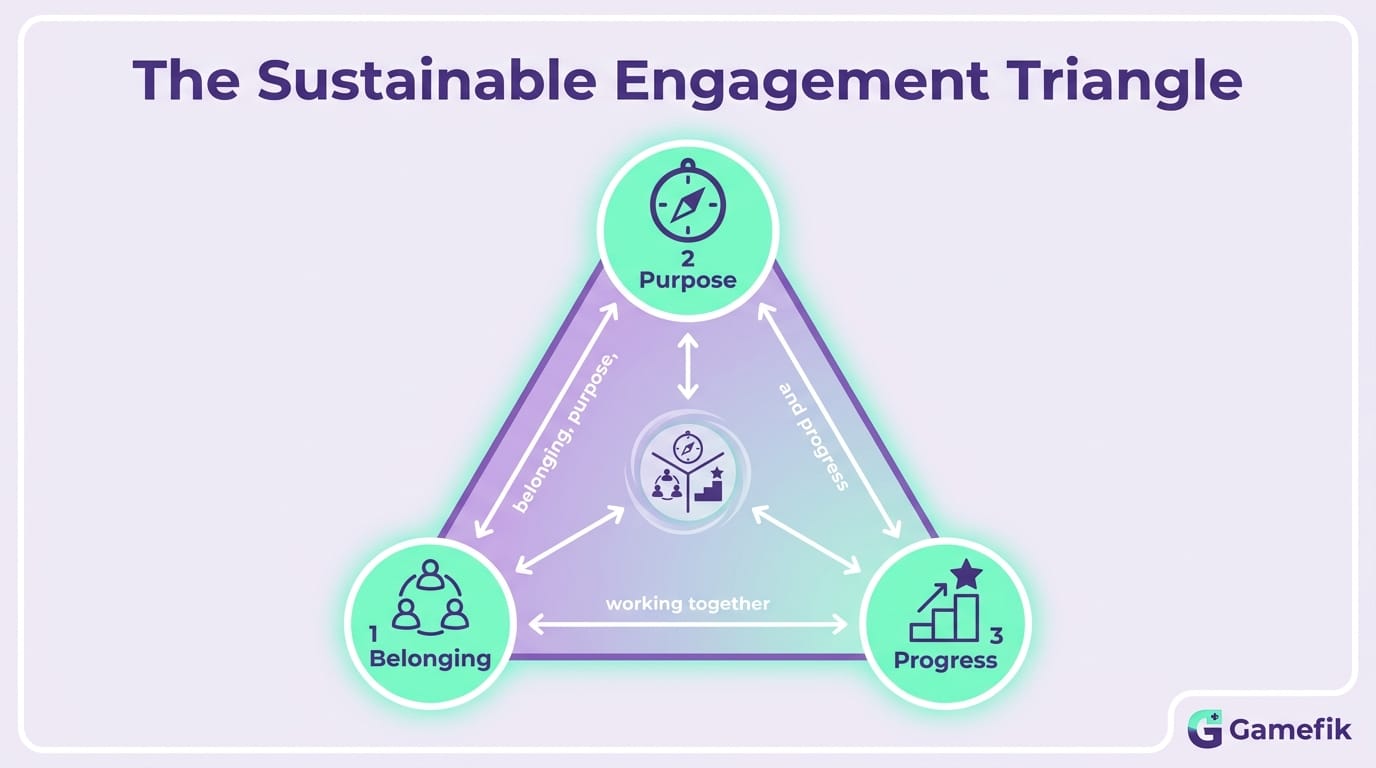
The 3 pillars of engagement are belonging (feeling part of a group), purpose (understanding the why), and progress (seeing your own growth). Together they form the Sustainable Engagement Triangle, applicable to students, teams, and communities. When one pillar weakens, overall engagement collapses — so diagnosis starts by identifying the weakest link.
Search "3 pillars of engagement" and you'll find three completely separate conversations that never intersect: one about employee engagement, one about corporate learning, and a third about social media metrics. Every article treats the topic as if it belongs exclusively to its own niche. But the pillars are the same across any human system — and that's exactly what this guide demonstrates.
After 10+ years applying gamification in K-12 schools, I've tested these three pillars in overcrowded public school classrooms and in small private school settings with 12 students. The framework doesn't change. What changes is which pillar is giving way. Here you'll find a unified framework — the Sustainable Engagement Triangle — that works across all these contexts, along with concrete metrics to measure each pillar and a self-diagnostic to identify which one to strengthen first in your classroom or school.
What Are the 3 Pillars of Engagement (and Why They Work Together)
The three pillars are belonging, purpose, and progress. This framing connects directly to self-determination theory — autonomy, competence, and relatedness — without demanding academic jargon from practitioners in the field.
Belonging is the sense of being part of something. A student who feels ownership over their class participates more actively. A colleague who trusts their team takes creative risks. Without belonging, no one puts themselves out there — and engagement is, at its core, voluntary exposure.
Purpose answers the silent question everyone asks: "Why am I doing this?" It's not motivational rhetoric. It's clarity about how today's task connects to something that genuinely matters to the individual student.
Progress means being able to see your own growth. The human brain needs a signal of advancement to keep investing effort. That's why progress bars, levels, and achievement badges work — they make visible what was previously invisible.
The central point: the three operate like a triangle. When one side fails, the other two can't hold the structure on their own. A student with clear purpose and visible progress who still feels excluded from the class will disengage anyway. Across 500+ schools validated in Brazil and LATAM, we've learned that diagnosing the weakest pillar is worth far more than reinforcing the one that's already working — most administrators spend energy strengthening the pillar that already functions because it's the most comfortable one to measure.
Pillars and Motivation: Intrinsic vs. Extrinsic
External rewards — grades, prizes, bonus points — work briefly and create dependency. The three pillars feed intrinsic motivation, which is the kind that sustains itself. Purpose and belonging provide meaning; progress provides the feeling of competence. When all three are in place, students don't need constant external stimulation to keep going. That's the difference between a student who studies only for the standardized test and one who studies because they want to genuinely master the subject.
In practice, schools that rely exclusively on prize-based systems — rewards for top grades, star-point leaderboards — see a spike in engagement in the first few weeks followed by a sharp drop. Once the novelty of the prize wears off, nothing remains. The three pillars are what holds engagement together after the initial shine fades.
How to Apply the 3 Pillars in Practice
The application changes in form, but not in foundation, across different contexts. Here's how each pillar shows up in the classroom, in school leadership, and in digital learning environments:
Belonging
- Classroom: Opening rituals, stable group assignments, giving students a real voice in class decisions.
- Leadership: Psychological safety — staff and students can make mistakes without fear of public punishment.
- Digital learning: Responding to student comments, building shared community language, acknowledging individual contributions by name.
Purpose
- Classroom: Connecting each content unit to a real-world problem students already recognize.
- Leadership: Explaining the why behind every goal, not just the what.
- Digital learning: Making explicit what transformation that lesson or course actually delivers.
Progress
- Classroom: Levels, achievement milestones, and frequent feedback that make growth visible to students.
- Leadership: Recognizing small wins, not only final outcomes.
- Digital learning: Sequential learning paths, checkpoints, and celebrating audience milestones.
A concrete example: a 9th-grade math teacher in a mid-sized public school district was losing her class during the functions unit. She didn't change the content — she changed the purpose. She began opening every lesson with a real problem her students recognized: a transit fare calculation, a grocery store discount, a credit card interest scenario. Voluntary participation doubled within three weeks, without her changing a single line of her lesson plan. Same content, same standards — the pillar she strengthened was purpose.
Metrics to Measure Each Pillar
What isn't measured becomes guesswork. Track each pillar separately:
- Belonging: eNPS (in staff teams), rate of voluntary participation in class, number of students asking questions per week.
- Purpose: Task completion rate without reminders, student retention, average time spent engaging with a piece of content.
- Progress: Frequency of feedback received, growth on formative assessments, number of learning goals met per grading period.
An honest caveat: none of these metrics proves anything in isolation. High classroom participation can be noise, not genuine engagement. What works is cross-referencing two or three signals — participation rising alongside unprompted task completion is a real indicator. A single number misleads.
The Role of Leadership and the Hybrid Reality in 2026
The three pillars of leadership are exactly these: the leader — or the teacher — doesn't motivate through speeches; they protect belonging, purpose, and progress day to day. In the hybrid and remote environments that dominate in 2026, all three become more fragile: belonging dissolves with distance, progress disappears without in-person cues, purpose gets lost in the noise of digital tools. The fix is intentional — structured connection rituals, frequent asynchronous feedback, and goals that are clearly explained and revisited. The same applies to fully online learning contexts, where dropout rates spike precisely when one pillar collapses without anyone noticing.
A field warning worth sharing: in remote settings, the pillar that typically falls first is belonging — but the one nobody notices collapsing is progress. Without a teacher circulating the room or reviewing a student's notebook, the student loses the signal that they're advancing — and simply stops. A curriculum coordinator at a large urban district we worked with only discovered why her online program's attrition had spiked when she cross-referenced her data: the students who had disappeared were exactly those who had gone weeks without receiving any visible signal of their own growth.
Mistakes That Destroy Each Pillar
- Against belonging: Public leaderboards that expose the lowest performers. They create shame, not community.
- Against purpose: Assigning work without explaining why. "Because it's on the state assessment" is not purpose.
- Against progress: Delivering feedback only at the end of the grading period. By then, the student has already checked out.
The public leaderboard is the mistake I see most often, and the most persistent — nearly every school believes competition motivates all students. It motivates the top five. The other twenty have already disengaged before the second week begins. If you want to understand how these errors compound over a semester and what evidence-based student engagement strategies look like at scale, that's worth exploring in depth.
Self-Diagnostic Checklist
Count how many "no" answers you have in each block. The pillar with the most "no" answers is where to start.
- Belonging: Does every student have at least one peer they connect with in class? Do they participate without fear of being wrong in front of others? Does the class make any real decisions together?
- Purpose: Do your students know why they're studying each topic? Do you connect the content to something real and relevant to their lives beyond school?
- Progress: Do they receive feedback at least weekly? Can they clearly visualize their own growth over time?
How Gamefik Helps Sustain All 3 Pillars
Most edtech tools solve lesson preparation — they generate plans, quizzes, and summaries. That addresses the teacher's workload, not the student's engagement. Gamefik does the opposite: it uses gamification in education and artificial intelligence to sustain all three pillars within the school's daily routine — not as an isolated initiative by one motivated teacher, but embedded across the whole building.
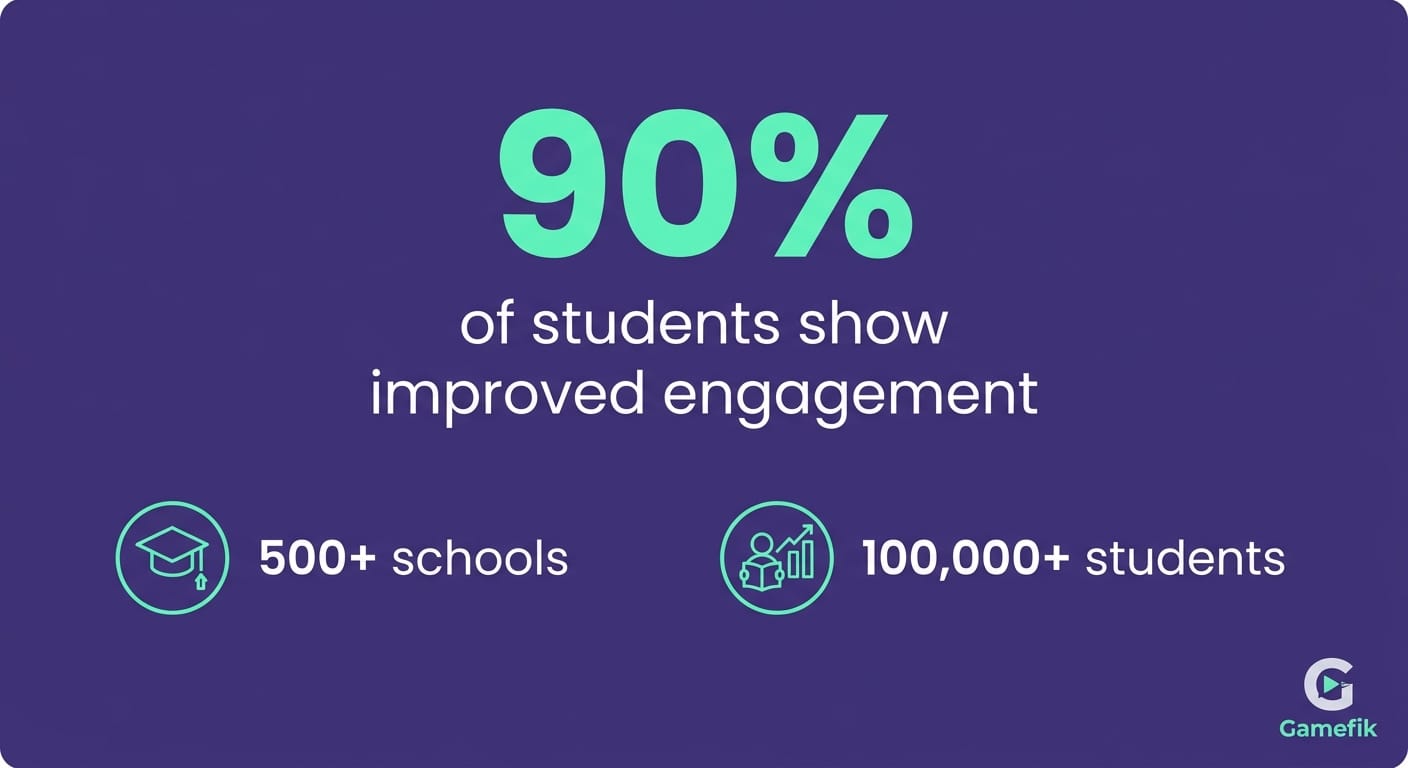
In practice: level and achievement mechanics make progress visible in every class session; team-based challenges fuel belonging; and learning pathways tied to real-world objectives reinforce purpose. Across 500+ schools validated in Brazil and LATAM, with more than 100,000 students reached, 90% report improved engagement — and implementation takes less than a week, without requiring teachers to rebuild their lesson plans from scratch. A side effect educators consistently celebrate: on average, they reclaim 2 hours per week they previously spent tracking down students who had quietly disengaged.
A note of honesty about the limits of any platform: gamification doesn't fix a pillar the school refuses to examine. If leadership insists on public rankings that humiliate students, no software will rebuild belonging. The tool accelerates schools that have already decided to act on all three pillars — it doesn't make that decision in their place.
For educators who want to understand how AI can work for teachers — beyond just generating materials — it's worth exploring how artificial intelligence for teachers functions inside a fully gamified school. If your focus is direct impact in your classroom, start with the student engagement strategies page and request a demo for your school or district.
Frequently Asked Questions
What are the pillars of engagement? Belonging, purpose, and progress. Belonging means feeling part of a group; purpose means understanding why the task matters; progress means seeing your own growth. These three apply equally to K-12 classrooms, school teams, and digital communities — the context changes, the structure does not.
What are the 3 pillars of student success? In the context of engagement, they align directly: belonging to something meaningful, having clarity of purpose, and seeing consistent progress. Sustainable success comes from balancing all three, not from isolated peaks of effort or last-minute cramming before a high-stakes exam.
What are the 3 pillars of motivation? Self-determination theory identifies autonomy, competence, and relatedness — which translate directly into purpose, progress, and belonging. External rewards such as prizes and grade incentives motivate in the short term; the three pillars sustain motivation across a full school year and beyond.
Start With Your Weakest Pillar
You don't need to strengthen all three pillars at once. Run the self-diagnostic above, find the side of the triangle that's giving way, and act there first — engagement recovers through its weakest link. If you want to see how gamification sustains all three pillars in practice, with outcomes measured across 500+ schools, visit Gamefik at gamefik.com and request a demo for your school or district.