
To build AI-generated K-12 assessments aligned to Common Core, your prompt must include the exact standard code (e.g., CCSS.ELA-LITERACY.RI.7.1), the full standard description, grade level, number and format of questions, and the target cognitive level. AI performs well on objective reading and math items but consistently fails on speaking and listening standards and social-emotional competencies — areas that require observational criteria only you can define.
Have you ever asked an AI to "create a 7th-grade ELA test aligned to Common Core" — and gotten back a set of questions that looked right on the surface, but actually targeted the wrong standard? The problem is almost never the tool. It's the prompt. And in some specific cases, it's the fact that AI simply cannot do what you asked — even with the best prompt in the world. This guide separates the two: where AI for K-12 assessments genuinely shines, and where it fails in predictable, consistent ways.
After more than 10 years working alongside school and district partners, I see the same pattern repeat: teachers blame the tool when they've actually given it vague instructions. AI is literal. It gives back exactly the quality of what you put in.
What to include in your prompt for AI to generate truly Common Core-aligned assessments
Common Core organizes each standard with an alphanumeric code. CCSS.ELA-LITERACY.RI.7.1, for example, identifies Reading Informational Text, grade 7, standard 1 — "Cite several pieces of textual evidence to support analysis of what the text says explicitly as well as inferences drawn from the text." The most common mistake educators make when using AI is dropping only the code into the prompt and assuming the model knows exactly what it means.
It often doesn't — or gets it wrong. Large language models were trained on uneven volumes of curriculum documentation. Frequently referenced standards (foundational reading, basic math operations) tend to be well represented; less commonly documented standards return questions aligned to the wrong label. In practice, the more "niche" the standard, the greater the chance AI will fabricate a plausible-sounding but incorrect alignment. The fix is simple and changes everything: include both the standard code AND the full standard description, copied directly from the official document.
A prompt that works has four layers:
- The full standard — code + complete text. E.g., "(CCSS.ELA-LITERACY.RI.7.1) Cite several pieces of textual evidence to support analysis of what the text says explicitly as well as inferences drawn from the text."
- Class context — grade level, and if possible the proficiency profile ("class struggling with inferential comprehension").
- Format — number of questions, multiple choice or open response, and the cognitive level (identify, analyze, compare, create).
- The audit request — "for each question, indicate which standard it addresses and which cognitive verb is being assessed."
That fourth layer is what separates the experienced teacher from the beginner. It turns AI into something you can verify in seconds, rather than rereading every question and guessing at its intent. An instructional coach at a bilingual school in Chicago shared that she made this "audit line" a non-negotiable requirement for every AI-generated assessment on her team — and the number of questions sent back for revision by the curriculum coordinator dropped dramatically within the first grading period.
Where AI consistently fails on K-12 assessments — and why you shouldn't rely on it
This is the part most tutorials skip, and that any classroom teacher knows firsthand. I'd rather be honest about the tool's limits than sell a convenience that doesn't exist.
AI is excellent for objective reading, grammar, and math items. It falls apart in two areas of K-12 standards:
Speaking and listening standards. Standards like CCSS.ELA-LITERACY.SL.6.1 (engage in collaborative discussions) or CCSS.ELA-LITERACY.SL.4.4 (report on a topic orally) assess spoken language, active listening, conversational turn-taking, tone, and the ability to argue in real time. None of that lives in text that AI generates. Ask for a "speaking and listening assessment" and you get a generic rubric — "student communicates clearly" — which is not a valid observational criterion. The training corpus of large language models is text-based; oral performance is precisely what gets left out. Valid criteria here must come from your own classroom observation, using a rubric that describes verifiable behaviors (e.g., "builds on a peer's comment before disagreeing" or "sustains an argument for more than 30 seconds without losing the thread").
Social-emotional learning (SEL) competencies. Common Core and most state frameworks treat SEL as cross-curricular and embedded, not isolated content. AI does not observe collaboration, persistence, or self-regulation — it only describes them. AI-generated SEL rubrics sound plausible and are pedagogically hollow. I've seen schools adopt rubrics like this thinking they were assessing collaboration, when they were actually just checking a box.
There is also a distinction AI does not make on its own: formative vs. summative assessment. AI excels at summative — the end-of-unit test with closed-format items and an answer key. For formative assessment, the kind that tracks learning in progress and feeds continuous feedback, AI can generate useful exit tickets and check-in questions, but reading what students' errors reveal about each individual learner remains human work. Use AI to produce the instrument; never use it to interpret what that instrument measures.
Step by step: how to build a standards-aligned assessment with AI in under 20 minutes
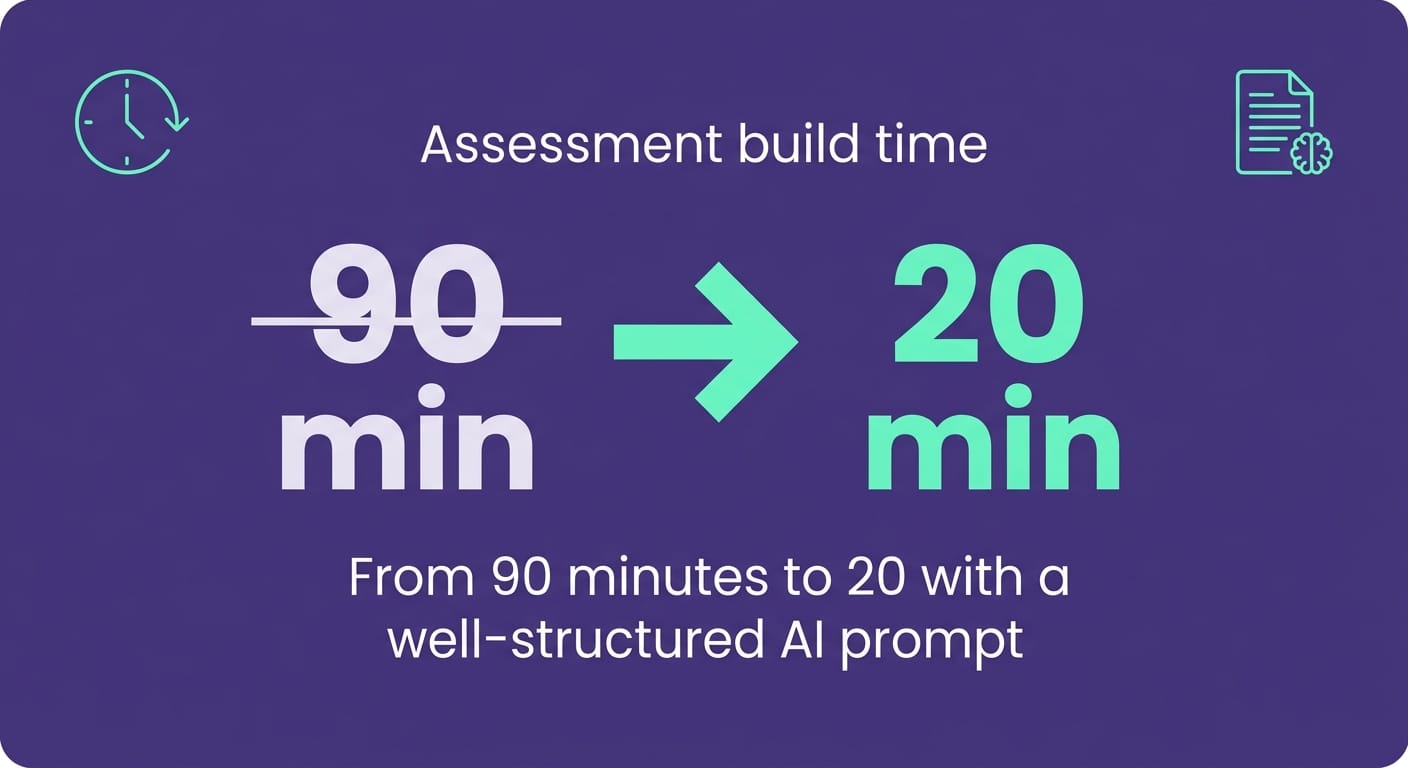
Across 500+ schools validated in Brazil and LATAM — and consistent with what we observe in US and Canadian partner schools — one pattern repeats: teachers who structure their prompts in layers build a full unit assessment in about 20 minutes, compared to 60–90 minutes for the manual process. Internally, we measure an average savings of 2 hours per week per teacher when AI enters the assessment preparation workflow. The savings don't come from skipping steps — they come from spending the right time on pedagogical review, not on formatting and typing.
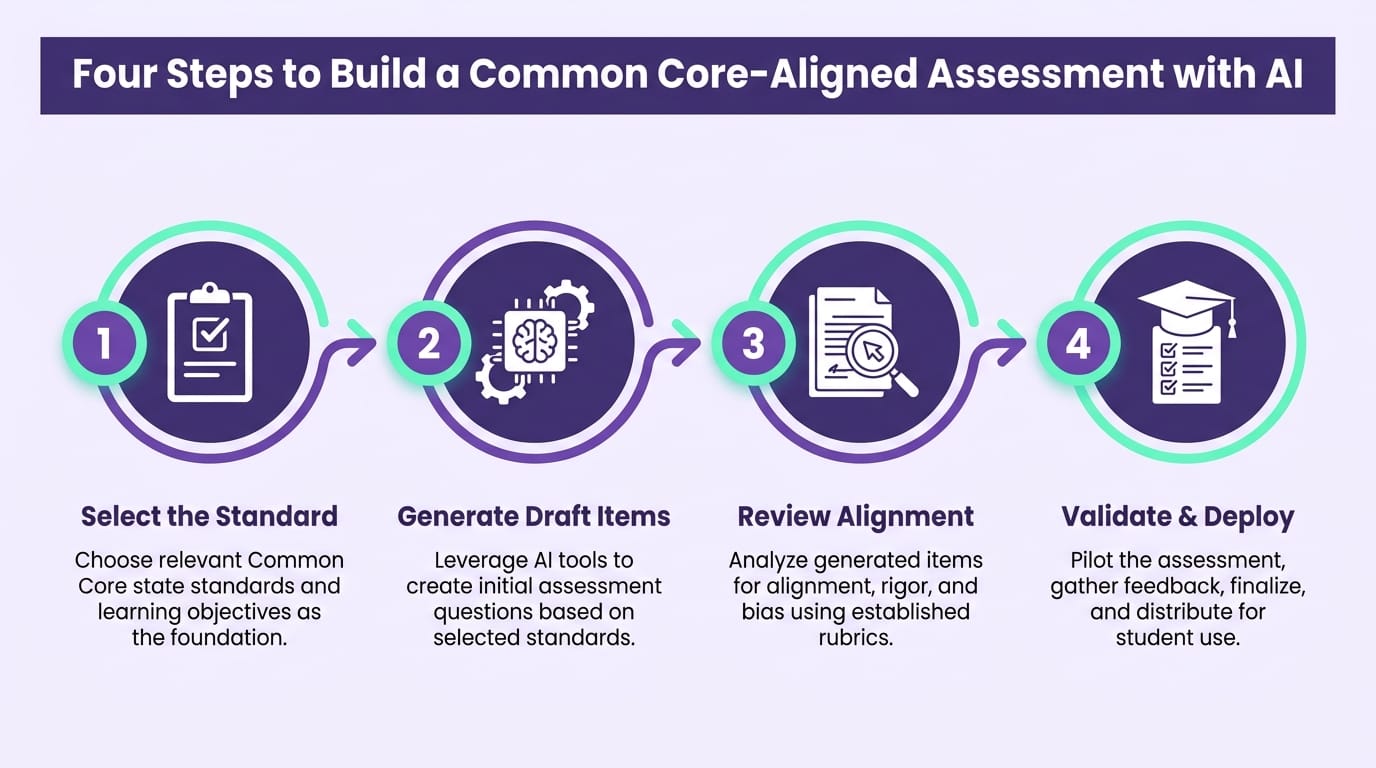
The workflow we recommend:
- Choose your standards before opening the AI. List 3–5 standard codes with their full descriptions. This is the one step that must be 100% yours.
- Write your prompt in layers (standard + context + format + audit request).
- Read the annotated answer key first. Check whether the cognitive verb in each question matches the verb in the standard. If the standard calls for "analyze" and the question only asks students to "identify," the cognitive level is off.
- Review pedagogically. Adjust language for your students, remove culturally distant examples, and reserve speaking and listening standards for your own observational instruments.
A concrete example: a 9th-grade math teacher at a public school in rural Ohio reported that her early AI-generated assessments had a high discard rate — nearly half the questions were misaligned when she used only the standard codes. After she started pasting the full standard description into the prompt, the discard rate dropped by half, and an assessment that used to take over an hour now fits comfortably in a prep period. No magic — just a two-line change to the prompt.
One practical caveat: these gains assume you already have your standards map for the unit in hand. Without that prerequisite, AI only accelerates the production of a misaligned assessment — faster, but just as wrong.
For ready-to-use prompts, check out our guide on ChatGPT for teachers and the resource on AI for classroom activities.
How Gamefik closes the loop between assessment and engagement
Generic AI tools solve the preparation side — your assessment instrument is ready. What they don't solve is the other side of the desk: the student who doesn't care about the test. A perfectly standards-aligned assessment changes nothing if the class arrives disengaged. Across 500+ schools, we've learned that the best-designed assessment falls flat when students don't see a reason to take it seriously.
That's where Gamefik works differently. While artificial intelligence for teachers handles the assessment and activity design, the platform drives the gamification in education strategy adopted by the whole school — not just one teacher in isolation. That distinction matters: one teacher's solo gamification effort becomes an island and doesn't sustain. In our 2024 internal data, schools that integrated assessment with game mechanics recorded a 90% average improvement in student engagement, with full implementation in under a week.
The practical difference: in a gamified school, assessment stops being an isolated moment of anxiety and becomes part of a learning journey students can track. This addresses the root cause we explore in our post on student disengagement — the problem is almost never a lack of interest; it's a lack of connection to what's being assessed. Investing in student engagement strategies is what makes a well-crafted assessment actually worth the effort.
Frequently asked questions
How do I write a prompt for AI to generate a Common Core-aligned assessment? Include the standard code, the full standard description copied from the official document, the grade level, and the desired format. Without the complete standard text, AI frequently misinterprets the code and aligns questions to the wrong objective.
Can AI reliably assess speaking and listening standards? Not reliably. Speaking and listening standards require observational criteria for oral performance and active listening that large language models represent poorly. AI generates generic rubrics; valid criteria must come from your own classroom observation.
Is AI better suited for formative or summative assessment? AI excels at summative — end-of-unit tests with closed-format items and an answer key. For formative assessment, it can generate useful exit tickets and check-in questions, but interpreting student errors and delivering continuous feedback remain human work.
How do I verify that an AI-generated question is truly standards-aligned? Ask the AI to indicate which standard and which cognitive verb each question addresses. If the verb in the question stem doesn't match the verb in the standard, rewrite or discard the item.
Start building better assessments today
AI shortens the path to creating assessments, but alignment and engagement still depend on you — and on a platform built for the whole school. See in practice how to connect assessment, AI, and gamification: create your free Gamefik account and start with a demo for your school.