
The leading barriers to student engagement in K-12 schools are digital distraction, mental health strain, lack of content relevance, and the absence of timely feedback. Each demands a different response — no single strategy works across the board. The path forward is diagnosing the real barrier before selecting a solution, whether behavioral, emotional, or cognitive.
You know the scene: half the class is following along, a third has their phones hidden under the desk, and a few students are physically present but mentally miles away. The temptation is to label it all as "lack of interest" and roll out the same fix for everyone. The problem is that low student engagement doesn't have a single cause — and that's precisely why a one-size-fits-all approach almost never works across an entire classroom.
After more than a decade applying gamification in K-12 schools, the mistake I see repeated most often is this: a principal overhauls the entire curriculum assuming the content is the problem, when half the class was actually disengaged simply because feedback was too delayed. Wrong diagnosis, resources invested in the wrong place.
This isn't another list of disconnected tips. It's a diagnostic guide: first you identify which real barrier is holding each group of students back, then you apply the right response for that specific type of challenge. Before that, we need to agree on what we're actually measuring.
What Is Student Engagement — and Why the 3 Pillars Change Your Diagnosis
Engagement is not behavior. A quiet student sitting still and looking at the board may be completely disengaged. That's why education research works with three pillars, each requiring a different lens:
- Behavioral — attendance, participation, assignment completion, visible effort. It's the easiest to observe and the most misleading.
- Emotional — interest, curiosity, sense of belonging within the class and the subject. When this pillar drops, disengagement begins long before a student officially withdraws or transfers.
- Cognitive — the willingness to think deeper, to pursue understanding rather than just pass. It's the hardest to see and the most important for actual learning.
The diagnosis starts here. Before choosing any strategy, ask yourself: is the student not participating (behavioral), not caring (emotional), or not pushing themselves to understand (cognitive)? The answer changes everything that follows.
In practice, across the 500+ schools validated in Brazil and LATAM that are Gamefik partners, the behavioral pillar is the only one most teachers measure — because it's the only one visible in the gradebook and the attendance log. A curriculum coordinator at a mid-sized district in the Midwest captured it plainly: for years she considered quiet, compliant students a solved case, until she realized those were precisely the students most likely to disengage entirely by the second semester. Presence is not engagement.
The 8 Real Student Engagement Challenges — and the Right Response for Each
Each challenge below is tied to a dominant pillar. That connection is what keeps you from applying the right solution to the wrong problem.
1. Digital distraction (behavioral). The phone isn't competing for your students' attention — it already won. Banning devices rarely resolves it. What works is channeling: using the screen as a classroom tool with short, timed tasks that deliver immediate feedback, rather than fighting the distraction head-on. At a K-8 school in Ohio that introduced 5-minute gamified tasks completed on students' own devices, sustained attention time actually increased — because the phone stopped being the enemy and became part of the lesson.
2. Mental health and emotional well-being (emotional). Anxiety, poor sleep, and chronic stress are direct barriers — not excuses. A student in emotional distress simply doesn't have the cognitive bandwidth left for photosynthesis or algebraic reasoning. The right response here isn't pedagogical — it's human: predictable routines, low-stakes assessment formats, and open channels for conversation before demanding performance. To be direct: no edtech platform solves this, and anyone claiming otherwise is selling a fantasy.
3. Lack of relevance in the curriculum (cognitive). "When am I ever going to use this?" is the most honest cognitive distress signal a student can send. Connecting every topic to a real-world problem, a decision, or a scenario from students' actual lives is what reactivates the cognitive pillar. A ninth-grade algebra teacher in Texas told me she only broke through with her class on functions when she stopped using abstract graphs and started modeling their actual monthly cell phone data plan usage instead.
4. Absence of timely feedback (behavioral + cognitive). Waiting two weeks for a grade kills motivation. Students need to know today whether they're on the right track. Immediate feedback is one of the highest-leverage drivers in engagement research — in Gamefik schools, it's the single variable with the greatest impact on assignment completion rates.
5. One-size-fits-all pacing for unequal classrooms (cognitive). Students who already get it disengage from boredom; students who can't keep up give up entirely. Personalizing pace — through differentiated learning pathways, leveled tasks, or optional challenge activities aligned with state standards — keeps both groups actively in the game.
6. Lack of student autonomy (emotional). Students with no meaningful choices feel like objects of the lesson, not active participants in it. Offering decisions within clear parameters — which topic to explore first, in what sequence, with whom to collaborate — restores the sense of agency that the emotional pillar depends on.
7. No family as an ally (external). Engagement doesn't end at the school door. When families don't know what to look for or how to follow up, students lose reinforcement at home. Simple, visible progress reports for parents transform an absent stakeholder into an active partner — and close the gap between what happens in the classroom and what families reinforce in the evenings.
8. The gap across in-person, hybrid, and fully online settings (contextual). Engagement drops fastest in fully online environments because the physical presence that anchors behavioral engagement is gone. In virtual or hybrid settings, what compensates is a visible progress structure and high-frequency interaction — not lengthy recorded lectures. For a deeper look at this specific challenge, see our guide on student engagement in online learning.
For a more thorough examination of the roots behind each barrier, our full guide on disengaged students and their causes covers the research in detail.
How to Apply the Diagnostic Framework in Your Classroom
The most common mistake is jumping straight to a solution. The framework has three steps, and the first is the one most educators skip.
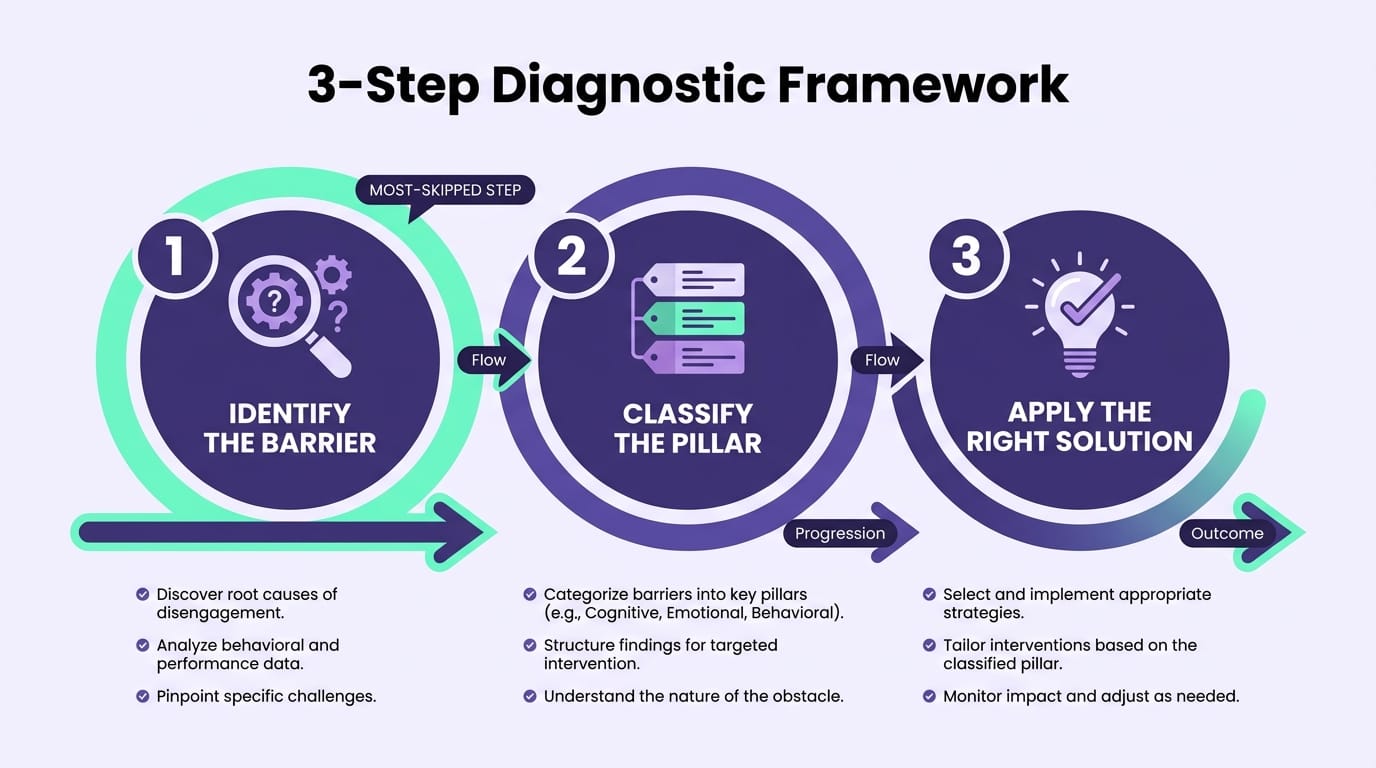
- Observe before you label. For one week, note how disengagement shows up: silence, devices out, declining grades, absenteeism. Different patterns point to different pillars.
- Identify the dominant pillar. Behavioral, emotional, or cognitive? A chronically absent student and a student who shows up but never participates do not share the same problem.
- Apply the response tied to that pillar — using the 8 challenges above as your reference.
- Measure again in two weeks. Track engagement with simple indicators: attendance rate, assignment completion, participation in classroom activities, and — most meaningfully — how many students advance to the next level or milestone in their learning pathway.
This cycle works from elementary through high school, with language and context adjusted accordingly. In elementary grades, the emotional pillar tends to dominate; in middle and high school, cognitive engagement and autonomy carry more weight. Our resource on 12 engagement strategies by grade band completes that calibration. The core principle stays the same throughout: sustainable student engagement strategies are built on diagnosis, not on guesswork.
A practical note from the field: two weeks is the minimum for your data to mean anything. Across 500+ schools validated in Brazil and LATAM, we've learned that administrators who measure engagement after the very first gamified session are confusing novelty with real change. The "shiny new thing" effect fades fast — what persists is the structure.
How Gamefik Helps You Run This Cycle Without Burning Out Your Teachers
The framework above is solid, but it takes time — and time is the resource most teachers have least of. That's where technology enters not as decoration, but as infrastructure. Gamification in education addresses three of the eight challenges simultaneously: immediate feedback, pace personalized through leveled pathways, and visible progress data for both students and families.
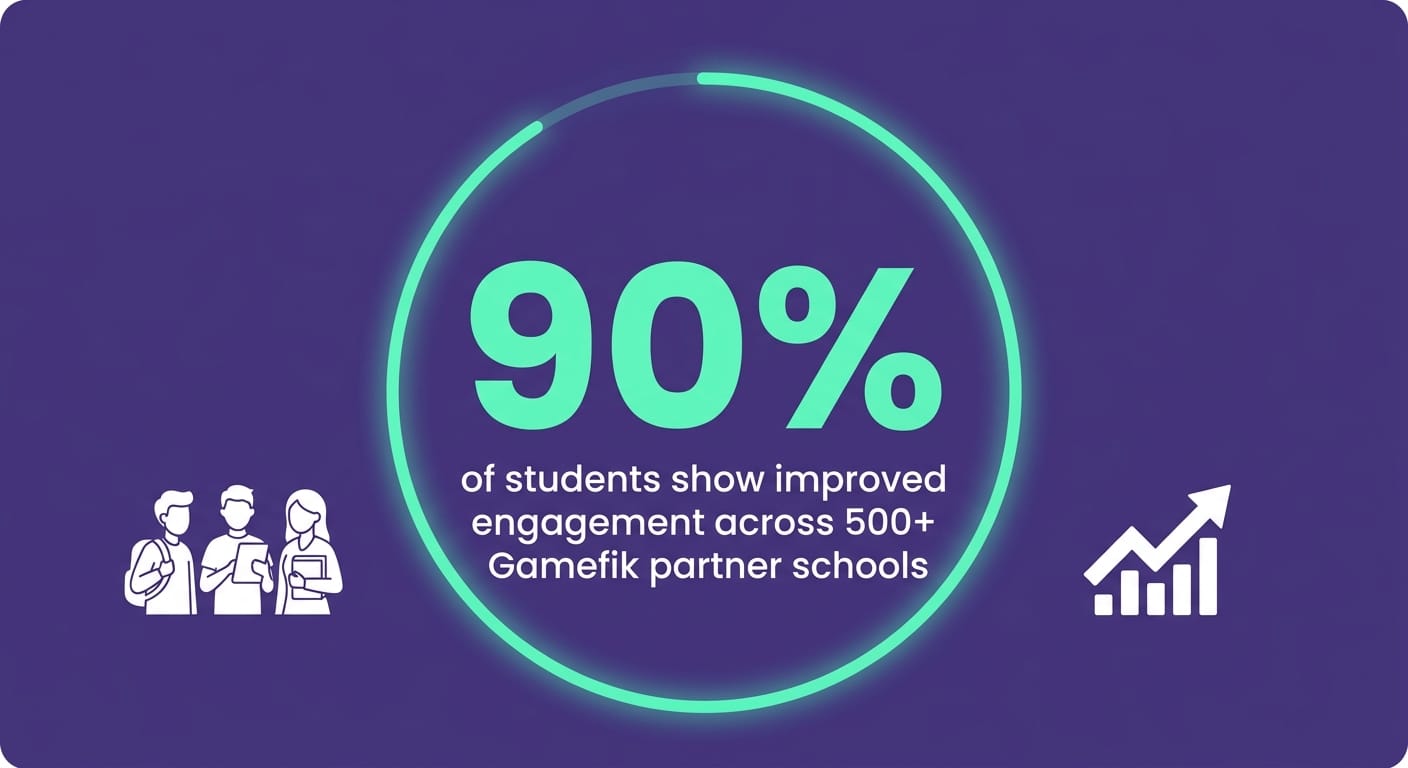
Across the 500+ schools validated in Brazil and LATAM, with more than 100,000 active students, 90% showed improved engagement (internal research, 2024) after adopting a gamified structure supported by artificial intelligence for teachers — which suggests targeted interventions by student profile and saves approximately 2 hours per week in lesson planning and grading. Those 2 hours aren't a minor detail: that's the time a teacher gets back to actually look at the disengaged student in the third row instead of grading 34 identical assignments.
In the spirit of transparency: no tool replaces a teacher's judgment on mental health or content relevance. Those pillars remain human. And no platform delivers results in a school where leadership hasn't committed to the approach — the prerequisite is the institution deciding together, not delegating one more responsibility to an already stretched staff. What the platform does is take over the measurable, repetitive parts — progress tracking, rapid feedback loops, monitoring dashboards — so educators have the capacity to act where only they can make a difference. In a gamified school model, full implementation takes less than one week and scales across the entire institution — not just a single pilot classroom.
Frequently Asked Questions
What are the main challenges students face that affect their engagement? Digital distraction, mental health pressures, lack of real-world connection to the curriculum, cumulative fatigue, and delayed feedback on their own progress. The intensity of each barrier varies significantly by grade level.
How do you engage challenging or hard-to-reach students? Through structured autonomy: short, visible goals, meaningful choice within clear boundaries, and immediate recognition of small wins. Punitive responses typically make things worse. Gamification helps because it makes effort visible and measurable — something that students who resist traditional formats tend to respond to positively.
What are the 3 pillars of student engagement? Behavioral (participation and visible effort), emotional (interest and sense of belonging), and cognitive (willingness to think more deeply). All three need to be observed together — a student can be fully compliant on the surface and still be cognitively absent.
Start with the Diagnosis
You don't need to solve all eight challenges at once. Start by identifying which pillar is most at risk in your classroom this week — and apply one targeted response. To see how Gamefik gives this structure to an entire school in approximately one week, schedule a demo for your school at gamefik.com.