
The 4 elements of student engagement are autonomy (student choice), competence (visible sense of progress), belonging (connection to the classroom community), and purpose (clarity on why the content matters). A lesson truly engages students when all four operate simultaneously — not just one.
Have you ever delivered a well-crafted lesson — standards-aligned, relevant, carefully planned — and still watched half the class zone out? The problem is almost never the material. Engagement doesn't come from what you teach. It comes from four psychological conditions that need to be present at the same time. Over 10 years of implementing gamification in 500+ schools across Brazil and LATAM, one lesson kept repeating itself: strong teachers with strong plans losing their class because those conditions weren't activated. This article identifies these student engagement elements and — more importantly — gives you concrete classroom examples of how each one works in practice.
What Are the 4 Elements of Student Engagement — and Why They Work Together
Research on human motivation converges on a simple idea: people engage when they feel they have choice, that they're making progress, that they belong to a group, and that what they're doing makes sense. Translated into the K-12 classroom, these are the four pillars:
- Autonomy — the student feels they have voice and choice over their own learning path.
- Competence — the student perceives they are improving and can measure that growth.
- Belonging — the student feels part of a group that recognizes and needs them.
- Purpose — the student understands why that content matters to their life beyond the classroom.
The most common mistake isn't ignoring all four. It's betting everything on just one. A loud group competition activates belonging — but without purpose, it becomes recreation with no learning transfer. A practice app with a leaderboard activates competence — but without autonomy, students comply out of obligation, not investment. The four elements are a system: weaken one and the others collapse.
In practice, most schools respond to low engagement by purchasing more technology or adding more hands-on activities. That's not the answer. We've audited award-winning lessons that engaged very little because they only addressed two elements. And we've seen simple whiteboard lessons engage an entire class because all four were active. The system outweighs the tool, every time.
Autonomy: Giving Real Choice, Not Decorative Choice
Autonomy isn't about letting students "do whatever they want." It's about offering choices with consequence within clear boundaries.
Sarah, a 7th-grade ELA teacher in Houston, TX, used to assign the same writing prompt to everyone: "the environment." She restructured it as three format options — a persuasive letter to a corporation, a short video script, or an opinion editorial — all assessed against the same argumentative writing rubric. On-time submission climbed from around 60% to nearly the entire class by the following grading period. The choice itself was small; the sense of ownership over the final product was significant.
A field note worth sharing: decorative choice is worse than no choice. If you offer three options but treat two of them as implicitly wrong, students spot the trap immediately and the effect disappears. The rule we share with partner districts is simple — if the options don't lead to the same learning objective, it isn't autonomy, it's a setup.
Competence: Making Progress Visible
Competence is the feeling of getting better. And it only exists when students can actually see their own advancement — something an end-of-unit test or a quarterly report card almost never delivers on its own.
Marcus, a 9th-grade Algebra teacher in Chicago, noticed his students shut down on equations because they only received feedback at the end of the unit. He restructured the content into five posted "mastery levels," and each student tracked their progress with a sticker after completing three exercises at a given level correctly. Students who had previously given up started asking for the next problem set — because now they could see how far they'd climbed. The content was identical; the difference was making progress measurable and immediate.
An honest limitation here: visible progress only works when the step is small enough to be achievable within the week. In classes carrying significant learning gaps — common across many US and UK school districts — we've seen the opposite effect: the progress tracker becomes a daily reminder of failure. In those cases, the key is to anchor the first level where nearly everyone already has mastery, generate that first win, and only then raise the bar.
Belonging: Making the Student a Contributor, Not an Audience Member
Belonging goes far beyond calling students by name. It means engineering situations where a student contributes something the group genuinely needs from them.
In Jennifer's 10th-grade World History class in Atlanta, a cluster of students rarely participated in discussions. She introduced "expert committees": each small group became the class authority on a specific historical period and was formally consulted by peers during debates and projects. The students who used to go unnoticed became the "Industrial Revolution experts" — and they started defending their topic because the rest of the class depended on them for it. Attendance stopped being passive. Belonging meant holding a function others needed filled.
A district instructional coach we partner with in the Chicago area captured it precisely: the students who presented the greatest behavioral challenges were, almost always, the ones who felt invisible. Assigning them a real function wasn't a reward — it was what brought their attention back into the room.
Purpose: Showing the Real Problem the Content Solves
Purpose is the most neglected element — and the most powerful. Telling students "this will be on the SAT" isn't purpose. That's a threat. Purpose connects content to a concrete problem the student already recognizes from their own life.
David, an 11th-grade Chemistry teacher in Seattle, was teaching oxidation reactions in the abstract until he registered blank stares across the room. He restructured his opening: "Why does the iron gate outside your house rust, but the stainless steel on your kitchen appliances doesn't?" From that point on, oxidation became the explanation for something students had observed hundreds of times but never had language for. Classroom questions increased noticeably because the content stopped being a subject and became an answer. Purpose isn't motivating students with an inspirational speech — it's showing the "why" before the "what."
How to Apply the 4 Elements in Your Next Lesson (Practical Framework)
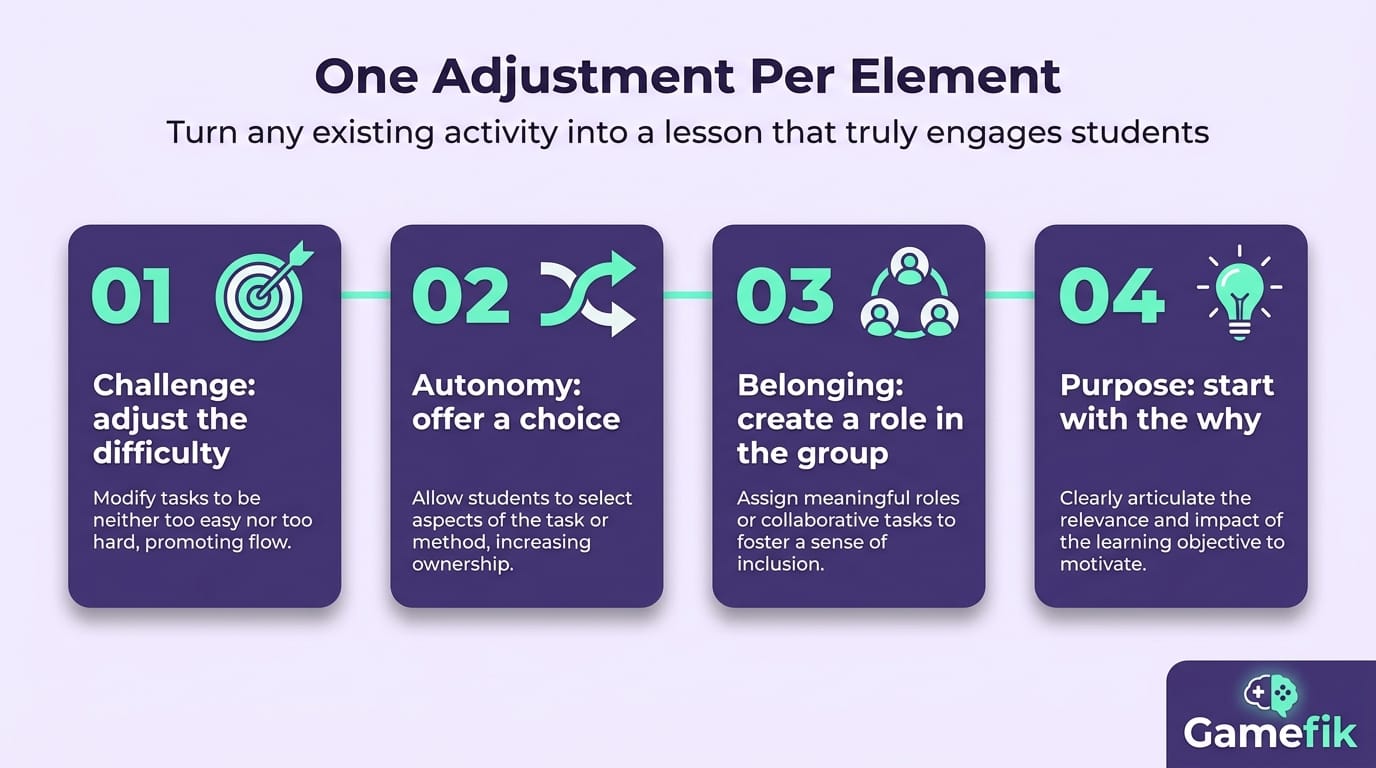
You don't need to rebuild your lesson plan from scratch. Take one activity you already use and apply one adjustment per element. This is the four-step framework — the same one we teach in the first week of implementation at any partner school:
Step 1 — Insert a real choice (autonomy). Offer two or three ways to complete the same task: written, oral, or visual. Keep the assessment criteria identical across all formats. The format choice creates ownership without complicating your grading workflow.
Step 2 — Make progress visible (competence). Break the learning objective into small, discrete steps and create a progress tracker — a checklist on the board, mastery levels, or a simple progress bar. Students need to see they've moved forward, not just learn their score at the end.
Step 3 — Create a role in the group (belonging). Assign roles with genuine responsibility: reporter, subject-matter expert, discussion facilitator. The rule is that the group depends on that student to complete the task. Belonging grows from being needed, not from being included.
Step 4 — Start with the "why" (purpose). Before presenting the content, present the problem it solves. A question tied to students' real-world experience is worth more than ten minutes of abstract context-setting.
Run this test with a single lesson. Afterward, ask yourself: which of the four elements was weakest in my activity? Almost always the answer is purpose — and that's where your biggest gain is waiting. If you want to go deeper on tactics, the guide on student engagement strategies offers variations by grade band, and the article on disengaged students walks you through diagnosing which element is missing in your specific class. For a broader view of how gamification in education structures these four elements into a coherent instructional system, that's a strong next read.
How Gamefik Helps Activate All Four Elements at Once
The biggest challenge isn't understanding the elements — it's sustaining all four every week without burning yourself out. That's exactly why Gamefik built its method over 10+ years around these four pillars.
In an analysis of 500+ partner schools in Brazil and LATAM between 2021 and 2024, we audited lesson plans looking for all four elements. Autonomy and competence appeared with reasonable frequency, but purpose was explicitly present in only 18% of the activities reviewed — by far the weakest link. When schools began structuring lessons with all four elements deliberately active, measured engagement in learning activities reached up to 90% improvement across more than 100,000 students tracked.

Let's be honest about the limitation: no platform solves engagement on its own. What Gamefik does is give students choice-based learning paths (autonomy), visible progress through levels and achievements (competence), collaborative team missions (belonging), and content applied to real-world problems (purpose) — without requiring you to build everything from scratch. But the purpose behind each specific piece of content still needs the teacher who knows their class. Implementation takes approximately one week and returns, on average, 2 hours per week of lesson-preparation time. To see how this works at the school level, explore the gamified school model and how gamification in education organizes these four elements into a sustainable weekly system. For educators managing particularly challenging classes, the student engagement strategies resource breaks down results by student profile and grade level.
Frequently Asked Questions About Student Engagement Elements
What are the 4 elements of student engagement? They are autonomy, competence, belonging, and purpose. Autonomy is the student's power of choice; competence is the sense of measurable progress; belonging is the connection to the classroom community; purpose is the clarity on why that content matters. Sustainable engagement emerges when all four work together — not in isolation.
Which student engagement element is most overlooked in the classroom? Purpose. In an analysis of 500+ Gamefik partner schools in Brazil and LATAM between 2021 and 2024, it appeared explicitly in only 18% of audited lesson plans. Most lessons cover the "what" and the "how" — but rarely answer "why does this matter to you."
How can I apply the 4 engagement elements without rewriting my entire lesson plan? You don't have to. Choose one existing activity and make one adjustment per element: give a real choice (autonomy), show students their own progress (competence), create a moment of group contribution (belonging), and explain the real-world problem the content solves (purpose). It takes a single lesson cycle to test and iterate.
Start With Your Weakest Element
If you've read this far, you've likely already identified which of the four elements is missing from your lessons most consistently. Start there on Monday — one adjustment, one activity. When you're ready to structure all four pillars systematically across your school without carrying it all yourself, explore Gamefik's method at gamefik.com. It's the same approach that has benefited more than 100,000 students across 500+ schools in Brazil and LATAM — and the framework translates directly into any K-12 classroom.