Active learning strategies place students at the center of learning through problems, projects, and collaboration. The right choice depends on a class diagnostic — size, grade level, and digital access. Of the 500+ schools Gamefik has worked with across Brazil and LATAM, 67% replaced their first strategy due to poor selection criteria.
Active learning strategies put students in the driver's seat — but the most expensive mistake isn't poor execution, it's poor selection. Of the 500+ schools Gamefik has partnered with, 67% abandoned their first active learning approach because no one ran a proper class diagnostic before choosing it. This guide brings 7 real cases with measurable outcomes, a 6-question class diagnostic checklist, and a concrete Week 1 implementation plan.
You've probably seen it happen: a district purchases a "Flipped Classroom" package, runs a Saturday PD session, and within two months teachers are back to direct instruction and rows of desks. After more than a decade applying this in the field, here's the honest truth: the problem is rarely the teacher. It's that the strategy chosen didn't match the class profile. We worked with a rural school district in the Midwest where the instructional coach pushed Flipped Classroom in a 7th-grade class where nearly half the students had no reliable internet at home — the pilot collapsed in three weeks, and no one in that classroom was to blame. Let's fix this in the right order: diagnostic first, strategy second.
Before You Choose: A 6-Question Class Diagnostic
You already know the difference between active and traditional instruction: in traditional, students receive; in active, students construct. What nobody gives you is the criterion for deciding which construction model fits your class of 34 students in 5th period.
Answer these six questions before you sign off on any lesson plan:
- How many students are in the class? Up to 30 opens the door for PBL and Design Thinking. Above 35, favor structures that divide the room — Station Rotation or Team-Based Learning (TBL).
- What grade level and subject band? Middle school (grades 6–8) responds better to short station rotations and gamification; higher education and upper high school can handle Flipped Classroom with dense pre-reading.
- What percentage of students have reliable digital access outside school? Below 60% makes pure Flipped Classroom unworkable — students simply won't watch the video at home. Across 500+ schools, this is the single item that most often sabotages a well-intentioned pilot: coordinators and coaches assume access and never actually ask.
- How much prep time does the teacher realistically have? Flipped Classroom requires producing or curating material in advance; Gamification and Peer Instruction can repurpose content that already exists. In practice, a teacher carrying five sections with no protected planning time won't sustain Flipped Classroom past the second month — and that needs to be factored in before launch, not after.
- What is the subject and content type? Procedural content (math, grammar, coding fundamentals) calls for deliberate practice with repetition; inquiry content (science, social studies, history) benefits from open-ended problems.
- What is the current engagement baseline? Classes with chronically disengaged students need quick wins — gamification delivers those before PBL can build momentum.
Quick decision matrix:
| Class Profile | Recommended Starting Strategy |
|---|---|
| 35+ students, grades 6–8 | Station Rotation or TBL |
| Up to 25 students, inquiry content | PBL or Design Thinking |
| Higher ed or grades 11–12, 80%+ digital access | Flipped Classroom |
| Very low engagement, any grade | Gamification as entry point |
| Procedural content, average class size | Peer Instruction |
An honest caveat: this matrix is a starting point, not a mandate. A high school math teacher with block scheduling and a small class can absolutely run PBL on procedural content — given adequate prep time. The diagnostic informs your opening bet; it doesn't replace the judgment of the person who actually knows the room.
7 Real Active Learning Cases with Metrics
Every case below came from schools Gamefik has partnered with. Names have been anonymized per agreement; context and numbers are real (Gamefik internal data, 2023–2024).
1. PBL in Life Science — Public middle school, grade 8, 34 students. The teacher replaced a unit of direct instruction with a single driving question: "Why did our school's track athlete collapse during practice?" Failure rates for the grading period dropped from 28% to 11% over one semester, and attendance rose 9 percentage points. One honest note: the first cycle was messy — students didn't know where to start. PBL has a learning curve, and the strong results came in the second problem cycle, not the first.
2. Station Rotation — Private K-8 school, grade 6, 41 students. Class too large for a single-group project. Four 12-minute stations (reading, digital game, writing, teacher-led) reduced observed idle time from 22 to 6 minutes per lesson, measured through direct observation across four weeks.
3. Flipped Classroom — Community college technical program, 52 students, 87% with reliable digital access. Eight-minute pre-class videos freed in-class time entirely for problem-solving. The average score on the practical assessment rose from 6.4 to 7.8 (out of 10) across the semester. Notice the high digital access rate — that was a prerequisite, not a footnote.
4. Gamification — Urban public school district, grade 7, three sections of ~35 students, math. Points, missions, and team leaderboards applied to a math unit. Homework completion climbed from 54% to 89% over five weeks. This is the typical effect of gamification in education when engagement is the bottleneck — and it aligns with our average of 90% improvement in engagement (Gamefik internal research, 2024).
5. Peer Instruction — High school, grade 11, 38 students, physics. Conceptual questions with voting and structured peer discussion. The correct-answer rate on conceptual questions rose from 41% (first vote) to 72% (after peer discussion) within the same class period — captured directly through the voting system.
6. Design Thinking — Private high school, grade 9, 28 students, interdisciplinary project. Five weeks to prototype a solution for the school's neighborhood waste management problem. Student self-reported engagement jumped from 3.2 to 4.5 on a 5-point scale between the start and end of the cycle.
7. TBL (Team-Based Learning) — University health sciences program, 60 students, first year. Permanent teams with individual and group readiness tests. Course failure rates dropped from 19% to 8% compared to the previous semester, with the same contact hours.
Notice the pattern: none of these results came from "adopting the trending methodology." They came from matching the class profile to the right approach — exactly what the diagnostic above does for you. As I often say during professional development sessions: active learning isn't what you purchase, it's the question you answer before you purchase anything.
How to Implement It: A Week 1 Step-by-Step Plan
You are not going to flip your entire school upside down on Monday morning. Start with one class, one subject, one strategy. What we consistently see is that schools that try to roll out across all classes simultaneously abandon the effort within two months; schools that start with one class sustain it through the full year.
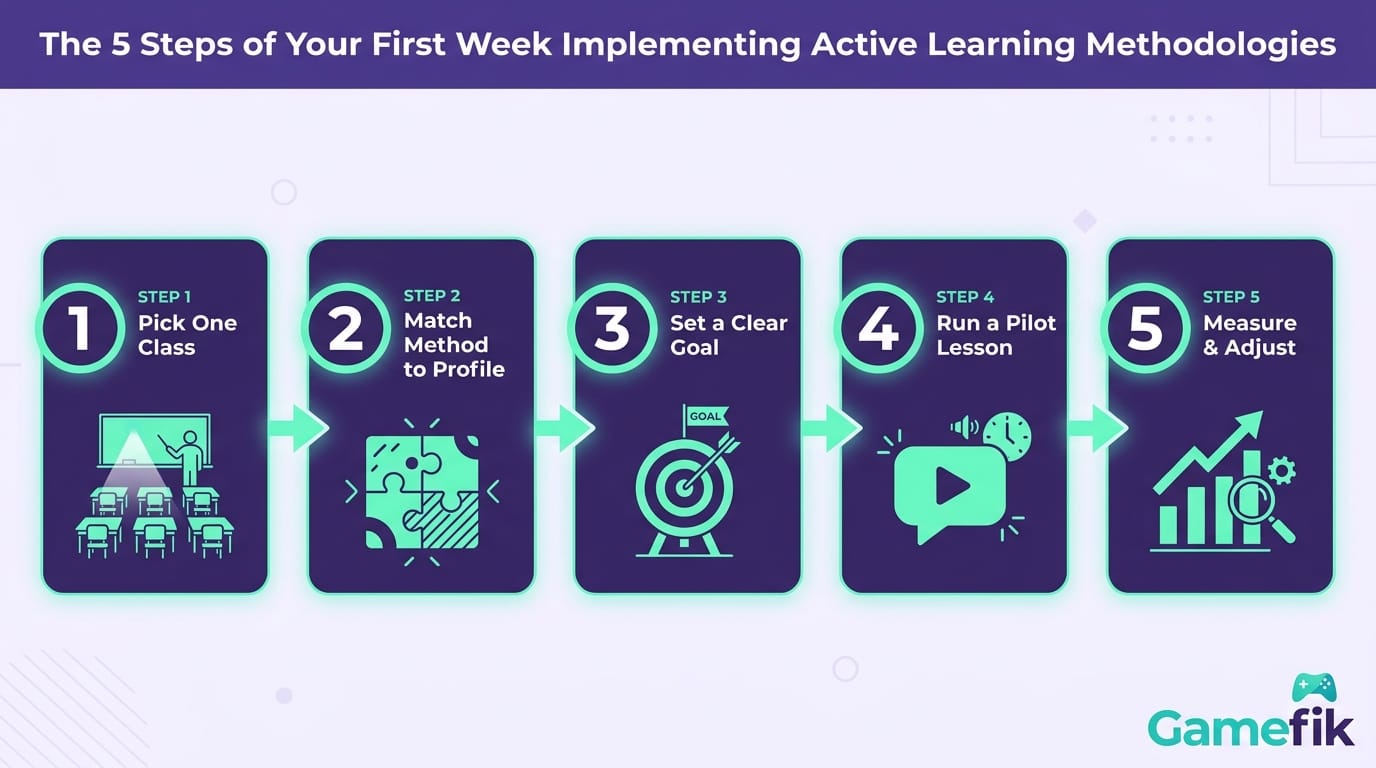
Monday — Diagnostic. Run the 6 questions with the teacher of the chosen class. Leave the meeting with ONE strategy selected from the matrix, not two.
Tuesday — Minimum Viable Slice. Define a single piece of content for the pilot. Flipped Classroom becomes one 8-minute video; PBL becomes one problem; gamification becomes one scored mission. A small scope is what prevents the abandonment that affects 67% of schools that skip the diagnostic step.
Wednesday — Baseline Metric. Before implementing, record the current number: homework completion rate, attendance, or the score on the most recent assessment. Without the "before," you can never prove the "after." This is the most common field error I see — a school implements and doesn't measure, then can't defend the investment at the next leadership meeting. A bilingual school director in Chicago told me he shut down an excellent pilot simply because he had no data to show the board. The program was working; the absence of metrics killed it.
Thursday — First Active Lesson. The teacher runs the first active learning session. Your job as an observer is to watch, not to intervene in the moment. Note idle time and participation levels.
Friday — Quick Read. Compare the baseline metric to what happened during the week. A positive shift in just one week is common with gamification; PBL and Design Thinking require longer cycles to show results — don't be alarmed if the first PBL cycle looks worse before it gets better.
The three mistakes that most often kill pilots: launching school-wide at once, choosing a strategy because it's trending, and failing to define a starting metric. All three are resolved by the minimum viable scope above.
How Gamefik Helps You Choose and Measure
Diagnostic and measurement are precisely where most instructional teams get stuck. The Gamefik platform integrates class diagnostic, strategy application, and engagement tracking in one place — and full implementation takes less than one week, not a semester of training cycles.
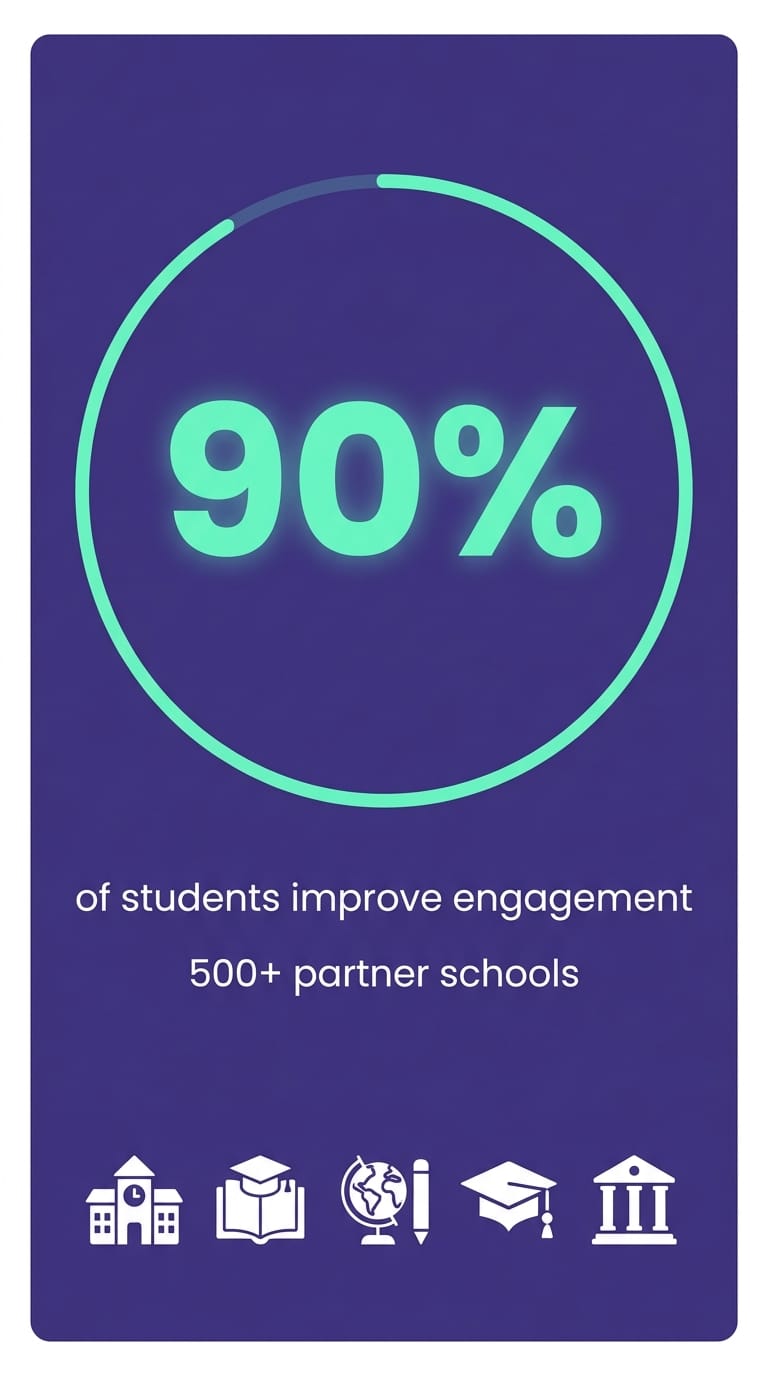
Accumulated outcomes: 90% of students improve engagement, 500+ partner schools validated across Brazil and LATAM, and more than 100,000 active students (Gamefik internal data, 2024–2025). Teachers also recover an average of 2 hours per week previously spent on manual lesson prep and grade tallying — time that goes back to what actually matters: being present with students.
No miracle claims here: the platform handles diagnostic, application, and measurement — but what sustains the method is a teacher with protected planning time and an instructional leader who shields the pilot from the next trend. Where those two conditions don't exist, no tool holds. If your challenge is maintaining momentum after Week 1, it's worth exploring what a gamified school looks like from the inside, how AI for teachers can reduce prep time without sacrificing rigor, and what shifts in student engagement look like across a full academic year.
Frequently Asked Questions
What are 5 examples of active learning strategies? Project-Based Learning (PBL), Flipped Classroom, Gamification, Peer Instruction, and Design Thinking. The choice between them depends on your class profile: PBL suits smaller, inquiry-driven groups; Station Rotation works better for larger middle school classes.
What are the 7 principles of active learning? Student agency, learning through real-world problems, peer collaboration, ongoing reflection, teacher as facilitator, intentional use of technology, and formative assessment with continuous feedback.
What are the main types of active learning strategies in K-12 education? PBL, Project-Based Learning, Flipped Classroom, Gamification, Peer Instruction, Design Thinking, Station Rotation, Team-Based Learning (TBL), and Case-Based Learning. The first five account for the majority of implementations in K-12 schools across the US, UK, and Canada.
Start with the Class That Needs It Most
You don't need a two-year strategic plan. You need one class, one diagnostic, and one baseline metric — this week. Run the 6-question diagnostic today, select one strategy from the matrix, and measure the result by Friday. When you're ready to scale that across your school and track engagement class by class, visit Gamefik at gamefik.com — full implementation in under a week, with data you can bring to your next leadership or department meeting.