
AI essay grading works well as a first-pass triage: it catches grammar and mechanics with solid accuracy but stumbles on evidence and argumentation. In our test on the same essay, scores ranged from 72% to 92%—which is why human feedback on reasoning and organization remains irreplaceable.
You've probably thought about dropping all 35 of your class's essays into ChatGPT and letting the machine do the work. I get the temptation—a high school English teacher in a public district outside Columbus told me she grades essays past midnight, with a sleeping kid on her lap. The problem is that, before you do that, it's worth understanding where AI gets it right, where it hallucinates, and how to build a workflow that saves your time without handing a student an inflated grade. We took one real essay and graded it with four different tools. The results explain a lot.
We tested the same essay on 4 AI tools: which one got closest to the real grade?
We used an essay scored at 88% (graded by two human readers following a standards-aligned argumentative rubric) and ran it through four tools: Grammarly, EssayGrader, an AI rubric tool, and ChatGPT with a structured prompt. This isn't a lab benchmark—it's the kind of test we run when a partner school asks us "can I trust this?"
- Tool A (rubric-based grader): gave 92%. It inflated the organization and conclusion scores. Clean interface and visual feedback, but a tendency to reward structure even when the argument was thin.
- Tool B (grammar-focused): gave 80%. It was the strictest on mechanics, flagging deviations that human readers let slide. Strong for grammar review.
- Tool C (essay grader): gave 76%. It underrated the use of evidence, labeling as "generic" a passage the humans scored well. Tends to lower the evidence and analysis dimension.
- ChatGPT with a 5-dimension rubric prompt: gave 84%. It was the closest to the real grade and the most detailed in qualitative feedback—precisely because the prompt forced the AI to justify each dimension.
The pattern repeats: no tool nailed it, and the error always lives in the same place—the dimensions covering evidence/argumentation and coherence/organization. These are the dimensions that depend on judgment, not rules. AI recognizes a misplaced comma; it doesn't recognize a sophisticated argument disguised as a simple one. In practice, a 20-point spread between two tools on the same essay is enough to change a student's fate when a placement or scholarship cutoff is on the line—and that's exactly why we treat AI as a starting point, never a sentence.
How AI scores each dimension of an argumentative rubric
Understanding how it works helps you trust the right part and distrust the rest. An AI grading tool is a language model trained on thousands of texts. It doesn't "understand" the essay the way you do—it recognizes statistical patterns in structure, vocabulary, and cohesion.
In practice, here's how it behaves across five common rubric dimensions:
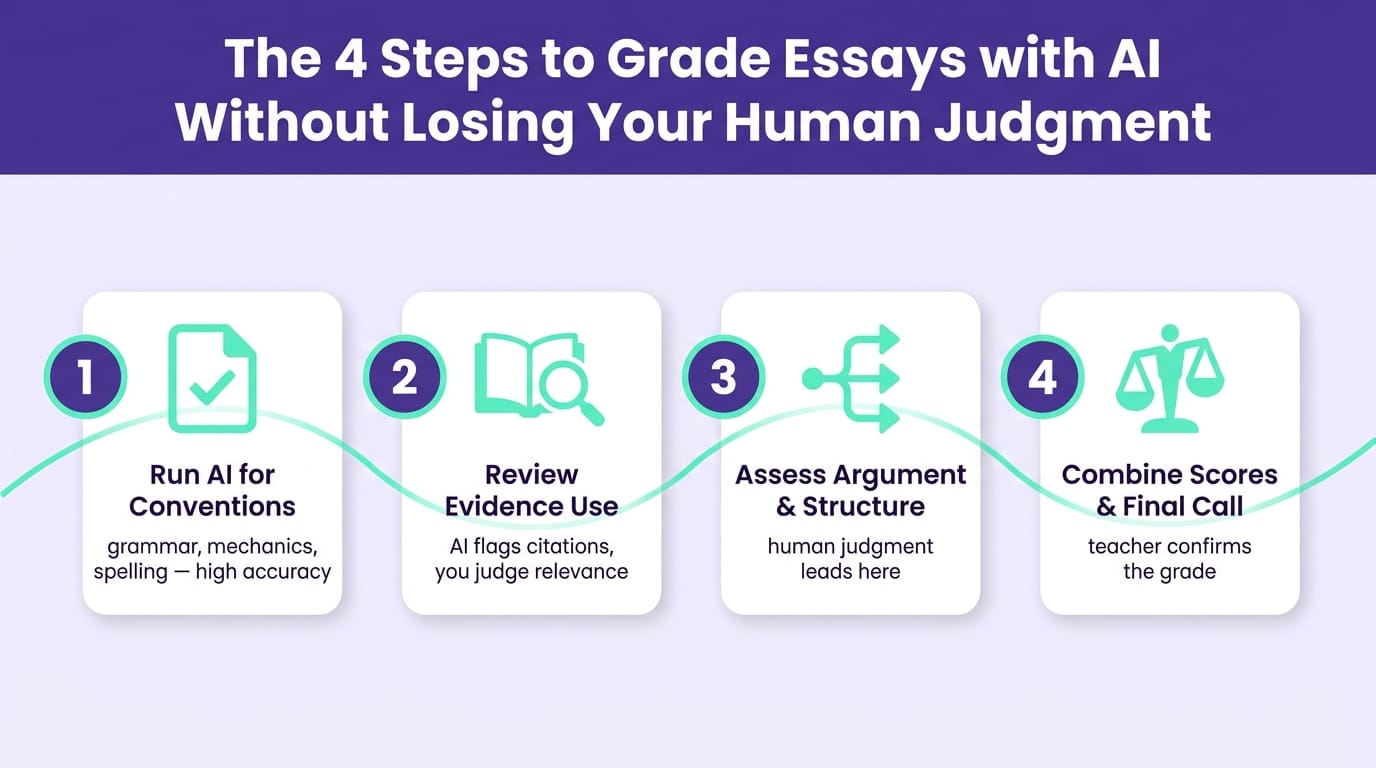
- Conventions (grammar, mechanics, spelling): high accuracy. AI catches grammatical errors more consistently than a tired reader at 11 p.m.
- Use of evidence and topic command: medium accuracy. It recognizes whether you cited a source or data point, but it doesn't judge well whether the evidence was productive or just decorative.
- Argumentation and structure (the writer's plan): low accuracy. This is where most hallucinations live—AI invents coherence where there is none, or penalizes writers who avoid the obvious.
- Cohesion and transitions: good accuracy. Connectives and progression are patterns the model reads well.
- Conclusion and call to action: high accuracy. AI checks the closing elements almost like a checklist.
Be honest about one thing: this behavior changes when the essay is handwritten and photographed. At a rural district that still collects essays on paper, the AI confused words and dropped the conventions score for no reason—the problem was the optical reading, not the writing. That's why the path isn't full automated grading. It's triage. You use AI to sweep conventions, cohesion, and the conclusion, and you reserve your human eye for the heart of the text.
The ready-to-use prompt we ran in ChatGPT and Gemini
This is the structured prompt that delivered the score closest to the real grade. Paste it into ChatGPT or Gemini along with the typed essay:
You are an experienced essay grader. Evaluate the essay below strictly following a standards-aligned argumentative rubric across 5 dimensions, assigning 0 to 200 points to each:
Dimension 1 — Command of standard written English (grammar, mechanics, conventions). Dimension 2 — Understanding of the topic and use of productive evidence, without straying from the argumentative essay structure. Dimension 3 — Selection, organization, and interpretation of arguments in defense of a point of view (the writer's plan). Dimension 4 — Linguistic mechanisms of cohesion and transitions between parts. Dimension 5 — A clear conclusion or proposed solution, with an agent, action, method, effect, and detail.
For each dimension: (1) assign the score, (2) cite the exact passage that justifies the score, (3) point out how to improve. At the end, sum the five scores and state the total. Do not inflate: if an argument is thin, penalize Dimension 3.
Essay: [paste here]
The instruction "do not inflate" and the request to cite the exact passage cut down hallucination significantly. We tested this prompt on dozens of real essays before recommending it to teachers at our partner schools—without the request to cite the passage, AI tends to "pad" and inflate the score by up to 40 points. If you want a bigger bank of commands, our AI for teachers resources cover practical classroom prompts and compare free and paid options.
How to integrate this into Google Classroom without creating chaos
The workflow that works doesn't trade one spreadsheet for another. It fits AI inside what you already use:
- Collection: receive typed essays via Google Classroom (ask students to type—photographed handwriting worsens AI reading).
- AI triage: run the prompt above in batches, copying the feedback for conventions, cohesion, and the conclusion.
- Human curation: you review only the evidence and argumentation dimensions, where your judgment is worth gold. Here you confirm, correct the inflated score, and adjust the tone of the feedback.
- Return: paste the consolidated feedback into the private comment in Classroom, with your personal stamp on the argumentation notes.
This design turns two hours of grading into something close to forty minutes—without outsourcing the pedagogical judgment the student actually needs. I'll be direct about a prerequisite no one mentions: this workflow only works if the class types its essays. At one charter school that adopted the workflow, adoption stalled for the first three weeks because half the students kept turning in paper. Once that was fixed, turnaround time dropped from two weeks to three days.
How Gamefik sees the use of AI in grading
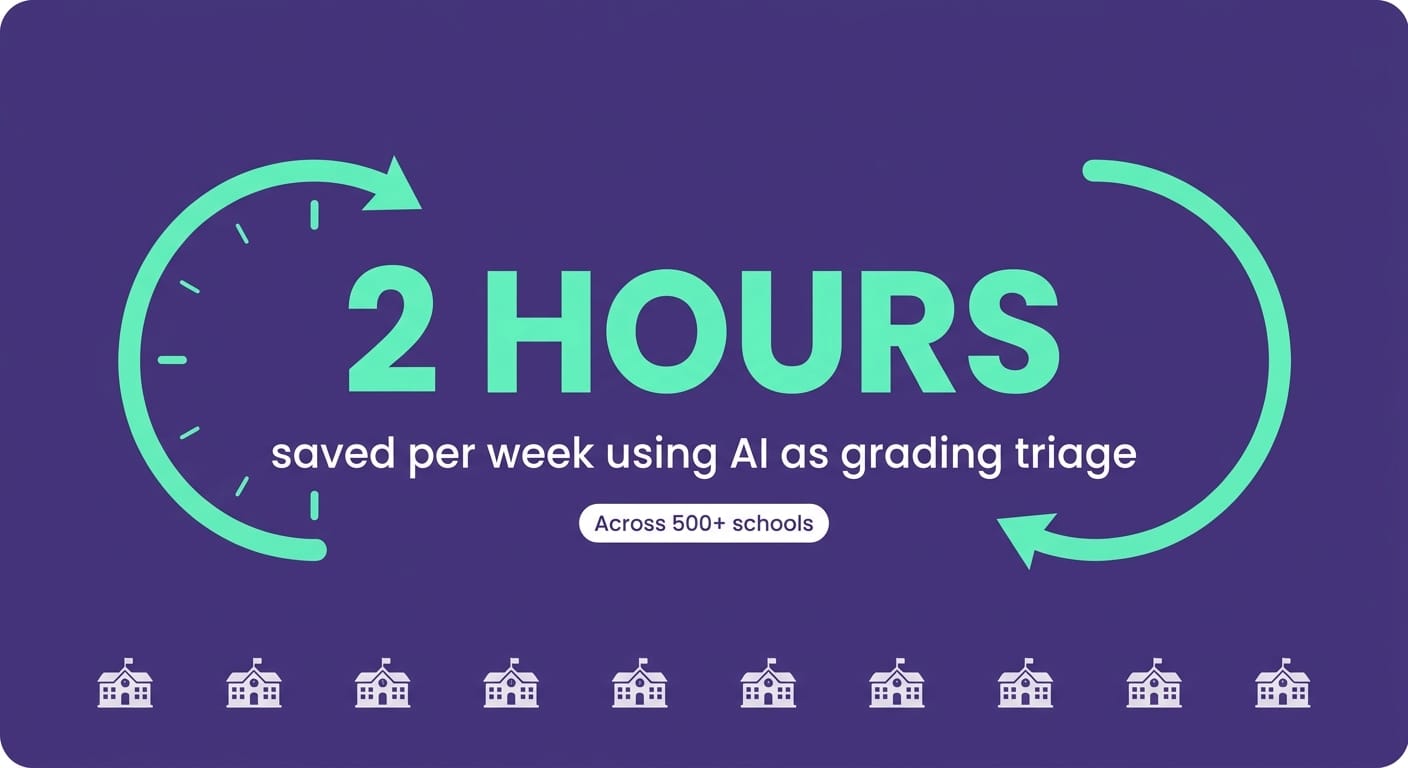
Across the 500+ schools validated in Brazil and LATAM that we work with, the pattern repeats clearly: teachers who use AI as triage save up to 2 hours a week on grading, but keep human feedback on evidence and argumentation. Those who outsource the entire grade to AI end up returning scores that don't hold up on official re-scoring—and lose the student's trust. In 500+ schools, we've learned that this break in trust is hard to recover: when a student gets 90% from the AI and 74% on the official assessment, they stop reading the feedback you worked so hard to give.
The data point that grabs our attention most is another one: fast turnaround changes student behavior. Among the 100,000+ active students who've gone through our methodology, 90% improve their engagement (internal Gamefik research, 2024) when they receive quick, personalized feedback—exactly what the hybrid workflow enables, since you return the graded essay in days, not weeks. AI frees up the time; gamification in education and the smart use of artificial intelligence for teachers turn that recovered time into measurable student engagement strategies. It's not the AI that moves the needle for the student—it's what the teacher does with the two hours it gives back.
Frequently asked questions about AI for essay grading
Is the score an AI gives an essay reliable? Partially. AI scores grammar, mechanics, and conventions with good accuracy, but it tends to inflate or underrate argumentation and use of evidence, which require human judgment. In our test, the same essay scored anywhere from 72% to 92%. Use AI scores as a reference, never a verdict.
What's the best free AI tool for grading student essays? For free use, ChatGPT and Gemini with a structured rubric prompt deliver the most detailed feedback and the closest score to a human grader. Dedicated tools offer polished interfaces but limit features on free plans.
Can AI replace teachers in grading essays? No. AI works as triage that saves time spotting mechanical errors, but the pedagogical judgment behind argumentation and organization still demands a human reader. The hybrid model is what holds the grade up and actually develops the student.
Start with the hybrid workflow, not the machine alone
The right question isn't "which AI grades best," but "how do I use AI to return feedback faster without losing my standards." If you want to build a gamified school where technology frees the teacher for what matters, learn at gamefik.com how we help 500+ schools turn grading time into real engagement—with implementation in under a week.