
AI personalizes learning by adjusting pace, difficulty level, and content format for each student based on performance data recorded during activities. In practice, teachers use tools like Khan Academy, Google Classroom with AI, and gamified platforms to diagnose skill gaps and deliver differentiated pathways within the same classroom — without losing instructional control.
AI personalizes learning by adjusting pace, difficulty level, and content format for each student based on performance data recorded during activities. In practice, teachers use tools like Khan Academy, Google Classroom with AI, and gamified platforms to diagnose skill gaps and deliver differentiated pathways within the same classroom — without losing instructional control.
AI personalizes learning by adjusting pace, difficulty level, and content format for each student based on performance data recorded during activities. In practice, teachers use tools like Khan Academy, Google Classroom with AI, and gamified platforms to diagnose skill gaps and deliver differentiated pathways within the same classroom — without losing instructional control.
You have 32 students and three learning levels in the same room. You always have. The difference is that there's now a layer of technology capable of treating that class as 32 individual classrooms of one student each — if you know how to use it. This guide doesn't promise miracles or ask you to become a software developer. It delivers a five-step framework, validated across 500+ schools in Brazil and LATAM, so you can start today and progress from diagnostic assessment all the way to adaptive testing.
What It Means to Personalize Learning with AI (and Where AI Actually Decides)
Personalization isn't slowing down the same lesson for everyone. It's adjusting three variables for each student: pace, level, and format.
Pace defines how many exercises a student completes before advancing to the next topic. Level defines the difficulty of the next question. Format defines whether content is delivered as video, text, interactive exercise, or game. The question that separates decorative educational theory from a genuinely useful guide is: how does AI decide?
AI decides through rules based on consecutive correct answers and response time. On adaptive platforms like Khan Academy, three consecutive correct answers on medium-level questions trigger advancement to the difficult level; two consecutive wrong answers drop the student back to the previous level and inject a review video before re-presenting the exercise. Format shifts when a student misses the same skill across two different content types — the system reads this as "text didn't work" and tries video or visual manipulation.
That's the mechanism. It's not magic — it's conditional logic applied to performance data. After ten years applying this in classrooms, the lesson I repeat most to teachers is: AI knows what a student got wrong, but only you know why that specific student struggled that day — whether they didn't sleep, are dealing with something at home, or simply don't believe they can succeed. Artificial intelligence for teachers works as a co-pilot — you're the one flying. Where we've seen personalization fail across 500+ schools was precisely when administrators treated the tool as a teacher replacement rather than a co-pilot.
5-Step Framework to Personalize Learning with AI
Each step below comes from a real school that implemented this approach. You don't need to execute all five at once. Do Step 1 this week.
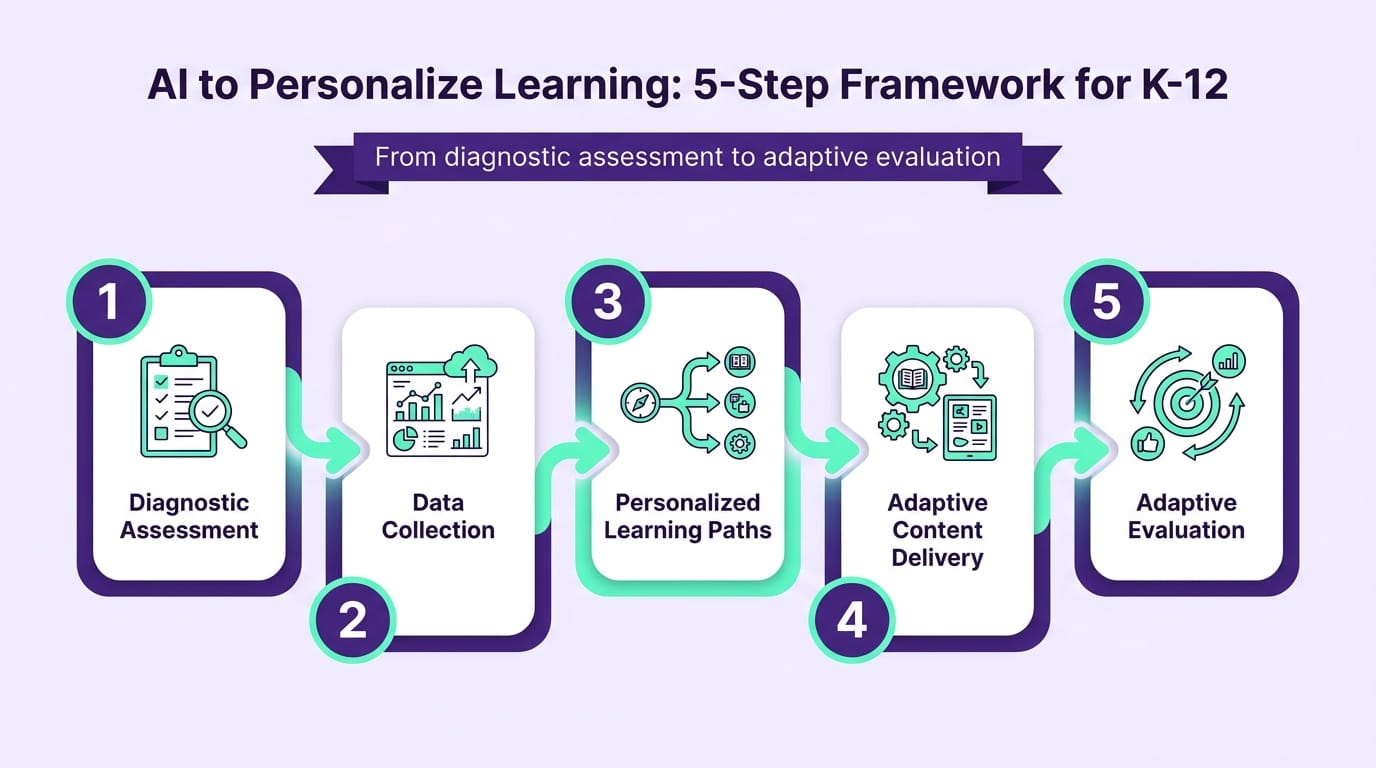
Step 1 — Diagnostic: Discover Learning Levels Before You Teach
Before personalizing, you need to know where each student stands. Run an initial diagnostic using a tool that generates a report by skill standard, not just a final grade.
At a Title I middle school in Houston, TX, a 7th-grade math teacher ran a digital diagnostic in the first week of school and discovered that 11 of her 28 students had not yet mastered fractions — a prerequisite for the unit she was about to begin. Without the diagnostic, she would have taught directly over the gap. With it, she built a parallel leveling group. Setup time: one afternoon to configure the diagnostic. Result measured three weeks later: the correct-answer rate on fraction problems in the leveling group climbed from 34% to 61%.
In practice, we see that most schools skip this step because of pressure to "start the content" — and it's the mistake that costs the most across the entire quarter. An honest warning: a diagnostic only works if you act on it. If the report is going to sit as a PDF in a shared drive, don't spend the afternoon setting it up.
Tools to start: Khan Academy (math), Google Forms with auto-grading, or gamified platforms that already deliver a ready-made skill-gap map.
Step 2 — Tiered Pathways: One Classroom, Three Learning Tracks
With diagnostic data in hand, divide your content into three tracks — foundational, intermediate, and advanced — and let AI move students between them.
A private K-12 network in Seattle, WA applied this approach in 9th-grade ELA using adaptive reading comprehension tracks. Advanced students unlocked argumentative texts while the foundational group consolidated literal reading — all within the same class period. The teacher circulated between all three groups instead of delivering a single middle-ground lesson that served no one particularly well. Over one semester, the class average on reading comprehension items rose from 5.8 to 7.1 (on a 10-point scale), and — the data point that mattered most to the administration — the performance gap between the highest and lowest performing students narrowed significantly, a clear signal that foundational learners had stopped falling further behind.
Three tracks is the number that works. We tested five differentiation levels at a bilingual school and the teacher lost the thread of classroom management — becoming a spreadsheet administrator rather than an educator. Start with three. Only increase granularity once you've mastered the flow.
Step 3 — Adaptive Format: Same Content, Multiple Entry Points
A student who doesn't learn through text may learn through video, game, or hands-on challenge. Let AI suggest the format based on each student's error history.
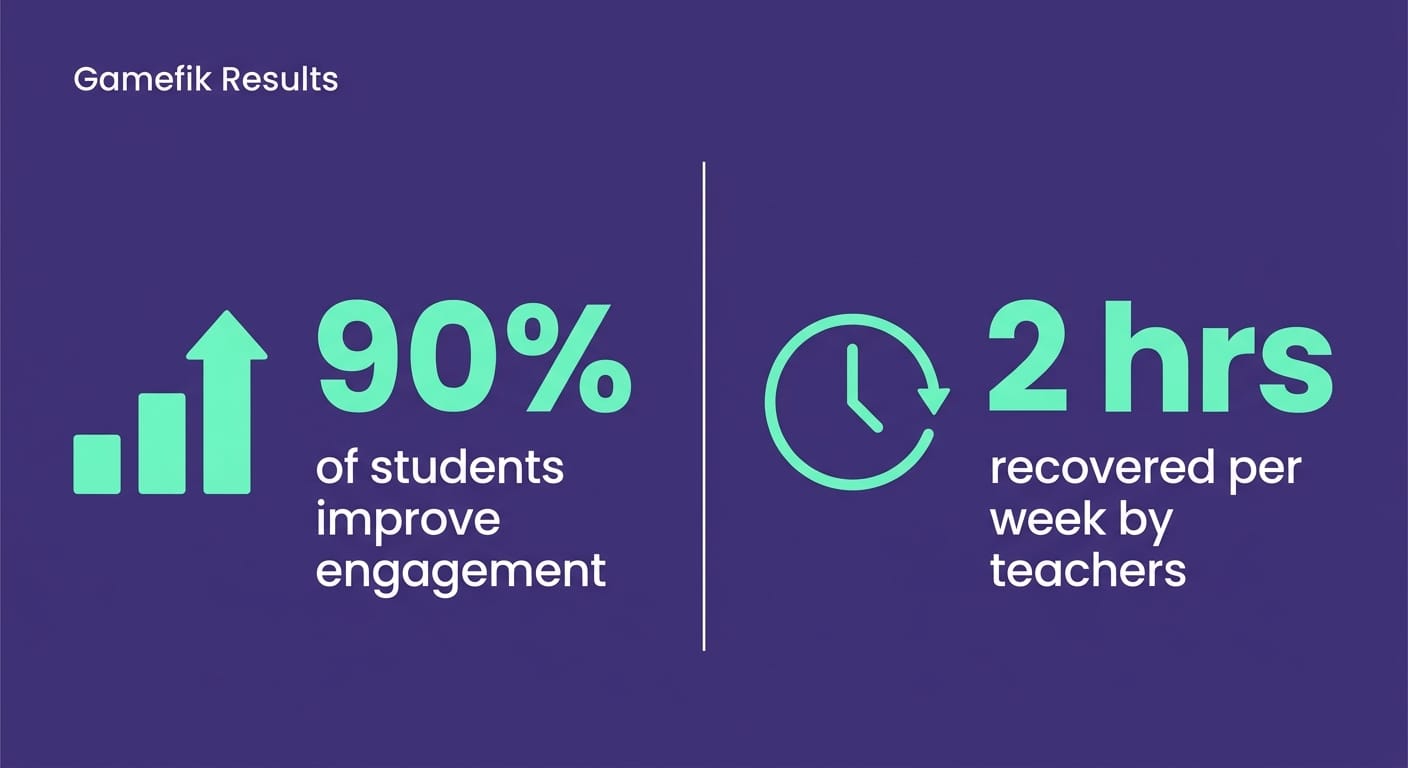
At a public middle school in Atlanta, GA, a science teacher noticed that two-thirds of his class stalled on food chains when the content was delivered as text only. He replaced part of the track with gamified activities featuring visual challenges. Student engagement on the activity — measured by completion rate — jumped from 47% to 82% in the first week with the new format. The content didn't change. The entry point did. This pattern repeats consistently: across 500+ partner schools, the average engagement improvement when switching to the right format is 90% (Gamefik internal research, 2024). If you want to generate these differentiated materials in minutes, see how to use AI to create classroom activities.
Step 4 — Feedback at Scale Without Losing Human Judgment
A teacher's real bottleneck isn't instruction — it's grading and returning meaningful feedback to 150 students every week. This is where AI buys back time.
A high school in suburban Ohio integrated AI-assisted grading into Google Classroom for student essays. The AI handled the first pass — flagging issues with cohesion, paragraph structure, and mechanical errors — and the teacher stepped in only to evaluate content quality and argumentation. Average grading time per essay dropped from 14 to 6 minutes, without outsourcing the final grade to the machine. The teacher recovered approximately two hours per week, time redirected to individual student conferences — exactly the 2 hrs/week average we record across the full Gamefik network. The step-by-step workflow for this is detailed in our guide on AI-assisted essay grading.
Where this doesn't work: grading philosophical arguments, creative writing, or any text where the "error" is intentional. AI handles structural triage — not content judgment. Anyone who lets the machine deliver the final grade on a student essay ends up re-grading the grade — and loses every minute they thought they saved.
Step 5 — Adaptive Assessment: Measure Real Level, Not Test-Day Luck
Traditional tests measure everyone with identical questions. Adaptive assessment adjusts the next question based on whether a student answers correctly or not, reaching the true performance level in fewer items.
A private high school network in New York replaced fixed-format practice tests with adaptive math assessments at the high school level. Students who answered the first set correctly received progressively harder questions; those who struggled received calibration questions. The result: the assessment stopped underestimating strong students and stopped demoralizing struggling ones, and the administration gained a much finer skill map for building the next semester's learning tracks. In Canada, a secondary school network in Ontario reported similar outcomes after piloting adaptive science assessments aligned to provincial standards.
Before adopting any tool of this kind, verify compliance with FERPA and COPPA (for students under 13) in the US: use institutional logins, avoid collecting sensitive data on minors, and require parental or guardian consent where applicable. For schools in Canada, align with PIPEDA and applicable provincial privacy legislation; in the UK, ensure compliance with UK GDPR. This isn't bureaucratic box-ticking — it's what separates a secure implementation from a serious liability. In every school we work with, this is the first item the administration validates before any pilot goes live.
How Gamefik Personalizes Learning Without Replacing the Teacher
Over the past ten years we've refined a method that combines personalization with gamification in education — because personalizing without engaging students produces nothing but an empty learning track that no one completes. That was our most expensive lesson: in the early years we delivered technically perfect tracks that nobody finished.
Today there are 100,000+ active students on the platform. In schools that adopted the co-pilot approach described in this framework, 90% of students improved their engagement — measured by activity completion rate across a full semester, Gamefik internal data, 2024. And the time savings are concrete: teachers report recovering approximately two hours per week previously spent on grading and building exercises, time redirected to individual student support — exactly where AI cannot reach.
Implementation takes less than one week: diagnostic setup, track configuration, and team onboarding. You don't need a technical background — you need the willingness to treat your classroom as the diverse group of learners it actually is. One honest prerequisite: if your school doesn't have sufficient devices or stable internet access, resolve that first. AI-powered personalization depends on reliable connectivity — without it, the framework never leaves the whiteboard. See how a gamified school runs this in practice.
Frequently Asked Questions
How can AI personalize learning? AI analyzes each student's responses to exercises and diagnostic assessments, identifies patterns of errors and correct answers, and adjusts pace, difficulty level, and the format of the next piece of content. Teachers receive a skill-gap map on a dashboard and decide on the pedagogical intervention.
What is the best AI tool for K-12 education? It depends on your objective. Khan Academy leads in adaptive math, Duolingo in language acquisition, Google Classroom with Gemini in grading and feedback, and gamified platforms combine personalization with engagement. The right criterion is which tool addresses the concrete bottleneck in your specific classroom. Compare options in our guide to AI tools for education.
Can AI create more efficient and personalized assessments? Yes. Adaptive assessments measure true performance level in fewer questions, generate versions by difficulty tier, and auto-grade objective questions on the spot — freeing teachers for the qualitative feedback that machines cannot provide.
How do I personalize learning without becoming a developer? Start with Step 1 of the framework: run a simple digital diagnostic this week. Ready-to-use prompts to get started are in our guide on ChatGPT for teachers.
Start Personalizing Your Classroom This Week
You don't need all five steps at once. You need the first one. Schedule a conversation at gamefik.com and see how to assess your class's learning levels, build tiered tracks, and recover your two hours per week — with AI as your co-pilot and you in command.