
The key benefits of gamification in education include higher student engagement, improved content retention, intrinsic motivation, and reduced dropout rates. In Gamefik partner schools, 90% of students show measurable engagement gains — with implementation taking under one week.
The key benefits of gamification in education include higher student engagement, improved content retention, intrinsic motivation, and reduced dropout rates. In Gamefik partner schools, 90% of students show measurable engagement gains — with implementation taking under one week.
You've seen the difference between a class that just shows up and one that wants to arrive early to finish a challenge. Gamification exists to close that gap — not based on opinion, but on outcomes you can track in your district's dashboards. After 10 years applying this in the field, I've learned to be skeptical of any claim without data behind it. That's why I've put together nine benefits below, each grounded in research and in the metrics I track closely across 500+ partner schools validated in Brazil and LATAM, with 100,000 active students.
What Are the 9 Proven Benefits of Gamification in Education?
Each benefit below has a practical effect that school administrators and curriculum coordinators can measure in their indicator dashboards. And I'll be honest: not all of them show up on the same timeline. Some appear within the first grading period; others only emerge over the mid-term.
- Higher student engagement. This is the most consistent result. In Gamefik's 2024 internal research, based on the 100,000 students we track, 90% show improved engagement after adopting game mechanics. This isn't a short-lived enthusiasm spike — it's sustained participation across an entire grading period. In a rural Midwest district, a 7th-grade class that had been submitting fewer than half of all assignments was completing nearly everything within five weeks — without the teacher changing any content, only the progress format.
- Better content retention. Spaced repetition and progress-based rewards help the brain consolidate what has been learned. I covered the science behind this in the article on neuroscience and gamification — worth reading if you want the mechanism explained.
- Intrinsic motivation, not just external rewards. When well-designed, gamification leverages autonomy and a sense of progress — not just points. Students begin to want to advance on their own. In practice, schools that rely solely on point tallies tend to lose the effect within two or three months: the mechanic becomes currency and interest drops off.
- Immediate feedback. Gamification turns feedback into something instant, rather than a test result that arrives weeks later. A student makes an error, understands it right away, and corrects it. A 9th-grade math teacher told me the biggest win wasn't the grade — it was students stopping the habit of carrying the same mistake through three consecutive units.
- Reduced dropout and silent disengagement. Visible goals and clear progress give students a reason to come back. Learning pathways with short milestones cut task abandonment rates in half across many classrooms. One caveat: this only works when the steps are genuinely short. Overly long missions push students away rather than keeping them engaged.
- Peer collaboration. Team challenges and group missions encourage higher-achieving students to support their peers. The classroom becomes a system, not simply a collection of individuals working in isolation.
- Real-time learning data. Every interaction generates actionable information. You can see which students are struggling before the grading period closes — and act. That's the difference between monitoring and reacting too late.
- Personalized pacing. Adaptive learning pathways let each student advance at their own speed without holding back the rest of the class — a critical advantage in mixed-ability K-12 settings.
- Student ownership. By choosing missions and tracking their own progress dashboard, students take responsibility for their own learning journey. This is the benefit teachers notice most in the medium term — typically from the second quarter onward.
If you want to understand the foundational concepts before putting them into practice, a good starting point is our Gamification in Education page, which organizes the core principles clearly.
How to Implement Gamification at Your School Without Losing Focus
The most common mistake I see in schools new to gamification is starting with points. The team builds a leaderboard, hands out digital badges, and within a month the novelty wears off. Start with the pedagogical objective and let the mechanic serve it — not the other way around.
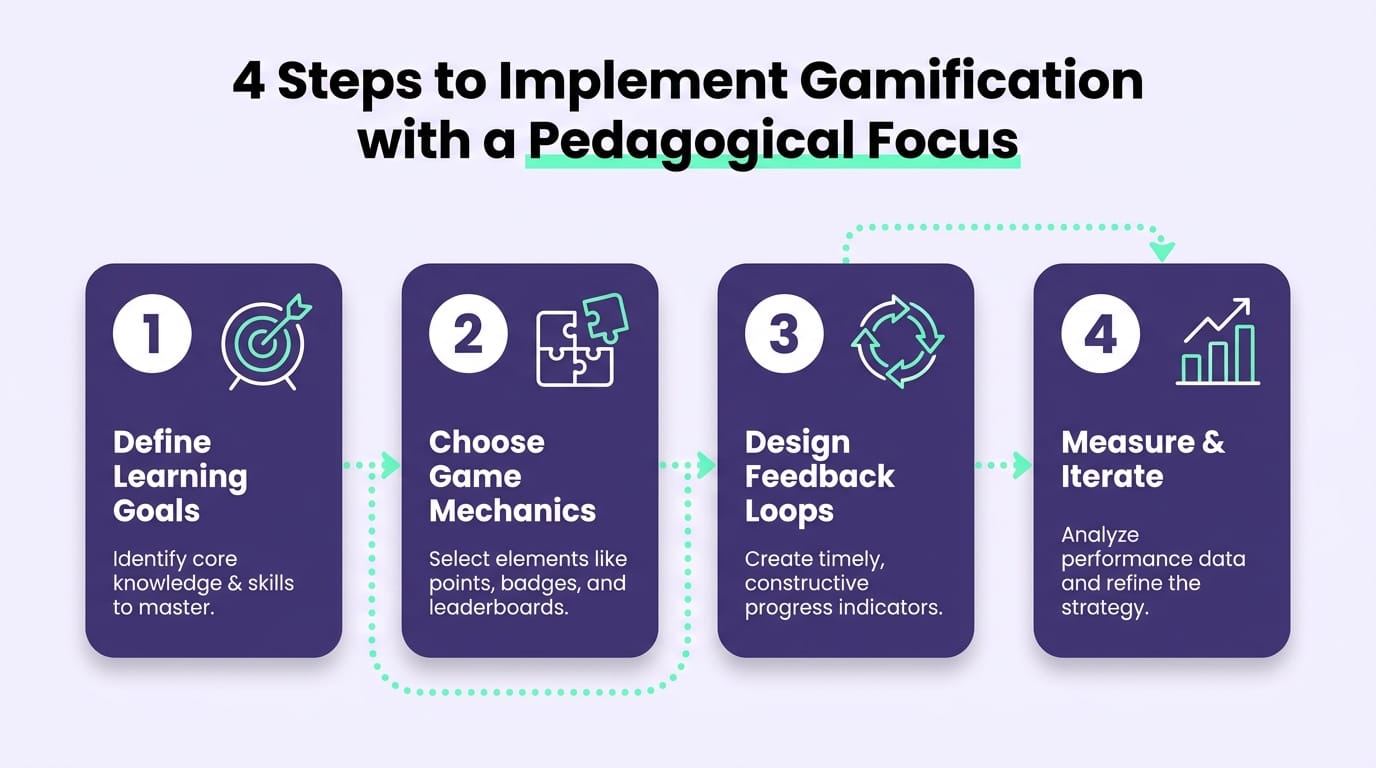
A practical approach, tested across 500+ schools:
- Define the target behavior. Do you want more homework submissions? More active participation in class discussions? Start with one single indicator. Schools — whether districts in the US, multi-academy trusts in the UK, or school boards in Canada — that try to shift five behaviors at once end up measuring none of them effectively.
- Choose the right mechanic for the objective. Not every goal calls for a leaderboard — in fact, leaderboards in classrooms with wide achievement gaps often demotivate the students at the bottom. Some goals call for cooperative missions. The article on types of gamification in education helps you decide which mechanic fits which outcome.
- Make progress visible. Progress bars, learning pathways, student dashboards. What isn't visible doesn't motivate.
- Measure and adjust every grading period. Without measurement, you don't know whether it worked — you only think it did.
To get started as early as next week, we have 12 ready-to-use mechanics in Gamification in the Classroom — all testable without any platform at all. A principal at a bilingual K-8 school in Miami started exactly this way, with pen and paper, before adopting any dedicated tool.
How Gamefik Turns These Benefits Into Measurable Numbers
The difference between gamification that works and gamification that burns out is in the execution. That's why 500+ partner schools opted for a dedicated platform rather than building everything from scratch — designing and maintaining game mechanics manually consumes time that teachers simply don't have.
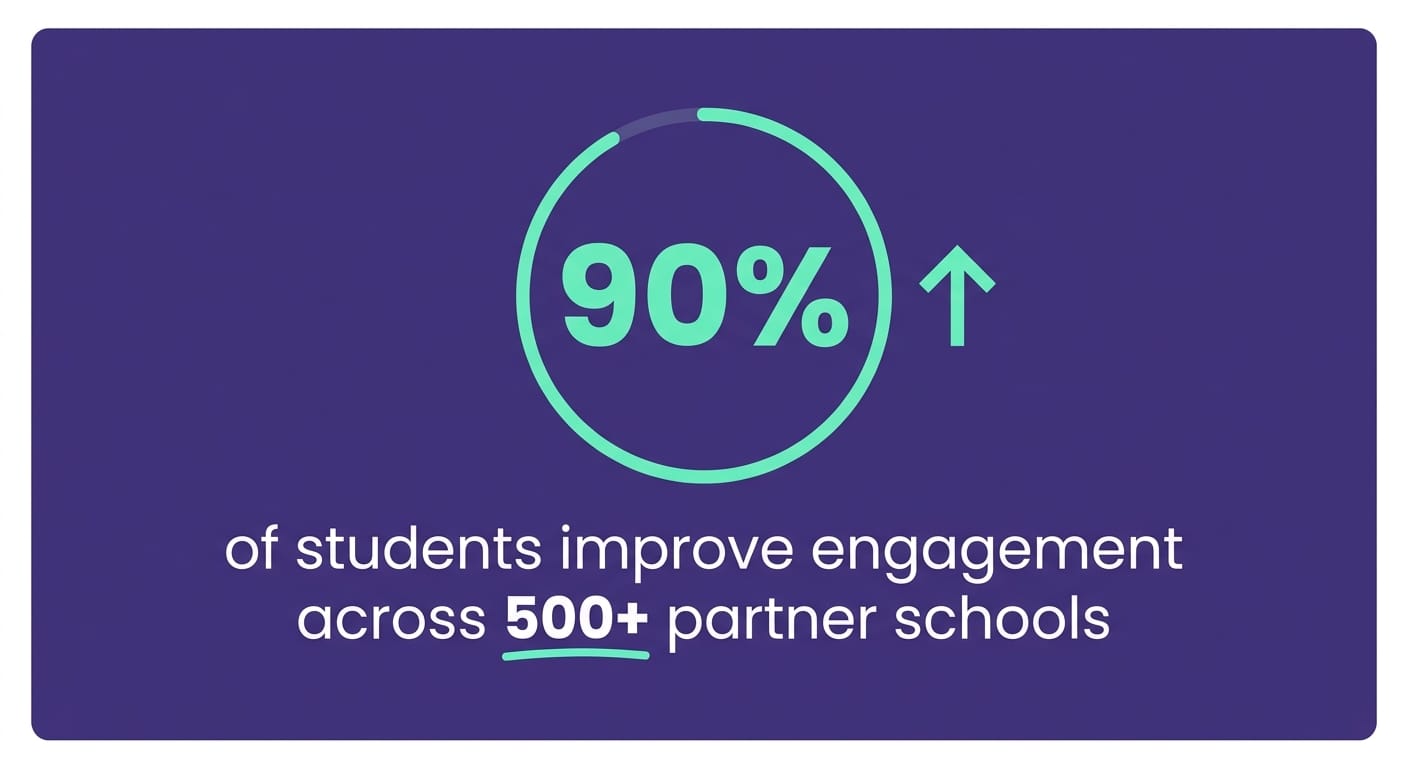
In schools using Gamefik, 90% of students improve their engagement — and that figure comes from the 100,000 students tracked in the 2024 internal research, validated in Brazil and LATAM, not from a single isolated classroom. Implementation takes under one week, with no requirement for teachers to become game designers.
There's also a meaningful benefit on the other side of the desk: teachers report saving an average of 2 hours per week on progress-tracking tasks, because student data is centralized rather than scattered across spreadsheets and grade books. With the support of AI for teachers, grading and feedback stop consuming the time that should go toward lesson planning and differentiated instruction.
To be fair about the limitations: the platform accelerates results, but it doesn't replace pedagogical design. If a school hasn't defined its objective upfront, no tool will save the implementation. What we consistently see in the field — across US districts, UK schools, and Canadian boards — is that results come when school leadership is actively involved, not when the outcome is delegated to "the system."
If your focus is the bottom-line result — more participation, less disengagement — the Student Engagement page shows how this translates into day-to-day practice at a gamified school.
Frequently Asked Questions About the Benefits of Gamification in Education
What are the main benefits of gamification in education? The most documented benefits are increased student engagement, better content retention, intrinsic motivation, immediate feedback, reduced dropout rates, and stronger peer collaboration. In Gamefik partner schools, 90% of students show improved engagement.
Does gamification in education work for all grade levels? Yes. The mechanisms of reward and progress work from early childhood education through high school (K-12), with mechanics scaling in complexity by grade level. Gamefik supports 100,000 students across diverse K-12 age groups.
How long does it take to see results with gamification in schools? Implementation on a platform like Gamefik takes under one week, and signs of greater student participation typically appear within the first grading period, based on data from 500+ partner schools validated in Brazil and LATAM.
Start With the One Indicator That Hurts Most in Your District
Pick one problem — assignment dropout, classroom participation, content retention — and test a single mechanic for one grading period. Don't try to fix everything at once: the grading period is short and your data needs to stay clean to be meaningful. If you want to do this with data support from day one, learn more about Gamefik at gamefik.com and see how 500+ schools have turned these nine benefits into numbers they can report.