Classroom discipline problems occur when student behaviors disrupt the learning process — side conversations, disengagement, confrontations with the teacher. In most cases, the root cause isn't a lack of rules but a lack of engagement: lessons with no active participation, absence of feedback, and a disconnect between content and students' reality. Strategies like gamification, class agreements, and continuous feedback have been shown to reduce disruptive behavior by up to 60%.
Classroom discipline problems happen when student behaviors interrupt the learning process — and in most cases, the cause isn't a lack of boundaries but a lack of engagement. Lessons with no active participation, absence of feedback, and a disconnect between content and students' lived experience are the most frequent triggers. Strategies like gamification, collaborative class agreements, and continuous feedback demonstrate significant reductions in disruptive behavior.
You walk into the classroom, pull up your lesson, start explaining — and within five minutes half the class has mentally checked out. Side conversations, phones hidden under desks, one student provoking another, someone else flat-out refusing to participate. Sound familiar?
Classroom discipline is, by a wide margin, the most common complaint in teacher lounges across the United States. But the problem isn't where most solutions point. Detentions, write-ups, suspensions — all of these treat the symptom. What's underneath is more complex and, paradoxically, simpler to solve once you understand the real mechanics.
Over the past 10 years, working with Gamefik in 500+ schools — validated across Brazil and Latin America, from bilingual private academies in major cities to under-resourced public schools in rural districts — I've seen a pattern that repeats itself without exception: schools that try to solve discipline with more punishment get worse; schools that redesign the classroom experience get better. This article digs into the concrete causes and delivers strategies that work in practice, backed by data from a team that watches this transformation happen up close, every single day. And the principles translate directly to the challenges facing American, Canadian, and British classrooms — because disengagement doesn't carry a passport.
Why classroom discipline problems have reached crisis levels in schools
It's not your imagination. The problem has gotten worse. Data from the OECD's Teaching and Learning International Survey (TALIS) consistently shows that U.S. teachers report spending a disproportionate amount of instructional time managing behavior rather than teaching. The National Center for Education Statistics (NCES) paints a similar picture: surveys of public school teachers regularly rank student discipline among their top concerns. On average, research suggests that roughly 20% of class time is consumed managing behavior — not teaching. In concrete numbers: in a 50-minute period, that's 10 minutes lost. Multiply that across six periods a day, 180 school days, and you're looking at over 180 hours per year that a teacher spends asking for quiet instead of teaching.
This escalation has structural roots. The dominant lesson model — teacher talks, students listen — was designed for an era when access to information was scarce. Today, any middle schooler with a smartphone has access to more content than an entire school library. When the lesson doesn't offer something the phone can't provide (real interaction, cognitive challenge, belonging to a group), the student disconnects. And a disconnected student becomes a "disruptive" student.
I see this with clarity when visiting schools. An assistant principal at a Title I school in Texas described the situation to me this way: "We've got 32 kids in the room, 28 phones, and zero activities that use those phones for anything. Then we ban phones and act surprised when it doesn't work." She was right. The ban alone is a declaration of defeat — you're admitting the phone is more interesting than your lesson and that your only response is to confiscate it.
There's also a generational factor that can't be ignored. Students born after 2008 — Gen Alpha, entering middle and high school now — grew up with rapid stimulation, instant feedback, and interactive environments. It's not that they can't focus — watch a teenager play an online game for three hours straight and that theory collapses. They can't focus on formats that ignore how their brains process information. Classroom discipline problems are, in many cases, the body reacting to boredom in ways the student can't even articulate.
The result is a destructive cycle: exhausted teacher spends energy on behavior management → less energy left for planning engaging lessons → less engaging lessons generate more disruption → more exhaustion. Without an intervention in the model itself, the cycle feeds itself. In data we collected at Gamefik throughout 2024, teachers report spending an average of 2 extra hours per week just on discipline documentation and follow-up conversations — time that, after platform implementation, gets recovered and redirected to actual instructional planning.
What classroom discipline problems actually are — and what they're not
We need to separate concepts that get constantly conflated. Classroom discipline problems are not synonymous with violence, nor with conduct disorders, nor with "bad upbringing." In pedagogical terms, a discipline problem is any behavior that interrupts the flow of learning — for the individual student or for the group.
This includes a wide spectrum: from constant side conversations to explicit refusal to participate in an activity, including phone use, chronic tardiness, disregard for agreed-upon norms, and provocations between peers. The intensity varies, but the underlying mechanism is the same: the student is not connected to what's happening in the lesson.
In practice, what we see across Gamefik's partner schools is that the overwhelming majority of cases cluster in the "low-intensity" range: side conversations, zoning out, phone use, inattention. A 9th-grade math teacher in a suburban Chicago district told me something that stuck: "Out of my 34 students, only two are genuinely difficult. But when I lose control with those two, the other 32 take the opening." This is textbook — a few students create the trigger, but the environment allows the behavior to spread.
It's critical to differentiate this from clinical issues. A student with ADHD who can't sit still for 50 minutes isn't being "disruptive" — they need instructional accommodations, likely outlined in an IEP or 504 plan. A student who physically assaults peers or teachers is in a territory that demands specialized intervention — behavioral support teams, possibly a Functional Behavioral Assessment — not just classroom management. Treating everything as "discipline" dilutes the problem and blocks appropriate solutions. At Gamefik, we actually coach schools not to use the points system for clinical cases — gamification is not a therapeutic tool, and pretending it is would be irresponsible.
What most classroom discipline cases have in common is a mismatch between what the lesson demands from the student (passivity, silence, sustained attention) and what it offers in return (little feedback, little choice, little perceived relevance). When that equation falls out of balance, disruptive behavior appears as a response — not as a root cause. As we discuss in our article on student engagement strategies, what looks like disinterest is often a rational response to an environment that gives students no compelling reason to engage.
The real causes hiding behind the "problem student" label
When a student gets labeled "disruptive," the focus goes to them — their behavior, their family, their "lack of motivation." But up to 70% of classroom discipline incidents are linked to factors the teacher can directly influence. Not to blame the teacher — quite the opposite. To give teachers back the agency that the "problem student" label takes away.
I say this with conviction because we've observed the reverse effect in hundreds of schools: when the teacher changes the lesson design, the same "problem" student changes their behavior. Not always, not with everyone, but frequently enough to invalidate the label as the sole explanation.
Cause 1: Lessons with low rates of active participation. John Hattie's landmark meta-analysis (Visible Learning, 2009) shows that the time a student is cognitively active — thinking, responding, producing — is what most impacts learning. When a lesson is 80% lecture and 20% activity, the student spends most of the time with nothing to do with their mind. That unoccupied mind seeks stimulation elsewhere: in a peer, in a phone, in a provocation. In a partner school we worked with in the Dallas–Fort Worth area, simply inverting that ratio — 40% direct instruction, 60% active learning — reduced office discipline referrals by over 40% in the first quarter. There was no change to rules. Only to format.
Cause 2: Absence of real-time feedback. In any game, the player knows at every moment whether they're progressing or not. In school, a student takes a test and finds out weeks later whether they learned anything. Without frequent feedback, there's no sense of progress. Without a sense of progress, there's no motivation. Without motivation, disruptive behavior fills the vacuum. In my experience, this feedback gap is the single most underestimated cause of classroom discipline problems — and the simplest to fix with the right tools.
Cause 3: Lack of belonging. Students who don't feel like part of the group — whether due to social exclusion, cultural disconnect, or not seeing themselves reflected in the content — are significantly more likely to exhibit disruptive behaviors. Belonging isn't abstract: it means knowing your voice matters in class, that the teacher knows your name and something about you, that there's a role for you in that space. A principal at a public middle school in Atlanta shared that after implementing a system where each student had a rotating "role" in class (timekeeper, note-taker, discussion leader), conflicts between students dropped by half. When a student has a function, they belong.
Cause 4: Rules imposed without perceived purpose. "No phones," "no talking," "stay in your seat." When rules are a list of prohibitions with no clear rationale, students see compliance as submission, not as an agreement. Adolescents in particular resist rules they don't understand — and that resistance is actually healthy from a developmental standpoint, even if difficult to manage. Kohlberg's research on moral development showed this back in the 1970s: adolescents are at the stage where they question rules that lack internal logic. Treating them like small children who should obey without question ignores where they are cognitively. This applies equally whether you're teaching in Houston, Toronto, or London — adolescent development doesn't vary by school district.
None of these causes can be fixed with more detentions. All of them can be fixed with lesson design. And that's exactly where the good news lives.
How to turn classroom discipline around in practice: 5 strategies that work
Here's what works — tested in real classrooms, not in a lab. Every strategy can be implemented with no extra budget and without waiting for a district-level decision. You can start tomorrow. I say this because I've watched teachers apply on Monday what they learned on Saturday and come back Tuesday to a different room.
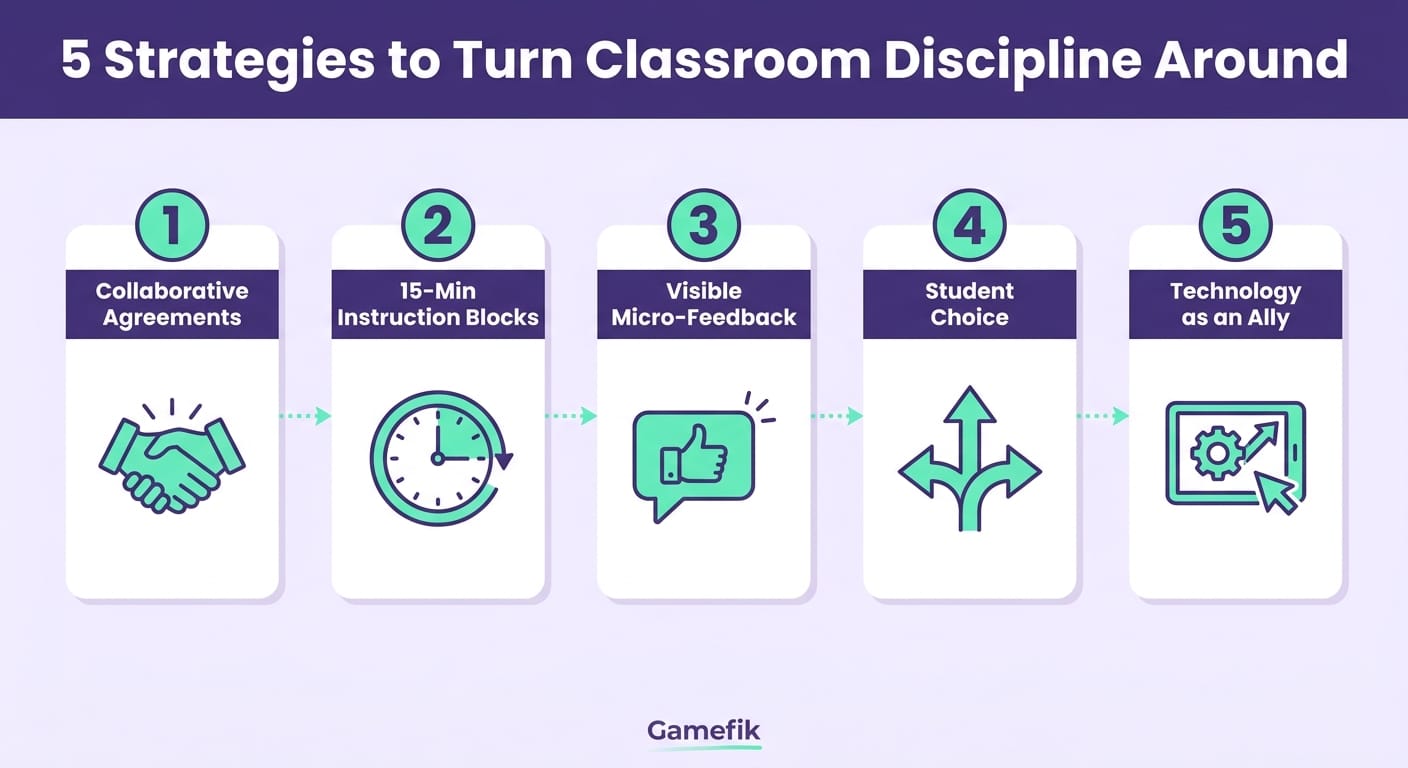
Strategy 1: Build agreements, not rules. In the first class (or during a mid-semester "reset"), facilitate a collaborative construction of class agreements. The difference is operational: rules are imposed top-down; agreements are negotiated. Ask the class: "What do we need so everyone can learn well in here?" Record it on the board. Include your own commitments too ("I commit to returning graded work within one week"). When a student helps create the expectation, they become co-responsible — and breaking the agreement becomes a group issue, not an authority issue. A 7th-grade social studies teacher in Ohio who uses Gamefik logs the class agreements as "community missions" within the platform — and reported that students started holding each other accountable, rather than relying on her. The weight shifted off the teacher's shoulders.
Strategy 2: Cap direct instruction at 15 continuous minutes maximum. Research on sustained attention (Bunce et al., 2010, published in the Journal of Chemical Education) shows that even college-aged adults experience significant attention drops after 10–18 minutes of passive listening. For middle and high schoolers, the threshold is lower. Break the lesson into blocks: 10 minutes of instruction → 5 minutes of partner activity → another 10 minutes of instruction → group discussion. The alternation between modes keeps the brain active and drastically shrinks the window of opportunity for disruptive behavior. A practical data point: in partner schools that adopted this block structure, teachers report that the number of disruptions per class drops from 8–12 to 2–3. It's not zero, but it's manageable.
Strategy 3: Implement visible micro-feedback. Instead of waiting for the unit test to signal progress, create feedback systems within the lesson. It can be something as simple as a group progress tracker on the board, points for participation in discussions, or an "achievement" system for specific behaviors. When a student sees their progress in real time, intrinsic motivation increases — and this is exactly the principle behind gamification in education. Making progress visible changes behavior more than any punishment ever will. In practice, what we see across 500+ schools is that the student who used to get three referrals per week starts pursuing three achievements per class. The behavior is the same — seeking recognition — just channeled into something productive.
Strategy 4: Give the student at least one genuine choice per lesson. Choosing which problem set to tackle, which format to use for an assignment, who to work with in a group — any real choice activates a sense of autonomy. Self-Determination Theory (Deci & Ryan, 2000) demonstrates that autonomy is one of the three pillars of intrinsic motivation, alongside competence and relatedness. Students who feel some control over the process resist the lesson less. An important caveat: the choice needs to be real. "Do you want to do worksheet A or... worksheet A?" isn't a choice. "You can present this topic as a written response, a short video, or a podcast" — that's a choice. The difference seems obvious, but I see teachers get this wrong frequently.
Strategy 5: Use technology as an ally, not an enemy. Banning phones is swimming against the current — and usually against a current that's going to pull you under. Integrating phones as tools — live quizzes, quick polls, student engagement platforms — transforms the "villain" into a pedagogical resource. Tools powered by artificial intelligence for teachers can help personalize activities for different levels, reducing the frustration that leads advanced students (or struggling ones) to disengage. An honest point here: this strategy works best when there's minimum infrastructure (Wi-Fi that actually works, for example). In schools without reliable connectivity — and there are plenty in rural districts across the U.S., Canada, and the UK — focus on strategies 1 through 4, which work with zero technology.
These strategies don't require you to change your personality or abandon your curriculum. They require redesigning the format — and format is what impacts behavior the most. Ten years of watching this play out across hundreds of schools has left me with zero doubt about that.
How Gamefik transforms behavior management into an engagement system
Applying the five strategies in isolation works. But maintaining consistency across the entire semester, with five or six different classes, 150+ students, and everything else a teacher has to juggle? That requires a system. I know this because I've watched brilliant teachers apply all of the above for three weeks, burn out, and revert to default mode. Not for lack of willpower — for lack of a structure that sustains the effort.
Gamefik was born from exactly that pain. After more than 10 years developing gamification methodology applied to education in real-world contexts — not in a doctoral thesis, but in classrooms with 35 students, a broken projector, and spotty Wi-Fi — the platform automates what would be humanly impossible: giving continuous individualized feedback, making progress visible for every student, and creating an environment where positive behavior is recognized — not just negative behavior punished.
In practice, it works like this: the teacher defines the behaviors and goals that matter for their class. The platform creates a system of points, achievements, and challenges that students track in real time. When a student contributes to a discussion, follows through on a class agreement, or helps a peer, it's recognized immediately — not two weeks later at a faculty meeting. This rapid feedback loop is what's missing in most classrooms and what digital games execute with mastery.
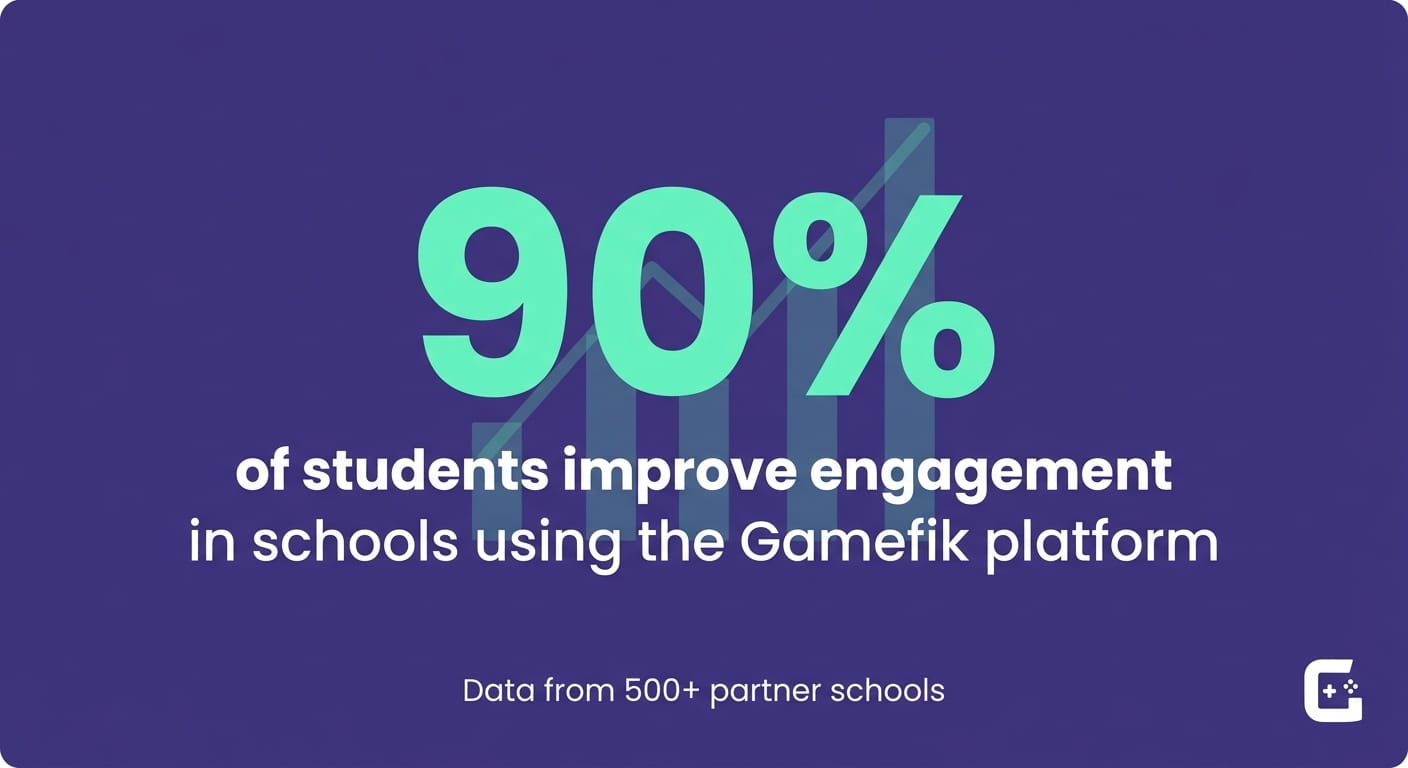
The numbers back the impact. Across 500+ partner schools validated in Brazil and Latin America, with over 100,000 students reached, Gamefik's 2024 internal data shows that 90% of students improve engagement after implementation. Schools report that time spent on discipline management drops significantly, freeing an average of 2 hours per week that teachers can redirect to planning and actual instruction. An instructional coach at a school network in the American South summarized the effect: "Before, our team meetings were 90% about behavior. Now they're 70% about learning. That's what I call real progress."
Implementation takes about a week on average — no extensive training or infrastructure overhaul required. The concept of a gamified school isn't about turning the lesson into a game. It's about using the mechanisms that make games engaging (visible progress, immediate feedback, achievements, collaboration) to solve real problems like classroom discipline.
A point worth highlighting: the platform doesn't replace the teacher-student relationship. It amplifies it. When the system identifies that a specific student is disengaging (drop in participation, absence of achievements), the teacher receives that information in real time — and can intervene before disruptive behavior surfaces. That's preventive management, not reactive. And that difference — acting before the problem, not after — is what separates schools that control discipline problems from schools that prevent them.
I need to be honest about one thing: Gamefik isn't a magic wand. Schools with severe infrastructure gaps, teacher turnover above 30% per year, or zero administrative support will need to address those issues first. The platform amplifies what already exists — it doesn't create from scratch what was never there.
The role of school leadership in reducing discipline problems
It would be unfair to put all of this on the teacher's shoulders. Classroom discipline problems are a systemic issue that demands a systemic response. School leadership — principals, assistant principals, instructional coaches, district coordinators — plays a decisive role on three fronts. And when leadership doesn't step up, even the best teacher in the world hits a ceiling.
First front: concrete support for teachers. This doesn't mean "calling the dean when a student acts out." It means ensuring ongoing professional development in active learning methodologies, protecting planning time, and providing tools that make classroom management easier. A teacher who plans in 30 minutes what used to take 2 hours has more energy to design engaging lessons. Tools like Gamefik help here by automating behavioral tracking and freeing teachers to do what they do best: teach. A charter school in Tennessee implemented the policy that no teacher could have more than three meetings per week that weren't dedicated to instructional planning. Result: lesson quality went up and discipline referrals went down. Not a coincidence.
Second front: a school culture built on recognition. Schools where the only consequence system is punitive (warning → detention → suspension → expulsion) create an environment where students are only "seen" when they mess up. Flipping this logic — publicly recognizing positive behaviors, creating merit systems by class or grade level, celebrating progress — changes the culture. When 80% of institutional energy goes toward recognition and 20% toward correction (rather than the reverse), discipline improves because students find positive pathways to be noticed. Across the 500+ schools we work with, the ones that most reduced discipline problems are exactly the ones that implemented systematic recognition — not the ones that doubled down on punishments. This pattern is so consistent that for me it's no longer a hypothesis: it's an operational fact.
Third front: communicating with families about progress, not just problems. When the school only contacts a family to complain, it creates a negative association that erodes the school-family relationship and, by extension, the student-school relationship. Platforms like Gamefik allow families to track their child's progress in real time — achievements, participation, growth. This transparency changes the conversation at home from "What did you do wrong at school today?" to "I saw you earned a new achievement today." A parent of a student at a partner school sent us a message I've kept: "For the first time in three years, my kid came home wanting to tell me something good that happened at school." When the information flow between school and home is positive, the student feels that both environments are aligned in their favor — and that reduces the resistance that fuels discipline problems.
FAQ — Frequently asked questions about classroom discipline problems
What are the main causes of discipline problems in the classroom?
The most common causes include disengagement with content, passive teaching methods (lecture-only instruction), weak teacher-student relationships, emotional or family challenges, and the absence of clear expectations and consequences. Research shows that up to 70% of discipline incidents are linked to a disconnect between the student and what the lesson offers — meaning the solution starts with redesigning the learning experience.
How do you handle disruptive students without being authoritarian?
The most effective approach combines three elements: establishing class agreements collaboratively (not imposing rules top-down), giving students agency within the lesson (choices, challenges, roles), and maintaining frequent feedback on behavior and progress. Tools for gamification in education help because they make expectations visible and turn meeting agreements into part of the classroom dynamic, not forced obedience.
Does gamification actually help reduce classroom discipline problems?
Yes, with data to back it up. When students have clear goals, immediate feedback, and a sense of progress, disruptive behavior decreases because attention is redirected to the activity. Gamefik's data from 500+ partner schools shows that 90% of students improve engagement — and schools report significant drops in discipline referrals after implementing gamified systems. The mechanism is straightforward: an engaged student doesn't need to seek stimulation through disruptive behavior.
What should you do when discipline problems are class-wide?
Class-wide disruption signals a systemic issue, not an individual one. Review the lesson structure: how long are students passive? Is there space for genuine participation? Are expectations clear? Start with a reset — a new class agreement built with students — and introduce at least one active-participation activity per lesson. If the problem persists across all of one teacher's classes, instructional coaching support from administration is essential.
Are discipline problems caused by bad parenting?
That's an oversimplification that doesn't solve the problem. While family context matters, school is its own environment with its own dynamics, and teachers can create conditions that either reduce or amplify disruptive behaviors. Students facing difficulties at home respond better to school environments with clear structure, strong relationships, and activities that build belonging — not punishments that reinforce the exclusion they already experience outside school.
The next step is yours
Classroom discipline problems aren't going to disappear with more rigidity. They'll decrease with more design — of lessons, of feedback, of recognition, of belonging. You already have the pedagogical knowledge. What's often missing is a system that makes all of it sustainable in the daily reality of 150 students and six class periods.
The question worth more than any detention slip: "What in this lesson is competing with my students' attention — and losing?"
When you answer that honestly and act on the answer, discipline stops being a behavior problem and becomes a design problem. And design problems have solutions.
If you want a system that automates feedback, makes progress visible, and transforms your classroom culture in a week, check out Gamefik at gamefik.com. Over 500 schools and 100,000 students have already made this shift. Yours could be next.