
Classroom gamification is the use of game elements—points, missions, levels, and immediate feedback—in real instructional activities to increase engagement and assignment completion rates. No technology required: it starts with a whiteboard and one clear scoring rule. The 12 mechanics in this guide have been tested in 500+ partner schools across Brazil and LATAM and are ready to implement in your classroom this week.
You've probably read listicles about gamification mechanics before. The problem is that almost all of them stop at theory—they talk about "points" and "levels" without telling you which grade saw improvement, which class pushed back, or how long it took to see results. This guide does the opposite: every mechanic comes with a real-world application context, and there's an entire section on when it doesn't work—because a skeptical principal or department head has every right to be doubtful.
After 10+ years applying gamification in 500+ schools across Brazil and LATAM, one lesson keeps proving itself: what's missing on the classroom floor isn't enthusiasm—it's translation. Teachers want to know "what do I do Monday morning," not a textbook definition of Bartle's player types.
What Is Classroom Gamification (and What It Isn't)
Gamification means bringing the logic of games into learning: clear goals, visible progress, rapid feedback, and rewards for effort. It is not playing video games in class, and it is not the same as an educational game.
The distinction trips up a lot of people. An educational game is a self-contained activity—a fractions board game, a spelling app—with a beginning, middle, and end. Gamification is a layer you place on top of your existing lesson: the instruction stays the same, but students now earn XP for participating, level up as they master content, and see their progress posted on the wall.
In practice, this confusion is costly: administrators buy a library of game titles thinking they've bought gamification, then can't figure out why engagement doesn't stick. A game is an event. Gamification is a routine.
The 4 pillars of gamification support everything:
- Mechanics — the rules: points, levels, challenges, achievements.
- Dynamics — the behavior the rules generate: persistence, collaboration, the drive to try again.
- Aesthetics — the emotional experience: class becomes something students look forward to, not something they endure.
- Motivation — the why: without a reason that makes sense to the student, the points table is just another spreadsheet.
When all four are aligned, gamification becomes a genuine gamification in education strategy—students shift from passive receivers to active agents working toward progress.
The 12 Ready-to-Use Mechanics, Organized by Effort Level
I've divided the 12 mechanics by effort level so you don't try to do everything at once—the single biggest mistake we see derail school implementations.
Start tomorrow (low effort):
- Simple XP System — every participation, submitted assignment, or peer-help moment earns points tracked on the whiteboard. Works with paper and marker alone.
- Error Hunter — present a worked example with a planted mistake; whoever finds it earns points. In English Language Arts, use sentences with subject-verb agreement errors.
- Achievements (Badges) — stickers for milestones: "Read 3 books," "Aced every equation." Basic stickers work perfectly.
- Immediate Feedback — update the scoreboard every class, without waiting for the test. This single pillar supports the other three more than any other mechanic.
Medium term (1–3 weeks):
- Progression Levels — students move from "Apprentice" to "Master" as they demonstrate content mastery aligned to grade-level standards.
- Weekly Missions — one clear goal per week, individual or in pairs.
- Teams (Guilds) — the class is divided into teams that pool points together. Reduces the exclusion that individual leaderboards create.
- Reward Store — points convert into real benefits: choosing their seat, 5 minutes of music, dropping the hardest question from a quiz.
Quarter-long project (high effort):
- Continuous Narrative — a storyline connecting all lessons. In Science, the class becomes an "expedition" that must "save" an ecosystem by solving challenges.
- Branching Quests — students choose their path: go deeper or move ahead, with real consequences for each choice.
- Review Boss — before a test, a collective "boss battle": the class must answer X questions correctly together to "defeat" it.
- Class Economy — a classroom currency with earning and spending across the quarter, teaching financial management alongside the content.
The golden rule: choose one low-effort mechanic and run it for two weeks before adding a second. Across 500+ partner schools, the teachers who attempted all 12 at once quit within 10 days. Teachers who started with a single mechanic consistently made it to the end of the unit.
Which Subject Benefits Most from Gamification (With Real Case Studies)
The right question isn't "does it work?"—it's "where have we seen it work, and with what numbers?" Two case studies from Gamefik's partner school network:
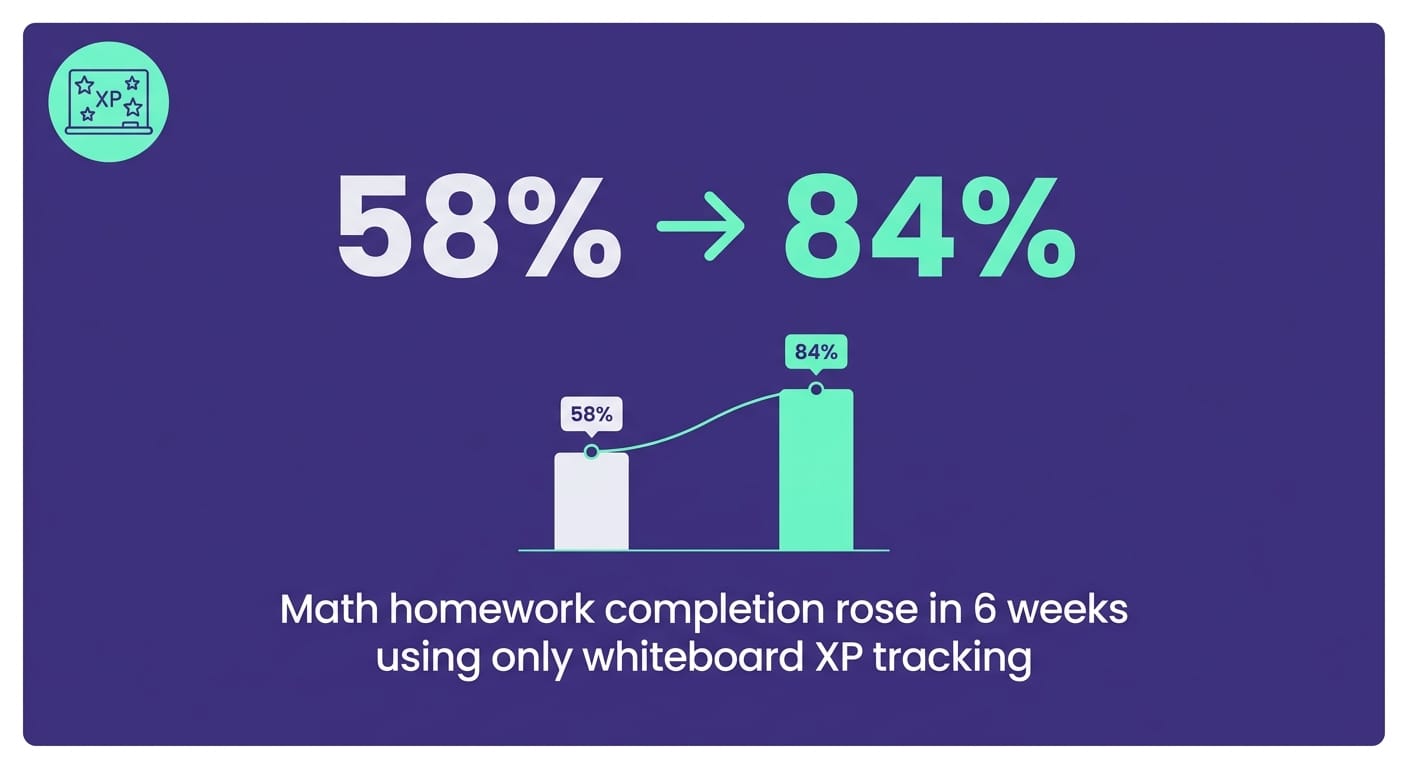
Math — 7th-grade partner school (2023). A 7th-grade teacher applied the analog XP system (Mechanic 1) combined with the Review Boss (Mechanic 11), targeting a single metric: homework completion. Before the pilot, 58% of the class submitted assignments on time. Over six weeks—with 31 students tracked—completion rose to 84%. Total cost: stickers and a poster. Zero technology.
English Language Arts — partner school network (2024). Three 9th-grade classes used Error Hunter (Mechanic 2) in pairs, twice a week, focused on subject-verb agreement. The school measured performance on revision exercises before and after: the class average rose from 6.1 to 7.8 in four weeks. The friction point was pair-versus-pair competition—I'll return to that in the mistakes section.
In Science, the highest-yield mechanic is the Continuous Narrative (Mechanic 9), because the content already has a natural storyline: ecosystems, the human body, evolution. Framing the class as an "expedition" turns review sessions into investigations. We saw this pay off especially well in a dual-language partner school where the narrative ran in both English and Spanish, doubling as language practice at no extra planning cost.
For subject selection, the guiding principle is: content-heavy practice subjects (Math, grammar) respond best to XP and immediate feedback; narrative-driven subjects (Science, History/Social Studies) respond to quests and storylines. That said, it's not an iron rule—a History teacher at a rural partner school found XP and badges outperformed narrative for her students, because they responded more to a visible scoreboard than to a story. Context always wins.
How to Apply Gamification with Zero Technology: 7-Day Checklist
You don't need Kahoot, Quizizz, or any platform to start. You need a poster and consistency. This is the path with the highest continuation rate among the teachers we support.
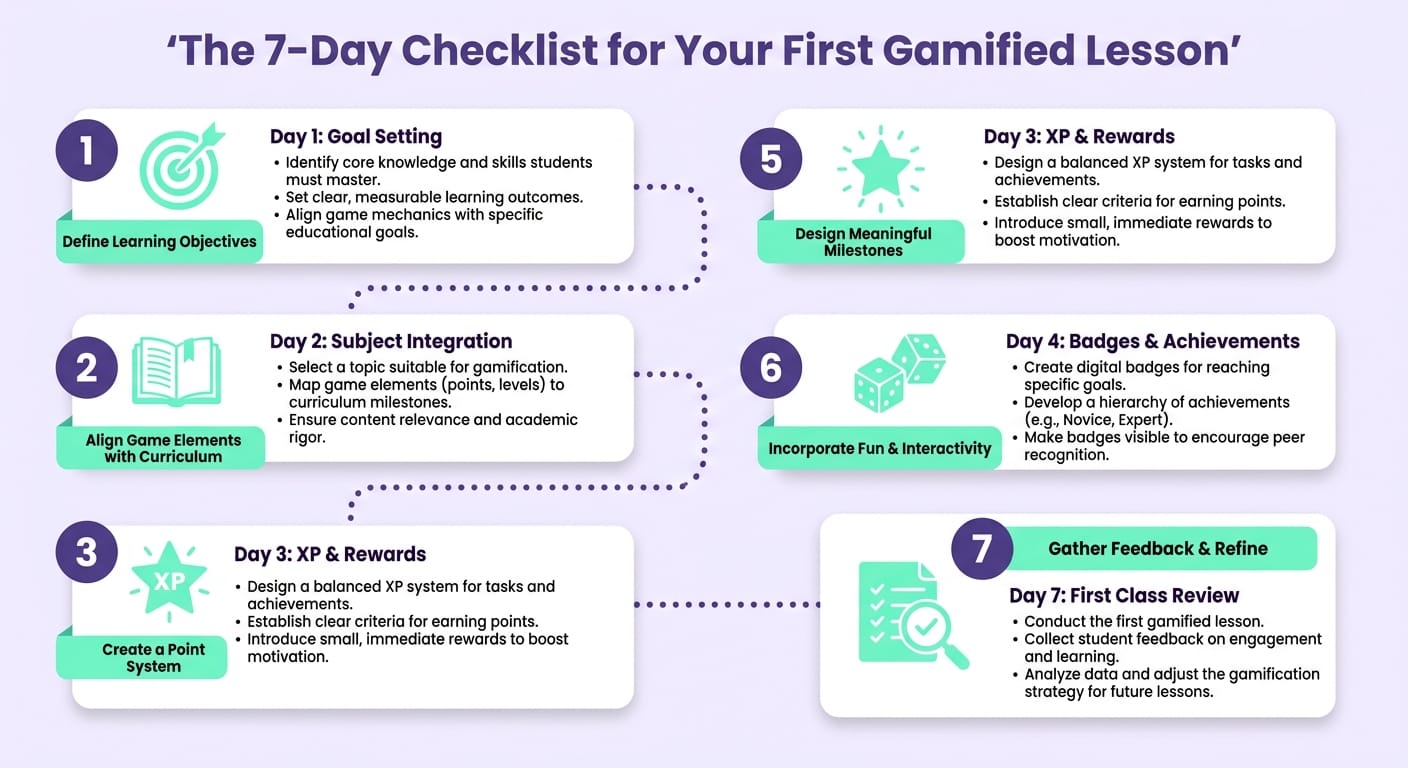
- Day 1 — Choose ONE class and ONE goal. Assignment completion? Participation rates? Define the number you want to move.
- Day 2 — Create the scoring rule. Simple enough for a student to understand in 30 seconds. Example: homework submitted = 10 XP, helping a classmate = 5 XP.
- Day 3 — Make the scoreboard visible. A poster on the wall, a projected spreadsheet—anything students see every day.
- Day 4 — Introduce it to the class. Explain the "rules of the game" and the first achievable reward. The aesthetic layer starts here.
- Day 5 — First round. Apply the low-effort mechanic. Give feedback on the spot.
- Day 6 — Adjust. What wasn't clear? Did any student get left out? Fix it now.
- Day 7 — Record your baseline. Write down today's number for your goal. Without this, you'll never know if it worked.
I'll be upfront about the poster's limitations: it works well for one class, but becomes a manual control nightmare when you try to replicate it across five. That's exactly where teachers lose, on average, 2 hours per week just updating the scoreboard by hand.
When you're ready to go digital, tools like Kahoot and Quizizz work well for targeted review, Duolingo for world languages, and Classcraft for full class RPG systems. But they amplify a system that already exists—they don't build one from scratch. Before investing, it's worth understanding what makes a gamified school and whether a platform truly fits your district's needs.
How to Measure Whether Gamification Worked
This is the step that almost every piece of content on this topic skips. Without metrics, gamification is just a good feeling.
Measure three things, comparing before and after:
- Behavior — assignment completion, attendance, participation. These are numbers you already have in your gradebook.
- Performance — class average on revision exercises, not just the end-of-unit test.
- Perception — one simple question to students: "From 0 to 10, how much did you want to come to class today?"
The Math case study above is convincing precisely because the teacher recorded 58% before starting. Without that baseline, 84% would just be a feeling. Gamefik's internal research (2024), across a base of 100,000+ students, shows 90% average improvement in engagement when the methodology is applied in a structured way—but that figure only exists because we measured the before in every partner school. For a deeper look at the neuroscience behind why this works—immediate feedback acts directly on the brain's reward circuit—it's worth exploring the research connecting game-based feedback loops and intrinsic motivation.
When Gamification DOESN'T Work (and the Mistakes That Derail Projects)
Here's what the top three search results won't tell you. Gamification has clear failure conditions, and ignoring them wastes weeks of work.
1. Classes without social cohesion. When a group already has significant conflict, competition mechanics and individual leaderboards amplify division instead of building community. That's what nearly happened in the ELA partner school case above: pair-versus-pair competition started generating friction, and the teacher shifted to a collective scoreboard in week two. In fragile classrooms, use only collaborative mechanics—guilds, group missions, shared point goals.
2. Teachers without curricular flexibility. If your school demands total rigidity in lesson plans with no room to adjust classroom dynamics, gamification will die from lack of breathing room. This conversation needs to go to your department head or curriculum coordinator before you start—especially in schools operating under strict pacing guides.
3. Assessment that contradicts the points system. If XP rewards collaboration but the test rewards silent individual performance, students spot the incoherence and disinvest. Your gamification system needs to align with your grading system—or at minimum, not conflict with it. This is a particularly sharp tension in districts using standards-based grading.
4. Rewards that become bribes. When points become the only reason a student does the work, intrinsic motivation drops. The reward should celebrate progress, not substitute for it. That's why narrative and meaning—the motivation pillar—matter as much as the scoring table.
The most common and costly mistake I see: the teacher who tries to gamify every class and every subject simultaneously, without recording a baseline, and without aligning to the school's assessment framework. To any principal or instructional coach reading this: that profile has the lowest success rate. Starting small isn't timid—it's exactly what makes it last.
How Gamefik Helps You Scale Beyond the Whiteboard
A poster on the wall works for one classroom. Sustaining a gamification system across an entire school—with student engagement data that administrators can actually track and act on—requires real infrastructure.
That's where Gamefik comes in. Our 2024 internal data shows that 90% of students improve their engagement when the methodology is applied in a structured way—and the platform centralizes scoring, achievements, and progress tracking so teachers save roughly 2 hours per week previously spent on manual scoreboard updates. Today, Gamefik supports 500+ partner schools across Brazil and LATAM, with more than 100,000 students inside the method and an initial implementation that takes less than one week per class.
The key difference from a whiteboard poster is sustainability: a gamified school can see what's working, in which class, backed by real numbers—rather than relying on each teacher's individual memory and manual records. And AI for teachers tools help build missions and challenges without the overhead of creating everything from scratch, saving planning time where it matters most.
Frequently Asked Questions
What are the 5 types of gamification in education? The 5 types applied to education are: points-based (XP and currencies), progression-based (levels), competition-based (leaderboards and challenges), collaboration-based (group missions), and narrative-based (a storyline connecting all activities). In practice, combine two or three—using only competition tends to exclude struggling learners.
What are the 4 pillars of gamification? Mechanics (the rules), dynamics (the behavior they generate), aesthetics (the student's emotional experience), and motivation (the reason for participating). Mechanics without motivation is just an empty points spreadsheet.
How do I implement gamification in my classroom? Start with one class, one clear goal, and a simple points system on the whiteboard. Give feedback every session and review after two weeks. Teachers who started with a single subject had a far higher continuation rate than those who tried to overhaul their entire routine at once.
Start Your First Gamified Lesson This Week
You now have 12 mechanics, a 7-day checklist, and—most importantly—a clear list of what to avoid. The next step is simple: choose one class and record your baseline today. If you're ready to move from a poster on the wall to a system your entire school can track with real, actionable data, explore Gamefik and see how to turn engagement into a measurable outcome.