
Formative assessment is the ongoing process of collecting learning evidence during instruction — not just at the end of a grading period — to adjust teaching in real time. Unlike traditional tests, it uses quick quizzes, rubrics, self-assessment, and immediate feedback so teachers and students can identify gaps before they become failing grades.
I say this after 10 years working alongside teachers in over 500 schools across Brazil and Latin America — from rural districts to urban bilingual academies. The pattern is the same everywhere, and it applies just as clearly to K-12 schools in the United States, the UK, and Canada: when a teacher relies solely on the end-of-quarter exam, they discover too late that students fell behind. When they insert formative checkpoints along the way, the dynamic shifts. Students know where they stand, teachers know what to adjust, and engagement rises in measurable ways. At Gamefik, we see this in hard numbers: a 90% average improvement in engagement at schools that adopt gamified formative cycles. That's not theory — it's field data, trackable by class and by individual student.
Why Traditional Assessment Alone Doesn't Solve the Engagement Problem
Have you ever graded 120 quarterly exams over a weekend and felt like the data arrived too late? The student who scored 42% in March had already checked out in January. The grade documented the failure but didn't prevent it. That's the core problem with exclusively summative assessment: it classifies, but it doesn't course-correct.
I remember a conversation with a curriculum coordinator at a public middle school in a mid-size district — the kind of school where one math teacher covers four sections of 30+ students each. She told me: "By the time we hand out report cards, parents ask what happened. But what happened was in September. The report card is from December." That time gap between the problem and the diagnosis is what kills engagement before any instructional intervention can take hold.
OECD research indicates that students who receive feedback only at the end of an assessment cycle are 40% more likely to repeat the same errors in the following period. The finding surprises no one who's been in a classroom. When the only learning thermometer is the quarterly exam, teachers fly blind for weeks. And students lose interest because they don't know exactly where they're struggling or how to improve.
The picture gets worse when you look at student engagement data across the US. The National Center for Education Statistics reports that roughly 14% of high school students are classified as chronically disengaged — and a significant portion of those students don't formally fail: they simply disengage before the test. An assessment that arrives at the end of the road can't hold onto students who already stepped off in the middle.
In practice, what we see across the 500+ partner schools Gamefik has worked with confirms this pattern: students who disengage rarely show an abrupt drop in performance. The disconnection is gradual — one week without turning in homework, another without participating in class discussion, and by the time the exam arrives, the decision to check out has already been made internally. Formative assessment functions as an early-warning system that flags this disengagement while it's still reversible.
What these numbers reveal is a process gap, not an instrument problem. The test itself isn't the villain. The problem is relying on it exclusively. That's where formative assessment enters as a structural complement — a system of checkpoints that keeps teacher and student on the same map throughout the entire journey.
What Is Formative Assessment: Definition, Origins, and Core Principles
The term "formative assessment" was coined by Michael Scriven in 1967 and gained pedagogical depth through the work of Benjamin Bloom in the 1970s. Bloom argued that assessment should serve the learning process — not merely certify whether a student learned or not. In the original formulation, to assess formatively means to use data collected during instruction to make immediate pedagogical decisions.
Although the concept is over half a century old, its systematic application in classrooms is still inconsistent. Most teachers I meet in professional development workshops know the term but don't have a clear method to operationalize it day-to-day — especially when juggling 5 sections, 30+ students each, and a gradebook that still runs on spreadsheets and paper. The distance between knowing what formative assessment is and doing it consistently is where most schools stall.
In practice, formative assessment is any activity that generates information about student understanding while the content is still being taught. It can be a 5-question quiz in the middle of a lesson, an open-ended prompt at the end of a lecture block, a concept map built in pairs, or a self-assessment with a rubric. What makes an assessment formative isn't the format — it's the timing and the purpose: it happens during the process and exists to adjust instruction, not to generate a grade.
Three principles anchor the concept:
- Clarity of objectives. Students need to know what's expected before they begin — explicit criteria, not surprises. A 7th-grade science teacher at a suburban school outside Chicago told me that when she started sharing the assessment rubric at the beginning of each unit (not just on test day), the assignment completion rate jumped from 62% to 89% in one quarter. It sounds simple, but clarity of criteria is the first barrier most classrooms face.
- Continuous evidence. The teacher collects data at multiple points, not in a single event. The minimum frequency I recommend, based on what works across Gamefik partner schools, is one formative touchpoint per week — whether it's a quiz, an exit ticket, or a self-assessment.
- Actionable feedback. The information collected returns to the student in useful time, with concrete guidance on what to do next. "Needs improvement" is not feedback. "You nailed the argument structure, but the supporting evidence is missing — reread paragraph 3 of the source text and rewrite the conclusion" is feedback. The difference between the two is what separates real formative assessment from formative assessment in name only.
Common Core State Standards and most state frameworks reinforce this logic by emphasizing that assessment should be ongoing, inform instruction, and support student growth. It's not a new recommendation, but the distance between standards documents and classroom reality remains wide. Formative assessment is the mechanism that closes that gap.
Formative vs. Summative Assessment: When to Use Each
The most common confusion I encounter in teacher training is treating formative and summative as opposites. They're not. They're complementary — and the most effective teachers use both in an integrated way, at different points in the instructional cycle.
Summative assessment answers the question: "Did the student meet the objective at the end of the unit?" It serves certification, ranking, and progression decisions. Quarterly exams, standardized tests, final projects — all summative. They generate grades, record performance, and close cycles.
Formative assessment answers a different question: "What does the student already understand, and what needs reinforcement right now?" It serves regulation, adjustment, and re-planning. Quick quizzes, exit tickets, process rubrics — all formative. They generate in-process data and feed immediate instructional decisions.
The mistake isn't using summative assessment. It's using it as the only instrument. A study published in the Educational Research Review (2018) analyzed 250 classrooms across 8 countries and found that classes with at least 3 formative checkpoints per instructional unit showed 25% greater gains on standardized tests compared with classes that received only summative assessment. The mechanism is straightforward: when students receive feedback every week — rather than every two months — they course-correct before the accumulation of gaps makes recovery impossible.
I'll be honest here: the ideal ratio depends on context. A K-5 PE teacher works with formative assessment dynamics that are naturally continuous — observation, movement correction, real-time verbal feedback. A high school history teacher with 6 sections and dense content needs tools that automate data collection to avoid drowning in extra work. There's no universal formula, but there is a solid starting point.
In practice, the recommendation is direct: for every summative assessment, use at least three formative checkpoints along the way. The 3:1 ratio is a starting point that works. In schools that operate as a gamified school, that ratio tends to be even higher — because game elements (points, leaderboards, badges) turn each formative check into an engagement experience, not just another bureaucratic task. Across Gamefik partner schools, the average reaches 5 formative touchpoints per summative, simply because the system makes the process natural for both teacher and student.
How to Apply Formative Assessment in Practice: 5 Techniques That Work in the Classroom
Theory without method is just talk. Here are five formative assessment techniques tested in real classrooms, presented in order of increasing complexity. You don't need to use all five at once — start with one, observe the impact, and scale.
A word of caution before we start: none of these techniques works if the teacher does nothing with the data collected. The exit ticket that goes into a drawer isn't formative assessment — it's paperwork. The technique is only formative when the data it generates comes back as an instructional decision in the next class. If you're not going to read the tickets, don't use them. Do something else with those 3 minutes.
1. Exit Ticket
In the last 3 minutes of class, ask each student to answer a single question about the content covered. It can be on paper, on a phone, or spoken aloud in smaller classes. The question needs to be specific: "Explain in one sentence why deoxygenated blood enters the right side of the heart" is useful. "What did you learn today?" is not — it produces vague responses that don't inform instructional decisions.
By reading the responses (it takes 5 to 10 minutes for a class of 30), you identify exactly which concepts need revisiting in the next session. It's simple, fast, and transforms lesson planning from guesswork to data-driven decision-making.
A concrete example: a 9th-grade Algebra I teacher at a public school in suburban Atlanta adopted exit tickets every Friday for one quarter. By the third week, she noticed that 70% of the class was confusing factoring with simplifying fractions — a misconception that, without the ticket, would only have surfaced on the midterm. She dedicated the entire next class to the point of confusion. On the quarterly exam, the class average on that topic rose 18 percentage points compared with the previous quarter. Thirty seconds of collection, ten minutes of analysis, one instructional decision that changed the outcome for 28 students.
2. Gamified Quiz with Instant Feedback
Gamification in education platforms let you deploy 5- to 10-question quizzes with auto-grading and immediate feedback. The student answers, sees the result instantly, and receives a short explanation for each error. The teacher accesses a dashboard showing the accuracy rate per question — and knows, in real time, where the class struggled.
The advantage of a gamified quiz over a paper exit ticket is twofold: speed of analysis (zero manual grading) and student engagement (scoring, leaderboards, badges). On Gamefik, for example, formative quizzes are integrated into a mission-and-XP system that keeps students motivated to participate — which eliminates the classic problem of "the quiz nobody takes seriously."
I have a data point that illustrates the difference clearly. At an independent school in the Dallas–Fort Worth area that we've partnered with since 2022, the voluntary participation rate in formative activities jumped from 45% (when done on paper) to 91% (when they migrated to gamified quizzes on Gamefik). The content was the same. The questions were equivalent. What changed was the format and the immediate feedback loop — visible scoring, a real-time leaderboard, a badge for streaks of correct answers. The student who used to "forget" to respond started asking the teacher to run the quiz.
3. Self-Assessment Rubric
Give each student a rubric with 3 to 4 performance levels for each criterion of the assignment. Ask them to rate themselves before submitting the work. Then compare the student's self-assessment with your own evaluation as the teacher. The discrepancies are pedagogical gold: when the student gives themselves a 4 and you give a 2, there's a metacognitive gap that needs to be addressed. When the scores align, the student is demonstrating accurate awareness of their own learning process.
This technique develops a competency that education researchers call "self-regulated learning" — and that John Hattie's meta-analyses rank among the highest-impact strategies for academic achievement (effect size d = 0.75, well above the 0.40 average).
An important caveat: self-assessment with rubrics requires practice. The first time you implement it, expect inaccurate results — students aren't used to evaluating themselves against objective criteria. That's normal. By the third or fourth round, calibration improves noticeably. Across schools where we've tracked this technique within Gamefik, the convergence between student self-assessment and teacher assessment increases by an average of 35% after the second cycle. Students learn to evaluate themselves — and that skill transfers well beyond the specific subject.
4. Stoplight Comprehension Check
Each student has three cards — green, yellow, and red — and holds them up during instruction to signal their level of understanding. Green: "I get it, keep going." Yellow: "I have a question, but I can follow along." Red: "I'm lost." It's the fastest technique on this list and works especially well in middle school (grades 6–8), where the social-exposure barrier tends to be lower.
I need to flag a real limitation: in high school classes, the physical stoplight can create embarrassment. A 16-year-old holding up a red card in front of peers is a scenario that inhibits rather than helps. In those cases, the digital version solves the problem — students signal anonymously and the teacher sees the aggregate, not individual responses on display.
The digital version of this technique exists on platforms like Gamefik, where students signal comprehension within the platform and the teacher receives a real-time aggregate view — without interrupting the flow of instruction. A high school physics teacher at a STEM-focused charter school in Denver told me that after adopting the digital stoplight, he discovered that 40% of his students consistently stalled at the same point in every lesson: the transition from theoretical concept to applied problem. Before the stoplight, he didn't have that visibility — he assumed the class was following along because nobody raised a hand to ask.
5. Project Checkpoint with Written Feedback
For longer assignments (projects, research papers, essays), establish 2 to 3 intermediate checkpoints with partial submissions and written teacher feedback. The key is that the feedback happens before the final submission, giving the student time and information to improve. A checkpoint in week 2 of a 4-week project radically changes the quality of the final product — and reduces the frustration of the student who only discovers they were on the wrong track when it's too late.
Here's a field lesson worth sharing: checkpoints work best when they have a small scope and clear criteria. "Submit your project draft" is too vague — the student submits anything and the teacher spends too much time evaluating something without defined boundaries. "Submit your research question and three sources you plan to use, with one sentence justifying each choice" is specific, quick to evaluate, and generates actionable feedback. Across Gamefik partner schools, checkpoints are structured as mission stages — each partial submission unlocks the next phase, with automated feedback on objective criteria and teacher feedback on qualitative criteria.
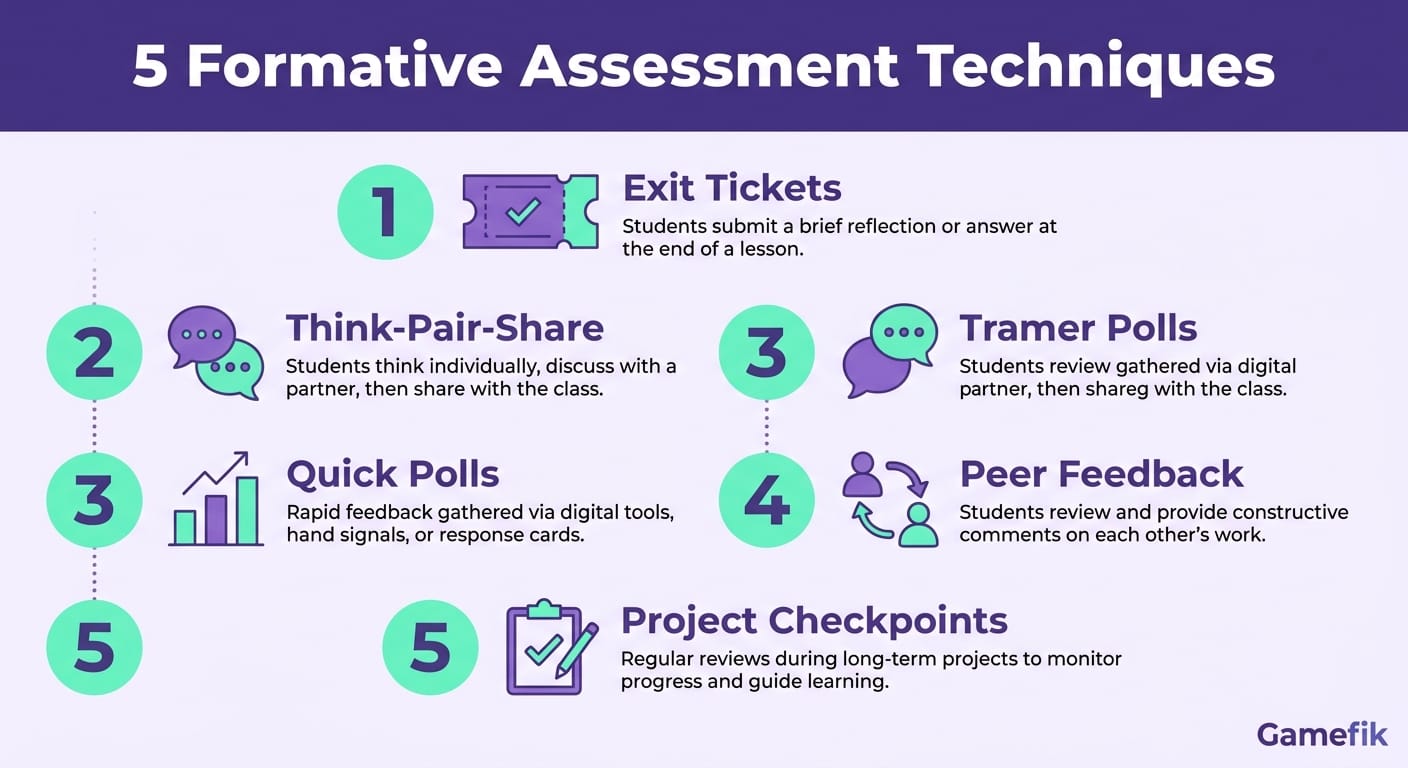
The common thread across all five techniques: none generates a final grade. All generate in-process data. It's this shift in logic — from classifying to adjusting — that defines formative assessment in practice.
How Gamefik Turns Formative Assessment into Measurable Engagement
Applying formative assessment without technology is possible. Scaling it consistently across 5 sections of 30+ students, maintaining data analysis and individualized feedback, is a different story entirely. It was exactly this bottleneck that led over 500 partner schools to integrate formative cycles into Gamefik's gamification platform.
This is a point I learned in practice, not in theory. In Gamefik's early years, we focused on gamification as motivation — points, badges, leaderboards. It worked for surface-level engagement, but teachers kept asking for something deeper: "OK, the student is participating, but I need to know what they're actually learning." That's when we integrated the formative assessment layer into the mission system. Every quiz, every challenge, every checkpoint started generating not just XP, but pedagogical data. Gamification became the engagement engine; formative assessment became the instructional intelligence engine. The two together are what makes the system actually work.
On Gamefik, every quiz, mission, and challenge functions as a formative assessment touchpoint. The student responds, receives immediate feedback, and earns XP. The teacher accesses a dashboard that shows not just the score, but the error pattern: which competencies are solid, which need reinforcement, and which students are at risk of disengagement. It's continuous diagnosis with zero manual grading.
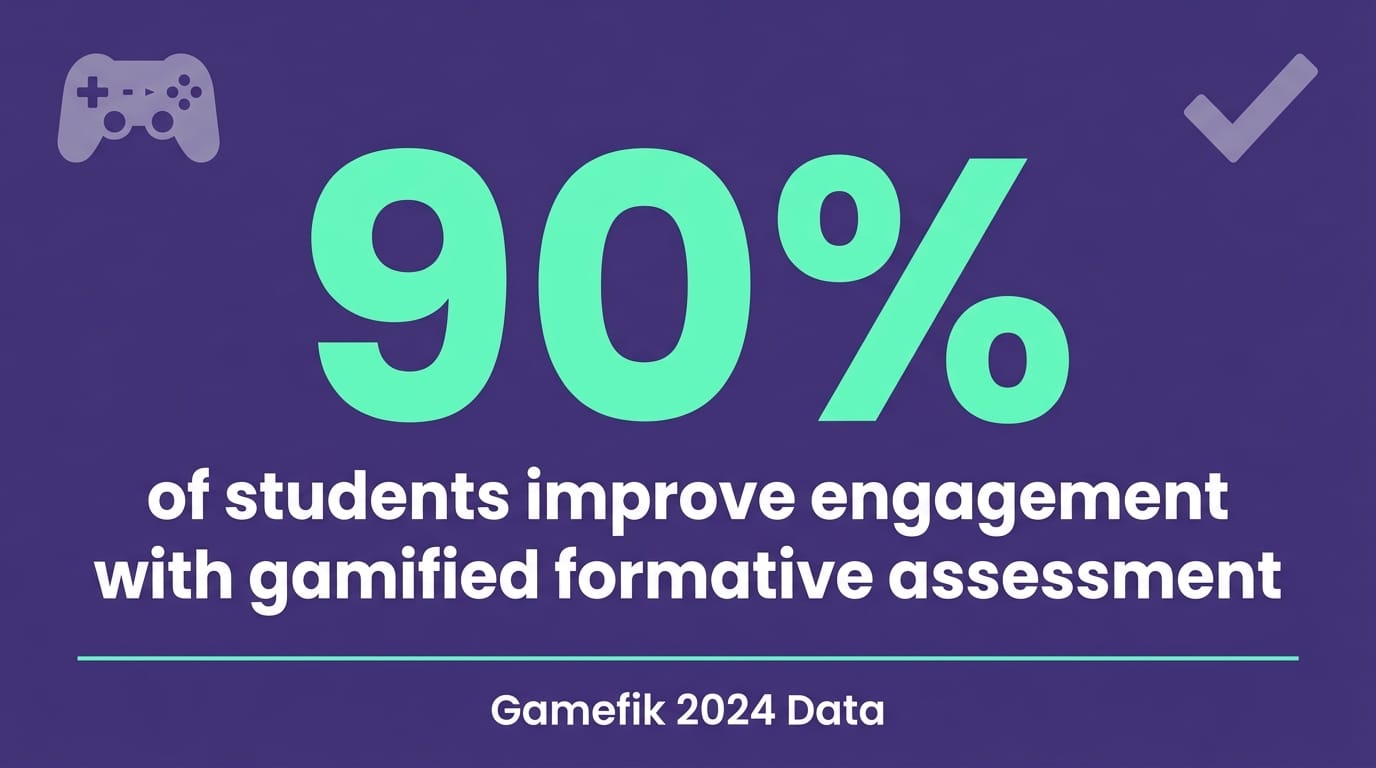
The numbers back the model. In 2024 internal data, collected across partner schools serving over 100,000 students, 90% of students who participated in gamified formative cycles on Gamefik showed measurable improvement in engagement — measured by activity participation frequency, mission completion rate, and active time on the platform. The data isn't generic: it's trackable by school, class, and individual student.
To make it concrete: in a network of K-8 schools across a large district in the Midwest, adopting gamified formative cycles reduced the percentage of students requiring academic intervention by 28% in the first semester of use. The district's curriculum director attributed the result directly to earlier diagnostics — teachers started intervening in weeks 3 and 4, not week 8.
Another data point that matters if you're short on time: Gamefik implementation takes an average of 1 week — from account creation to the first active mission with students. Teachers report saving an average of 2 hours per week on tracking and grading tasks, time that goes back into lesson planning and individualized feedback. For educators already working with artificial intelligence for teachers, Gamefik integrates as an engagement and data layer that complements planning and content-creation tools.
The central point: formative assessment isn't just a pedagogical technique. When combined with gamification and automated data, it becomes a real-time learning management system — for the teacher and the student.
Why Formative Assessment Improves Engagement: The Mechanism Behind the Data
Saying "formative assessment improves engagement" without explaining why is the kind of empty claim that won't help you make the case in a staff meeting. The mechanism has three layers, and understanding them changes how you present the approach to administrators and colleagues.
First layer: reducing test anxiety. When students know they'll be evaluated only in one high-pressure moment (the quarterly exam), anxiety increases and performance drops — this is the well-documented "test anxiety" effect, studied in over 1,000 research papers since the 1980s. Formative assessment distributes the risk: instead of one make-or-break event, there are multiple low-stakes checkpoints. The student responds to a quiz knowing the goal is to learn, not to be judged. Anxiety drops, participation rises.
I see this very clearly across Gamefik schools: when the teacher configures the quiz as "no grade, XP only," the participation rate is consistently 20–30% higher than when the same activity counts toward a grade. The student who freezes during a test answers the gamified quiz without hesitation — because the psychological framing changes. It's the same question, the same content, but the emotional context is different.
Second layer: feedback as a driver of autonomy. Self-determination theory (Deci & Ryan, 2000) shows that intrinsic motivation depends on three needs: competence, autonomy, and relatedness. Formative feedback directly feeds the perception of competence — the student sees where they've advanced, understands what's missing, and feels that progress is possible. Without that feedback, the perception of competence depends entirely on the final grade, which often arrives too late to generate motivation.
In practice, what I observe in classrooms is this: the student who receives weekly formative feedback develops a different relationship with error. They stop seeing mistakes as failure and start treating them as information. A school leader at an independent school in Toronto described it well: "Before formative assessment, students hid their confusion. After, they started asking questions — because they understood that the gap is the data that helps, not the problem that condemns."
Third layer: visibility of progress. Human beings are biologically oriented toward short-term goals. An entire quarter without visible feedback is, to an adolescent brain, the equivalent of running a marathon with no mile markers. Formative assessment — especially when gamified with progress bars, XP, and badges — makes advancement visible and frequent. That's why gamification in education platforms generate such striking engagement data: they leverage this visibility mechanism systematically.
This is, in fact, the most underutilized principle in schools that still operate with only notebooks and whiteboards. The progress exists — the student is learning — but they can't see the progress happening. The XP bar, the level-up, the badge that unlocks: these are visual representations of something the student already knew intuitively but can now confirm objectively. Across 500+ partner schools, this is the feature that administrators most frequently cite as the "turning point" for engagement in classes that were previously written off as "difficult."
These three mechanisms explain why the engagement improvement isn't accidental. It's structural. When you distribute assessment, offer rapid feedback, and make progress visible, you're activating the same motivational circuits that keep a person engaged in a game, a fitness app, or any system of progressive goals.
FAQ — Frequently Asked Questions About Formative Assessment
What is the difference between formative and summative assessment?
Formative assessment happens during the learning process and is used to adjust instruction in real time. Summative assessment occurs at the end of a unit or grading period (midterm, final exam) and measures accumulated results. In practice, formative is diagnostic and continuous; summative is evaluative and point-in-time. The two complement each other — aim for at least 3 formative checkpoints for every summative assessment.
How do you implement formative assessment without increasing teacher workload?
Use quick techniques like exit tickets (2 minutes at the end of class), gamified quizzes with auto-grading, and pre-built rubrics. Platforms like Gamefik automate data collection and analysis, saving teachers an average of 2 hours per week on tracking and grading tasks. The key is to systematize: pick one technique, apply it every week, and scale once you build fluency.
Does formative assessment work in elementary, middle, and high school?
Yes. In elementary and middle school, visual techniques like stoplight comprehension checks and class discussions are highly effective. In high school, digital quizzes, self-assessment with rubrics, and projects with intermediate checkpoints generate precise data and keep engagement high. Gamefik serves over 100,000 students across all grade levels with formative cycles adapted by age group.
What are practical examples of formative assessment?
Exit tickets, multiple-choice quizzes with instant feedback, collaborative concept maps, learning journals, self-assessment rubrics, one-minute surveys, and gamified challenges with progressive scoring. The format matters less than the purpose: if the activity generates in-process data and feeds back before the final assessment, it is formative.
Does formative assessment replace tests?
No — it complements them. Common Core and most state standards recommend diversifying assessment instruments. Formative assessment feeds teachers continuous data that makes the final test less high-stakes and more fair, because students have already received feedback along the way. In practice, schools that combine formative and summative assessment report up to a 30% reduction in remediation rates.
Conclusion: Formative Assessment Is a Pedagogical Decision, Not a Trend
Formative assessment isn't a novelty or a conference buzzword. It's a pedagogical decision backed by over 50 years of accumulated evidence — and one that reaches real scale when supported by technology and automated data.
After 10 years implementing gamification in schools, I can say with confidence: the biggest barrier to formative assessment isn't technical — it's cultural. The teacher who was assessed by tests their entire life tends to reproduce the model. Breaking that cycle requires two things — a tool that simplifies the process and a visible result that justifies the change. When a teacher runs their first gamified formative quiz and sees, on the dashboard, exactly where the class struggled, the resistance drops. Data persuades more than any keynote.
You don't need to overhaul your entire assessment system tomorrow. Start with one exit ticket per week. Then try a gamified quiz. Observe what changes in your ability to make instructional decisions — and in your students' level of participation.
If you want to accelerate that process with a system that already integrates formative assessment, gamification, and engagement data in a single dashboard, explore Gamefik. That's 10+ years of method, 500+ partner schools validated in Brazil and LATAM, and an implementation that takes 1 week. Visit gamefik.com and see how it works in practice.
{
  "@context": "https://schema.org",
  "@type": "FAQPage",
  "mainEntity": [
    {
      "@type": "Question",
      "name": "What is the difference between formative and summative assessment?",
      "acceptedAnswer": {
        "@type": "Answer",
        "text": "Formative assessment happens during the learning process and is used to adjust instruction in real time. Summative assessment occurs at the end of a unit or grading period (midterm, final exam) and measures accumulated results. In practice, formative is diagnostic and continuous; summative is evaluative and point-in-time."
      }
    },
    {
      "@type": "Question",
      "name": "How do you implement formative assessment without increasing teacher workload?",
      "acceptedAnswer": {
        "@type": "Answer",
        "text": "Use quick techniques like exit tickets (2 minutes at the end of class), gamified quizzes with auto-grading, and pre-built rubrics. Platforms like Gamefik automate data collection and analysis, saving teachers an average of 2 hours per week on tracking and grading tasks."
      }
    },
    {
      "@type": "Question",
      "name": "Does formative assessment work in elementary, middle, and high school?",
      "acceptedAnswer": {
        "@type": "Answer",
        "text": "Yes. In elementary and middle school, visual techniques like stoplight comprehension checks and class discussions are highly effective. In high school, digital quizzes, self-assessment with rubrics, and projects with intermediate checkpoints generate precise data and keep engagement high."
      }
    },
    {
      "@type": "Question",
      "name": "What are practical examples of formative assessment?",
      "acceptedAnswer": {
        "@type": "Answer",
        "text": "Exit tickets, multiple-choice quizzes with instant feedback, collaborative concept maps, learning journals, self-assessment rubrics, one-minute surveys, and gamified challenges with progressive scoring."
      }
    },
    {
      "@type": "Question",
      "name": "Does formative assessment replace tests?",
      "acceptedAnswer": {
        "@type": "Answer",
        "text": "No — it complements them. Common Core and most state standards recommend diversifying assessment instruments. Formative assessment feeds teachers continuous data that makes the final test less high-stakes and more fair, because students have already received feedback along the way."
      }
    }
  ]
}