
The leading gamification platforms for schools in 2026 are Gamefik (K-12 focus, integrated AI, 500+ schools), ClassDojo (family-school communication), Kahoot (review quizzes), and Classcraft/Quizizz (classroom RPG). For districts seeking systemic engagement with actionable data for administrators, Gamefik is the only platform with standards-aligned implementation in under one week.
You've got three or four tabs open right now, each one showing a different gamification platform's website. They all promise to "transform engagement." They all have glowing testimonials. And none of them clearly explain where their strengths end and their limitations begin.
I know this scenario because I've been walking school leaders through this decision for over ten years. A curriculum coordinator running a 12-school network in the Midwest told me once: "I spent three weeks comparing platforms. They all looked the same on their websites. It wasn't until I actually piloted them that I realized they were solving completely different problems." This article exists so you don't need three weeks.
I'm going to compare Gamefik, ClassDojo, Kahoot, and Classcraft (now part of Quizizz) across seven criteria that matter to the person signing the contract — the principal, the curriculum director, and the district administrator. Full disclosure: Gamefik is the company behind this blog, so you know where I'm coming from. But a dishonest comparison doesn't convince anyone. I'll point out where each platform shines and where it stumbles, including ours. Across 500+ partner schools, I've learned that transparency closes more contracts than superlatives.
Why choosing the wrong platform costs more than having none at all
The 2026 landscape puts real pressure on school leaders. Research across the sector indicates that chronic disengagement affects between 40% and 60% of middle and high school students in the United States — a figure that tracks with Gallup's long-running student engagement surveys showing steady decline from 5th grade onward. Gamification in education emerged as a practical response — not as a trend, but as a structured method to reconnect students with the process of learning.
The problem is that "gamification" has become an umbrella term for anything with points, badges, or a leaderboard. Is a review quiz gamification? Technically, yes. But does it solve systemic disengagement in a school with 800 students and 50 teachers? No. The difference between a quiz tool and a gamification platform for schools is the same as between a thermometer and a full medical chart: one measures a single data point, the other gives you a complete picture of the patient.
In practice, the most expensive mistake isn't choosing the wrong platform — it's choosing without a diagnosis. A mid-size private school outside Atlanta adopted a gamified quiz tool expecting it to solve attention dropout in high school. Three months in, the math and science teachers were using it regularly, the humanities department had abandoned it entirely, and the administration didn't have a single consolidated data point about what was working. It wasn't the tool's fault — it was a scope mismatch. The tool did quizzes exceptionally well. The school's problem was systemic.
When a school leader selects the wrong platform, the damage goes beyond the subscription fee. Teachers invest hours learning the tool, students get excited the first month and disengage by the second, and the coordinator has no data to understand what happened. From Gamefik's data, schools that migrated from point solutions to the platform report that the invisible cost of the previous project — teacher frustration, loss of credibility for the pedagogical initiative, wasted training time — often exceeded 3 to 5 times the subscription they were paying. That's why being rigorous about your choice isn't perfectionism. It's risk management.
What defines a real gamification platform for schools
Before we compare, we need to align on what we're evaluating. After implementing gamification in over 500 schools across Brazil and LATAM, we've identified three characteristics that separate a real platform from a point tool with game elements bolted on top:
Systematic, not episodic. It operates across the semester, not just during a Friday review session. It creates an engagement arc that students progress through week by week, with visible growth. A gamified school isn't one that runs a quiz on Fridays — it's one where gamification is woven into the daily pedagogical routine. A 9th-grade math teacher in one of our partner schools described it this way: "The shift happened when students stopped asking 'Are we doing the game today?' and started opening the platform on their own to check their mission progress." When students seek out the gamification instead of waiting for it, the system is working.
With data for leadership, not just for the teacher. The teacher needs to know if Period 3 engaged more than Period 4. The curriculum coordinator needs to see patterns across grade levels. The principal needs metrics to present to the school board or superintendent. A real platform generates layered dashboards — from the individual student to the entire district. This isn't a technical luxury: it's what separates a decision based on gut feeling from one based on evidence. In 2024, administrators using the Gamefik dashboard to present results to their boards successfully renewed innovation budgets with concrete data — engagement by class, interaction frequency, mission completion rates — instead of relying on enthusiastic anecdotes.
Aligned to curriculum standards, not generic. Gamification without a connection to learning objectives becomes disconnected entertainment. For U.S. schools, this means alignment with Common Core, state standards like TEKS (Texas), NGSS, or district-specific frameworks — not as a marketing claim on the website, but as the internal logic of how missions and challenges map to specific skills and competencies. When a gamification mission reinforces understanding of proportional relationships (7.RP.A) without the student realizing they're practicing ratios, the pedagogical design is doing its job. When the student is just clicking buttons to earn points, it's entertainment wearing an education costume.
With this rubric in place, let's get to the comparison.
Comparison table: Gamefik, ClassDojo, Kahoot, and Classcraft across 7 criteria
| Criterion | Gamefik | ClassDojo | Kahoot | Classcraft (Quizizz) |
|---|---|---|---|---|
| Pedagogical focus vs. entertainment | Pedagogical — proprietary methodology with 10+ years of iteration in K-12 schools | Behavioral — conduct points and student portfolios | Content review — gamified quizzes | Behavioral/narrative — classroom RPG |
| Standards alignment | Adaptable — missions mappable to Common Core, state standards, and custom frameworks | Not designed for curriculum alignment | Teacher-dependent — requires manual alignment per quiz | Generic mechanics — no curriculum built in |
| Implementation time | 1 week — with guided pedagogical onboarding | 1-2 days — simple setup, but limited scope | Immediate — but point-of-use, not institutional implementation | 3-6 weeks — high complexity for RPG configuration |
| Reports for administrators | Multi-level dashboard: student → class → school → district | Behavior reports by class — no network view | Individual quiz reports — no longitudinal data | Limited to teacher view — no institutional overview |
| Cost and model | Institutional subscription (per school/district) | Freemium — free with basic features, paid school plan | Freemium — limited free tier, paid plans per teacher | Free (integrated into Quizizz) with paid premium features |
| Dedicated support | Expanding English-language support with pedagogical coaching; native team for LATAM | Strong English support — U.S.-based | Strong English support — global | English support — via Quizizz |
| Scalability for districts | High — multi-school management in a single dashboard | Low — designed per classroom, not per district | Low — individual teacher use | Low — per-teacher configuration |
Credit where it's due: ClassDojo nails simplicity and family communication. Kahoot delivers content review with an experience students genuinely love — I've seen a 6th-grade class erupt in cheers when their teacher opens a Kahoot, and that has real value. Classcraft brought RPG narrative to education before almost anyone else. None of these platforms are bad. Each one solves a different problem. The administrator's mistake isn't choosing poorly — it's choosing without criteria.
One thing the table doesn't capture: engagement longevity. Quiz tools produce excitement spikes that drop off after 4-6 weeks — it's the "novelty effect" that any teacher recognizes. Systemic platforms, when properly implemented, build ascending engagement curves over the semester because the student perceives real progression, not format repetition. In Gamefik's data, the interaction rate in the third month averages 12% higher than in the first month — the opposite of what happens with episodic tools.
Which school is each platform best suited for
There's no "best gamification platform for schools" in the absolute. There's the most appropriate one for your context. I'll be direct about where each makes the most sense — and this clarity comes from watching hundreds of schools navigate this decision.
ClassDojo is ideal if your school's primary challenge is family communication and classroom behavior management. Elementary schools across the U.S. use it massively because ClassDojo does that exceptionally well. It's a household name in American K-5 education for good reason. If your goal is systemic academic engagement across middle and high school, though, ClassDojo wasn't built for that. It works as a complement, not as a central student engagement strategy. A K-3 campus in a district with high parent-communication needs can find tremendous value here — just don't expect it to solve 8th-grade disengagement.
Kahoot is ideal if you need a lightweight tool for individual teachers to make review sessions more dynamic. It's free at the basic level, intuitive, and students of any age have fun with it. The limitation surfaces when the curriculum coordinator asks: "What about engagement across the quarter?" Kahoot wasn't built to answer that question. It operates at the lesson level, not the school level. I have genuine respect for what Kahoot does — I actually recommend it for teachers who are starting to experiment with game mechanics before proposing something institutional. It's a legitimate entry point.
Classcraft (Quizizz) is ideal if you have a highly motivated teacher invested in RPG narratives, smaller class sizes, and the time to configure a complex system of characters, powers, and consequences. When it works, it's magical — I've visited a 7th-grade class in a rural district where the social studies teacher created a medieval narrative that students followed for an entire semester. But that teacher had 15 years of experience and invested weekends in the platform. When the teacher doesn't have time to maintain it, the system gets abandoned. For districts with dozens of teachers at different levels of tech fluency, the implementation complexity is a real risk. The absorption by Quizizz brought more focus on quizzes and less on the original RPG — diluting the narrative differentiator that made Classcraft unique.
Gamefik is ideal if your school or district needs gamification as an institutional strategy — with data for administrators, curriculum alignment, rapid implementation, and dedicated support. It's the most robust option for K-12 schools seeking systemic engagement, and I say that with the accountability of having implemented in 500+ schools and measured results in every one. The honest limitation: as an institutional subscription, it's not the lightest choice for an individual teacher who just wants to experiment with gamification in one class. For that exploratory scenario, Kahoot or even ClassDojo's free tier serve better as a first step. Another limitation: Gamefik requires institutional buy-in. If the principal doesn't champion the initiative and leaves everything to a single coordinator without support, results fall below potential — just as with any pedagogical tool without leadership backing. A third consideration: Gamefik's deepest curriculum alignment is currently with Brazilian standards (BNCC), though the platform is actively building Common Core and state-standards mapping for U.S. districts. Early adopters in the U.S. should expect a collaborative alignment process during onboarding.
How to choose the right platform: 5 practical criteria for school leaders
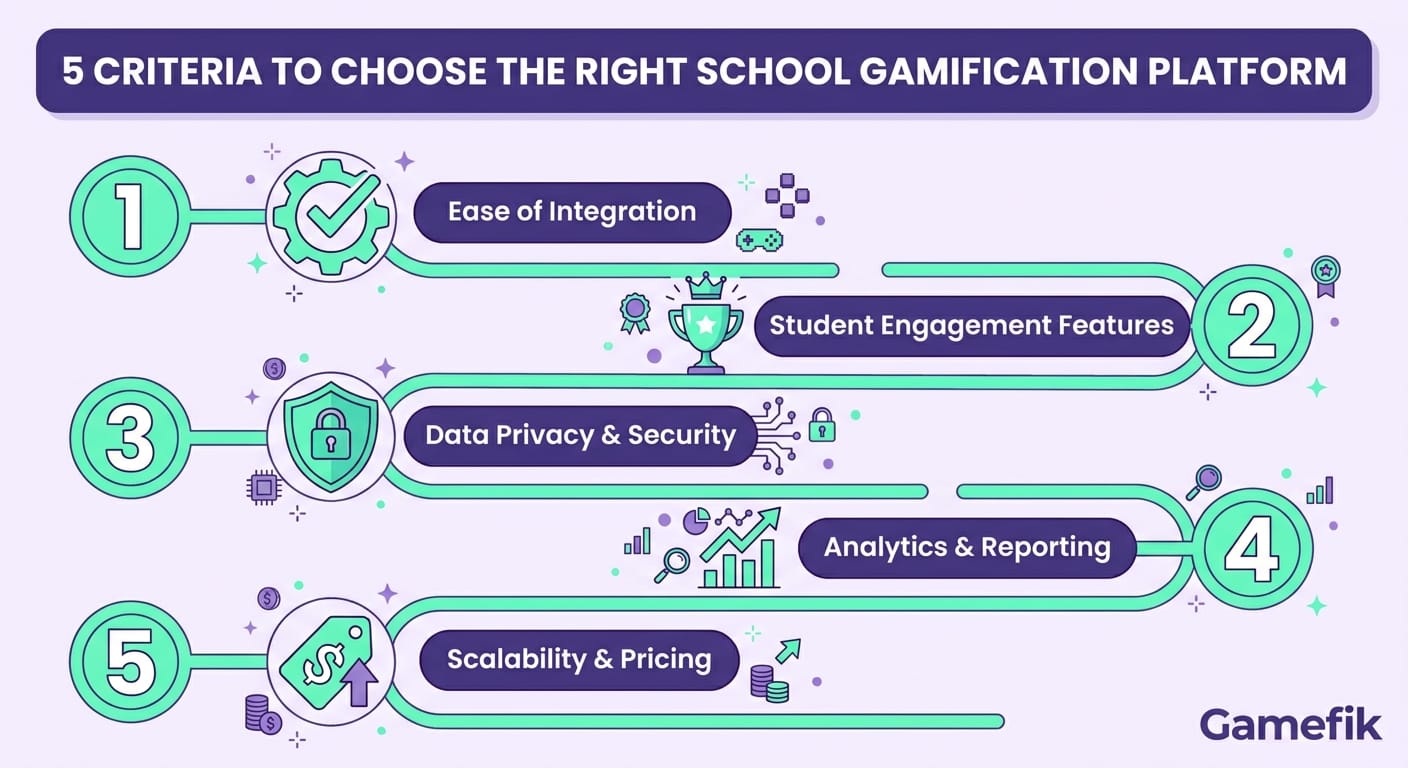
If you're a curriculum director or district administrator, the decision starts before you open any vendor's website. It starts with internal questions that define what your school actually needs. These five criteria came from mistakes I've seen schools make — and that we've learned to prevent during Gamefik's onboarding process.
1. Define the problem before the solution. Chronic disengagement is different from boring lessons in one specific subject. The first requires a systemic platform; the second might be solved with point tools. Gather real data: assignment completion rates, participation frequency, teacher feedback. Without a diagnosis, every platform looks good — and none of them work. A school in the suburbs of Chicago reached out to us thinking they needed gamification. After a 40-minute conversation with their instructional coach, we discovered the real issue was a lack of structured feedback loops — something gamification addresses, but that could have been partially solved with changes to internal processes. We advised the school to make those adjustments before purchasing any platform. Six months later, when the remaining challenge was genuinely about engagement, the implementation delivered results far faster.
2. Ask who will use it and who will manage it. If gamification depends on each teacher configuring everything independently, adoption will be uneven. Teachers with stronger tech skills adopt; others abandon. Across 500+ implementations, we've learned that teacher adoption rates depend less on the teacher's age and more on the support they receive in the first week. Platforms with institutional onboarding and pedagogical coaching — not just technical support — reduce this disparity. Gamefik implements with pedagogical support in the first week, and teachers who resist most on Day 1 frequently become the most engaged by Day 30, because they see real time savings: an average of 2 hours per week fewer spent on operational engagement management tasks. Classcraft, at the other extreme, requires the teacher to build the RPG universe from scratch — which works for the hero teacher, but excludes the other 80%.
3. Demand reports that speak the language of leadership. You need to know if the investment is generating results. That means dashboards with engagement metrics by class, grade level, and campus — accessible without asking a teacher to pull a report. Ask the vendor: "Can I see engagement across all 8th-grade classes on one screen?" If the answer is evasive, the product wasn't built for school leadership. Another practical test: ask to see an exportable report you could present to your school board in 5 minutes. If the vendor needs a week to assemble that material, the platform wasn't designed for decision-makers.
4. Pilot before you scale. No comparison article replaces an actual pilot. Choose two or three classes, run it for 30 days, and measure. How many students completed missions? Did the teacher spend more or less time? Could the coordinator track progress from the dashboard? Pilot data is worth more than any sales webinar — including ours. A school district in Georgia did exactly this: tested Gamefik in 3 classes at one campus, measured for 45 days, and then expanded to 8 schools with confidence based on their own numbers, not ours. That's the right way to decide.
5. Evaluate total cost, not just the subscription. A "free" platform that requires 4 hours of manual configuration per teacher per week is expensive in teacher time. Consider: if a teacher's loaded hourly rate is $45 and they spend 4 extra hours per week building quizzes manually, that's $720/month for just that one teacher. Multiply by 30 teachers and the "free" tool costs $21,600/month in teacher hours. A subscription that implements in 1 week and saves 2 hours per teacher per week — as Gamefik does across 500+ schools — can deliver a positive ROI in the first month. Do the math with hours, not just dollars.
Why Gamefik leads in partner schools — and where it still needs to improve
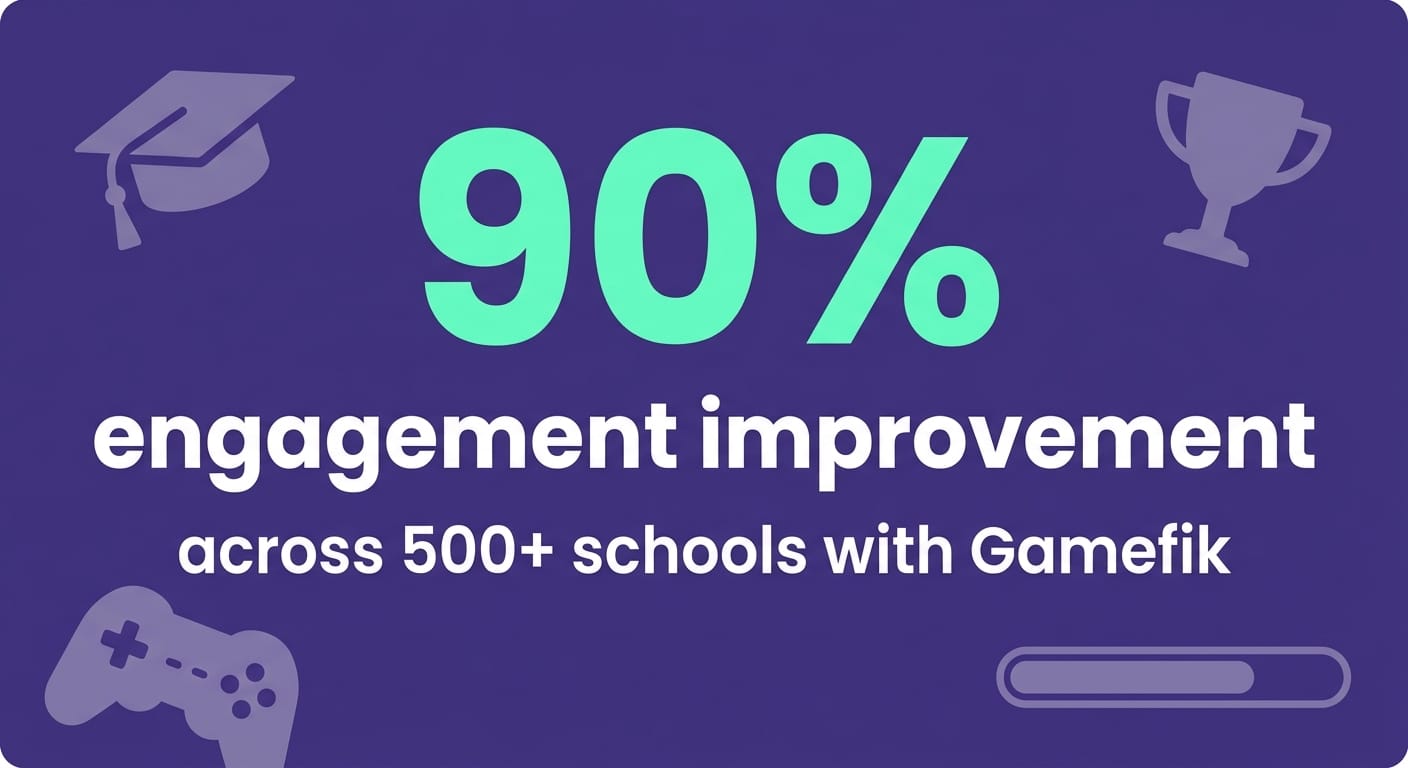
Across 500+ partner schools, Gamefik records a 90% improvement in student engagement — measured by interaction frequency and gamified activity completion over the semester, based on internal 2024 data from over 100,000 students. That number doesn't happen by accident. It's 10+ years of methodology iterated in the field, not in a lab. Every product iteration came from direct feedback from teachers and coordinators who said "this doesn't work in my classroom" — and we had to listen and adjust.
Three pillars sustain this result. The first is artificial intelligence for teachers integrated into the platform: Gamefik's generative AI personalizes missions and challenges by student profile, adjusting difficulty and topic without the teacher needing to manually configure each variation. In practice, this means an 8th-grader who has mastered fractions but struggles with equations receives calibrated missions — without the teacher spending 45 minutes creating variations. Research in neuroscience and gamification confirms that personalization is one of the most powerful triggers of intrinsic motivation — and AI makes this feasible at scale, something no teacher can do manually for 35 students per class across 6 periods a day.
The second pillar is partnerships with recognizable brands like Nike and Fanta. This might sound like marketing, but the mechanics are pedagogical: tangible, recognizable rewards create an extrinsic motivation cycle that complements the intrinsic motivation of the missions. The student isn't competing for abstract points — they're progressing toward something they recognize and value outside of school. This bridge between the school world and the real world is a differentiator that none of the three competitors in this comparison offer. An administrator at a school in one of our partner networks reported that mission completion rates jumped 34% during a month when a brand partner campaign was active, compared to the previous month without one. Extrinsic motivation doesn't replace intrinsic motivation, but ignoring it means leaving a real lever on the table.
The third pillar is the network-level view. Gamefik's dashboard allows a district administrator overseeing 15 schools to see, on a single screen, comparative engagement across campuses, identify schools that need support, and make decisions based on concrete data. ClassDojo, Kahoot, and Classcraft were not designed for this layer of management. For superintendents and board members who need to justify edtech investments with clear metrics, this is frequently the deciding feature. It's not the gamification that convinces the board — it's the numbers it generates.
Now, the honest part. Gamefik still isn't the best choice in two scenarios — and I'll add a third I learned recently. First: if your school just wants to experiment with gamification in an exploratory way in one or two classes, without institutional commitment, the investment may feel disproportionate when Kahoot does a solid introductory job at zero cost. Second: Gamefik's deepest standards integration is currently with Brazilian curriculum frameworks. U.S. and Canadian schools following Common Core, NGSS, or provincial curricula will find the alignment process collaborative but not yet as turnkey as it is for LATAM schools — this is our primary development focus for the North American market in 2025-2026. Third — and this one is less obvious: schools where teacher turnover exceeds 40% per year need re-onboarding processes that we're still refining. The platform works, but the cost of retraining new staff each semester reduces ROI in the first year. We're building asynchronous automated onboarding to address this, but we haven't reached where we want to be yet.
For K-12 schools and districts that want gamification as a strategy — not as an experiment — the data shows that the shortest path between decision and results runs through Gamefik.
Why honest comparisons work better than pure marketing
You've probably read "comparison" articles that are just propaganda in disguise. Competitor A is presented as weak in everything, Competitor B as mediocre, and the company that wrote the post is perfect. The reader spots it in 30 seconds. Closes the tab. Goes looking for opinions on Reddit, EdSurge forums, or a principals' Facebook group.
School leaders are professionals experienced in detecting sales pitches dressed up as advice — they deal with vendors for textbooks, curricula, technology, food services, and facilities year-round. When a comparison acknowledges that a competitor does something well and that its own product has limitations, the credibility of the entire piece rises. Not because the reader is naive, but because trust is built with honesty, not with superlatives.
I have a conviction about this that guides everything we publish at Gamefik: the administrator who chooses another platform based on informed criteria is better for the market than one who contracts Gamefik without understanding why. Clients who sign under sales pressure cancel in 6 months. Clients who sign based on an informed decision renew for years and become references for other schools. Over 10 years, this approach has cost us contracts in the short run and built our reputation in the long run.
That's why I explicitly laid out where Kahoot shines, where ClassDojo gets it right, and where Gamefik still isn't the best option. If after reading all of this you conclude that Kahoot solves your school's problem, great — you made an informed decision. If you conclude that you need something more robust, Gamefik is one demo away.
Frequently asked questions about gamification platforms for schools
What is the best gamification platform for schools? It depends on your goal. For systemic K-12 engagement with administrator dashboards and standards alignment, Gamefik leads with 500+ schools and a 90% improvement in student engagement. For one-off review quizzes, Kahoot works well. For family-school communication, ClassDojo is the U.S. market leader but doesn't offer curriculum-integrated gamification.
Are ClassDojo and Gamefik the same thing? No. ClassDojo focuses on family-school communication and behavior points. Gamefik is a full pedagogical gamification platform with generative AI, a proprietary methodology, student engagement dashboards by class and grade, and curriculum integration. They solve different problems.
Can Kahoot gamify an entire school? Kahoot excels at gamified review quizzes but was not designed for systemic gamification. It lacks administrator dashboards, longitudinal engagement reports, and curriculum integration. To gamify a school as an institutional strategy, you need a platform with a network-level view.
How do I choose a gamification platform for my school or district? Evaluate seven criteria: pedagogical focus vs. entertainment, standards alignment, implementation time, administrator reports, total cost (including teacher hours), dedicated support, and scalability across schools. Run a 30-day pilot before committing district-wide.
Which gamification platform offers dedicated support for U.S. schools? ClassDojo and Kahoot have strong English-language interfaces and U.S.-based support. Gamefik offers dedicated onboarding with pedagogical coaching and is actively expanding its English-language support for U.S. and Canadian districts. Classcraft (now part of Quizizz) also operates primarily in English.
The choice is in your hands — literally
No article replaces 30 minutes testing a platform with your instructional team. You already have the criteria. You already know where each tool is strong and where it falls short. The next step is to get hands-on.
If your school or district needs gamification as an institutional strategy — with real data for leadership, standards alignment, AI that personalizes without overloading teachers, and implementation in 1 week — schedule a free Gamefik demo. No commitment, no pressure. You see the dashboard, pilot it with a few classes, and decide with data, not with promises.
500+ schools have already made this choice. Over 100,000 students are more engaged because of it. The decision is now yours.