
Brazilian schools that adopted gamification report concrete gains: assignment completion rising from 41% to 78% in a single term, dropout cut in half, and attendance holding above 90%. This guide collects 7 cases with name, year, and metric — including one that didn't work.
Schools that adopted gamification report concrete, measurable gains: assignment completion climbing from 41% to 78% in one term, dropout cut in half, and attendance above 90%. This guide gathers 7 cases with identification, year, and before-and-after metrics — including one where the strategy failed, and why.
If you run a school and you're tired of articles that promise "real cases" and deliver interchangeable anonymous profiles, this is the opposite. Where a confidentiality agreement applies, I say so explicitly and use the aggregated data with its source. Where there's a public name, the name is here.
What separates a gamified school from a classroom that uses Kahoot
Before the cases, a distinction people often confuse. Running a Kahoot quiz once a week is one-off gamification. It works for that class and disappears when the teacher closes the laptop.
A gamified school is something else: the system of points, quests, levels, and narrative is integrated into the curriculum, into the school's management routine, and into the student's bond with the institution across the entire school year. The student isn't "playing a game today"; they're advancing on a track that runs through subjects and terms.
In 10 years in the field, the pattern I see most is this: a school buys the tool excited about Friday's quiz and stops there. In practice, that's the difference between an event and a system. This distinction in scale explains why some projects scale and others die in three months. I'll come back to this point in the failure case.
The four pillars behind any serious implementation are a clear goal, transparent rules, immediate feedback, and meaningful reward. And the five types that show up in the cases below are competitive, collaborative, progressive, narrative, and reward-based — almost always combined. Across the 500+ schools we work with, I've never seen a success case built on a single type: a school that only uses a competitive leaderboard, for example, engages the five students who were already doing well and sinks the rest.
7 real cases of gamified schools in Brazil
1. Colégio Bandeirantes (São Paulo, Brazil) — 2019
Bandeirantes publicly documented its use of Classcraft in middle-school classes starting in 2019. The model translated behavior and assignment completion into team character progression. The school reported an increase in how consistently students turned in work and in cooperation among students, with the collaborative system pulling along students who used to lag behind. It's one of the most-cited Brazilian cases precisely because the institution communicated it openly — and because it shows collaborative gamification works well in high-performing schools, not just as a rescue plan for struggling classes.
2. Sobral Municipal School Network (Sobral, Brazil) — since 2015
Sobral is the Brazilian municipality with the best basic-education quality index in the country (IDEB, Brazil's national measure), and part of its pedagogical strategy includes recognition and reward elements tied to goals — an institutional gamification logic applied to learning management. Schools work with visible goals, frequent feedback, and public recognition of progress. Sobral's early-grades index rose from 4.0 in 2005 to above 9.0 in recent measurements. I won't attribute that only to gamification — that would be dishonest — but the goal-and-recognition mechanic is a declared part of the method. What's worth extracting here is the principle: a visible goal plus frequent feedback is the foundation of any system that works, with or without a digital platform.
3. Mid-size private school, Greater Curitiba, Brazil — 2023 (under NDA)
There's a confidentiality agreement here, so I can't name the school. The data is attributed to Gamefik's measurement within the partnership: the 7th-grade math assignment completion rate went from 41% to 78% between the 1st and 2nd terms of 2023, after implementing a quest track with daily feedback. Attendance at reinforcement classes, previously 52%, rose to 81% in the same period. The teacher in charge — who resisted the idea, thinking "math can't become a game" — ended up being the model's strongest advocate by the end of the semester, because the daily feedback gave her real-time information on exactly who was stuck on which topic.
4. Faith-based school, inland Minas Gerais, Brazil — 2022 (under NDA)
Another case under contractual confidentiality. The metric Gamefik tracked was night-shift high school dropout: it fell from 14% to 6.5% over the 2022 school year, with gamified narrative used to build belonging in a historically unstable cohort. The collaborative system — where one student leaving hurt the whole team's score — was the factor coordinators pointed to as decisive. This is one of the cases that stuck with me most: in the night shift, most students work full-time during the day, and the bond with teammates became a real reason not to miss class. The mechanic only worked because the coordination team built the groups carefully, mixing profiles — leaving it on autopilot would have created unequal teams and made dropout worse.
5. Instituto Ayrton Senna — learning-track programs
Instituto Ayrton Senna, in partnership with public school networks, develops social-emotional learning solutions with progressive tracks and skill recognition. It's an example of institutional gamification applied at public-network scale, with improvement data on social-emotional competencies published in its reports. It's worth citing as proof that gamification isn't a private-school privilege — and it dismantles the most common objection I hear from public-network administrators: "that's for expensive schools." It isn't.
6. State public school, Greater Recife, Brazil — 2024 (under NDA)
Confidentiality again. Gamefik measured active class participation — defined as the number of students who answer, propose, or turn in something each week. The rate went from 44% to 82% in the first half of 2024, with the implementation taking about a week to go live and saving teachers around 2 hours a week of manual grading, which the platform automated. The honest detail: the school had a rundown computer lab, and the model had to run partly on paper and on students' phones. It worked, but it required adaptation — it's not the one-tablet-per-student scenario the brochures usually sell.
7. Full-time school network, Goiás, Brazil — 2023 (Gamefik aggregate data)
Across a nine-school network in Goiás, Gamefik tracked the average 9th-grade Portuguese-language grade: it rose from 6.2 to 7.4 between the initial diagnostic and the 2023 year-end assessment. What drove the result was combining flipped classroom (an active methodology) with a layer of gamified quests — students studied the content beforehand, and in-person class became solving scored "challenges." It's the case that best proves a thesis I've defended for years: gamification alone pushes engagement, but the grade jump comes when it's paired with an active methodology that gives students something real to do.
When institutional gamification didn't work
A real case-study article needs the courage to show what the top three Google results hide. Not every project succeeds.
In a two-school private network in inland São Paulo, Gamefik tracked a 2022 implementation that failed. The platform was installed, points were configured, leaderboards appeared — and within three months the system became a dead spreadsheet nobody checked.
The diagnosis was clear, and it's the most common mistake I see in the field: the school skipped teacher training. Teachers received the tool without understanding the pedagogical logic behind it. Without an engaged teacher, there's no gamification — just a points table students realize, within weeks, is irrelevant. Immediate feedback, one of the four pillars, simply didn't exist because nobody updated the system.
The lesson: institutional gamification isn't software you switch on. It's a change in practice, and practice requires training. In the cases that worked, there was at least a week of training and a coordinator responsible for keeping the pace. In the ones that failed, technology was treated as an end, not a means. Today, when a school wants to buy in without setting aside time for training, I tell them not to — it's money wasted, and I'd rather lose the sale than deliver a dead spreadsheet.
Two honest objections you probably have:
- How much does it cost and how long does it take? It depends on size, but technical implementation usually takes about a week. Visible pedagogical results appear in one to two terms — not "a few weeks" as many promise.
- What about access inequality and student data privacy? These are real limitations. In schools with poor infrastructure, like the Recife case above, the model needs to work offline and on paper too. And any platform that collects minors' data needs to comply with student-data privacy regulations (like FERPA/COPPA in the US or GDPR in the UK/EU) — ask your vendor about this before signing, and be wary of anyone who dodges the question.
How to apply it: a 5-step roadmap
If you want to move from examples to practice, this is the path that separated the successes from the failure above.
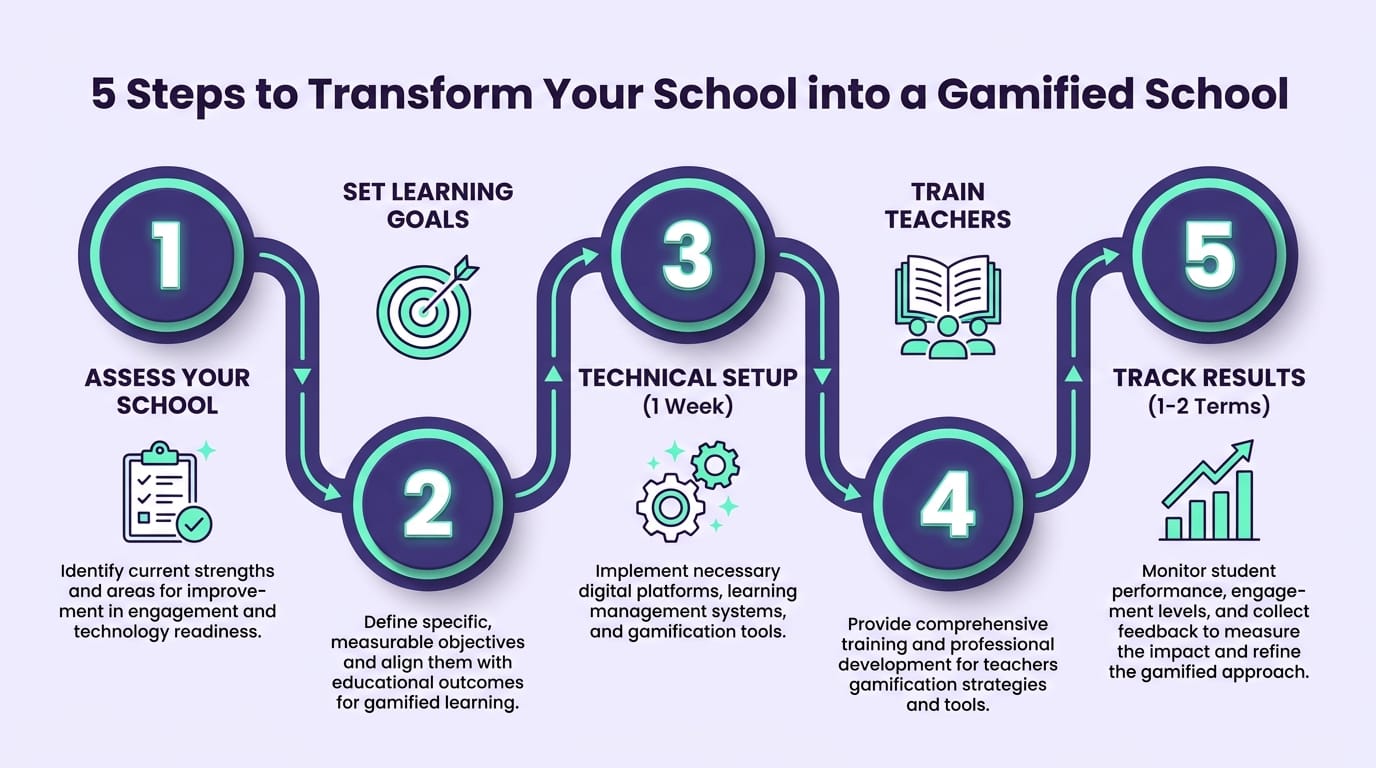
- Define the metric before you start. Without a baseline (today's assignment completion, today's dropout, today's attendance), you'll never know if it worked. Every case above with a number started by measuring. It's the step 8 out of 10 schools skip — and then can't defend the investment in the board meeting.
- Train teachers first. The failure case proves a tool without training becomes a dead spreadsheet. Set aside at least a week.
- Choose the right gamification types for the age group. Competitive leaderboards work well in middle school; collaborative quests hold at-risk-of-dropout classes together better, as we saw in the Minas Gerais case.
- Pair it with an active methodology. The flipped classroom in the Goiás case and project-based learning amplify gamification because they give students something to do between one score and the next.
- Review every term. Immediate feedback applies to the school too: look at what the metric says and adjust.
The complete step-by-step with a timeline is in our guide on how to gamify a school in 90 days.
How Gamefik helps — and what the "90%" number actually means
You've probably seen "90% engagement" on dozens of sites without knowing what was actually measured. Let me spell out ours.
Gamefik's data point that 90% of students improve engagement (2024 internal data) measures two concrete variables across a cohort of partner schools: attendance at activities and active participation (a student who answers, submits, or proposes something each week). It's a before-and-after comparison in the same class, over at least one term. It's not login frequency, it's not "thought it was cool" — it's observable behavior in learning. I want to be explicit about this because the market has cheapened the number, and a serious administrator deserves to know exactly what they're buying.
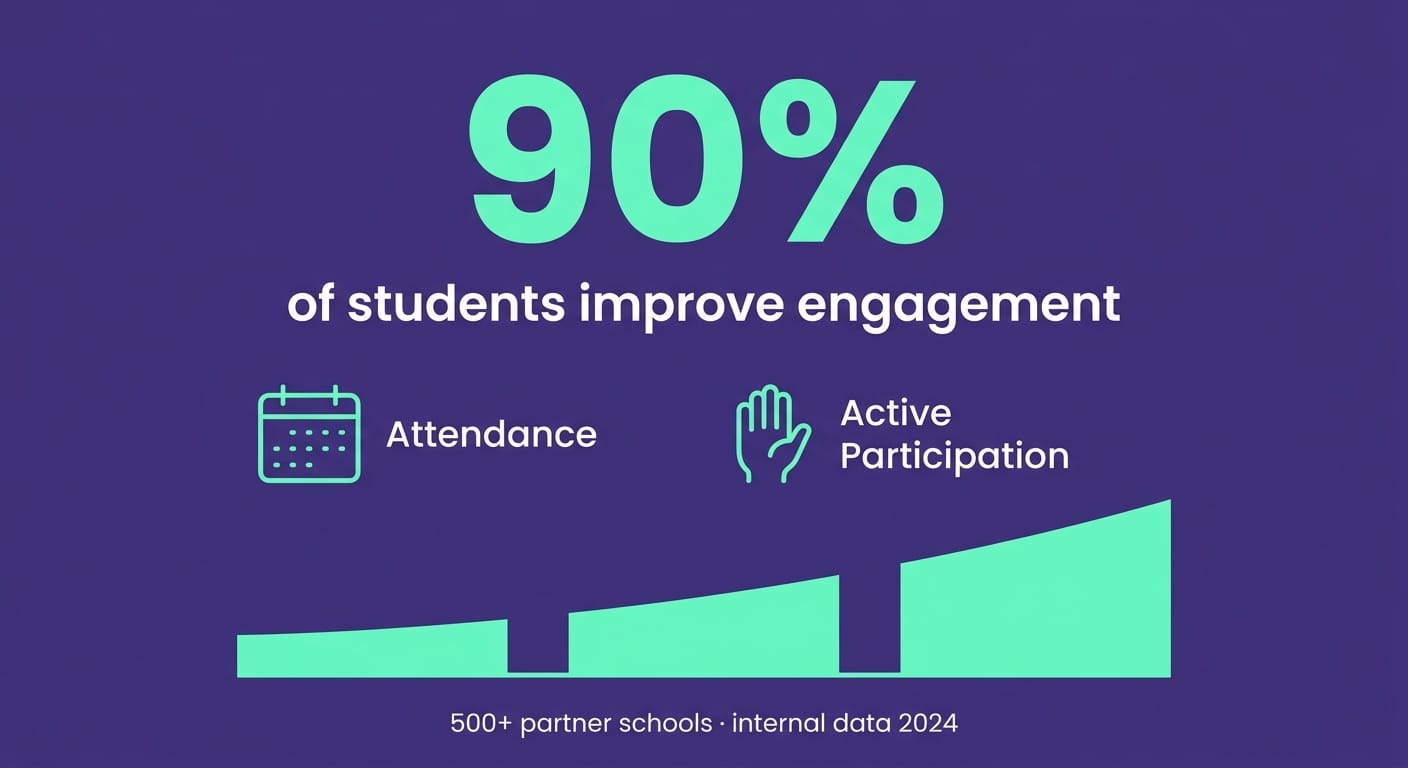
This result comes from more than 500 partner schools and more than 100,000 students tracked through 2025, with a method refined over more than 10 years. Technical implementation takes about a week, and automated grading gives teachers back around 2 hours a week — the same 2 hours that, in the Recife case, were redirected to one-on-one student support. That's the gain that most convinces the teachers' lounge: it's not more work, it's the same work with less manual grading.
If you want to understand the pedagogical foundation behind this, it's worth reading our page on gamification in education and how we use artificial intelligence for teachers to sustain student engagement without overloading staff.
FAQ
What is a gamified school? It's an institution that applies game logic — points, quests, levels, narrative — integrated into the curriculum and management, not just in one isolated class. The difference is one of scale: one-off gamification happens in a single activity; a gamified school uses the system as the backbone of the entire school year.
What are the 5 types of gamification? Competitive (leaderboards), collaborative (team quests), progressive (levels and tracks), narrative (a storyline connecting activities), and reward-based (points and badges). The cases in this article almost always combine two or three of these types.
What are the 4 pillars of gamification? A clear goal, transparent rules, immediate feedback, and meaningful reward. The failure case in this article failed precisely because it lacked immediate feedback — nobody updated the system.
See the method in practice
You've seen cases with names, years, and numbers — and one that didn't work. If you want to apply this at your school with an implementation of about a week and before-and-after metrics defined from day one, talk to Gamefik at gamefik.com. We start by defining what to measure for your reality, not by selling a promise.