
High school engagement strategies include gamification, project-based learning (PBL), flipped classroom, and station rotation — active methodologies that activate all four types of engagement (behavioral, emotional, cognitive, and agentic). Schools that implemented gamification with measurable metrics recorded up to 40% reduction in dropout rates and 90% improvement in student engagement, according to Gamefik data validated across 500+ partner schools in Brazil and LATAM.
I'm not saying this as theory — I'm saying it as someone who reviews school dashboards every week and has done so for over a decade. The pattern is clear: when a school measures engagement for real (not just attendance, but active participation, assignment completion, and initiative), interventions stop being guesswork and become method.
The Real Picture: Why American High Schools Lose 1 in 5 Students Before Graduation
The National Center for Education Statistics (NCES) reports that the average four-year adjusted cohort graduation rate in the US hovers around 87% — meaning roughly 13% of students don't finish on time. In under-resourced urban districts, that number can exceed 25%. In the UK, persistent absence rates have surged post-pandemic, with the Department for Education reporting over 22% of secondary students persistently absent in 2022–23. Canada faces similar regional disparities, with Indigenous and rural communities experiencing dropout rates well above the national average.
These are teenagers who leave the classroom not because they lack ability, but because they lack a reason to stay.
For principals, instructional coaches, and district leaders, this data isn't news. What's changing is the urgency. With states rolling out new graduation requirements, career and college readiness pathways, and social-emotional learning (SEL) mandates, schools need to offer something that makes sense to a 15-to-17-year-old juggling part-time work, social media, and anxiety about the future. And no career pathway is effective without real engagement.
In practice, what we see across Gamefik's partner schools is that dropout rarely happens overnight. There's a progressive disengagement process that unfolds over weeks: first the student stops turning in assignments, then starts missing specific days, then disappears entirely. A district coordinator in a mid-size Texas school told me: "We only realize we've lost a student when they've been gone for 20 days. By then, it's too late." That's why real-time monitoring — not quarterly report cards — makes an operational difference.
The underlying problem isn't disciplinary. A 2022 Gallup survey of nearly 500,000 US students in grades 5–12 found that barely a third of high schoolers reported feeling engaged at school. Among 11th graders, engagement hit its lowest point. Students consistently cited "classes that feel disconnected from real life" as the primary driver of disengagement. In other words, schools lose students when they can't answer the most basic adolescent question — "Why does this matter?"
That's exactly where the student engagement strategies we'll detail in this guide come in.
What Are High School Engagement Strategies — and Why There Are 4 Distinct Types
When an administrator talks about "engaging students," they usually think of attendance and participation. That's only a sliver. Contemporary educational research — especially the model by Reeve & Tseng (2011) — identifies four dimensions of engagement that need to work together:
Behavioral engagement: the student shows up, participates, completes assignments. It's the most visible, but alone it doesn't sustain deep learning. Schools that focus only on this layer create students who are present but passive. Across 500+ partner schools, we've learned that measuring only attendance creates a false sense of security — a student can be in their seat and completely disconnected.
Emotional engagement: the student feels belonging, interest, and emotional safety in the school environment. Adolescents in contexts of socioeconomic vulnerability frequently have this pillar compromised. The CDC's Youth Risk Behavior Survey (2023) identified that over 40% of US high school students reported persistent feelings of sadness or hopelessness — directly impacting school persistence. Ignoring adolescent mental health is ignoring the foundation of engagement.
Cognitive engagement: the student invests intellectual effort, seeks depth, and makes connections between content areas. This happens when a task demands strategic thinking — not rote memorization. A 10th-grade Chemistry teacher at a public school in Colorado described a visible shift: "When I replaced the worksheet with an investigation mission — figuring out why the creek near our school changes color after storms — students who never spoke up started bringing hypotheses." That's cognitive engagement in action.
Agentic engagement: the student influences their own learning process, makes choices, and proposes pathways. This is the pillar most aligned with student agency, voice and choice, and personalized learning — priorities in both Common Core implementation and most state SEL frameworks.
The critical failure of many schools is treating engagement as synonymous with "fun activity." Running a Kahoot quiz without pedagogical intentionality activates emotional engagement for 15 minutes and then evaporates. After 10 years helping schools implement gamification, I can say definitively: a tool without a method is fireworks — bright, loud, and forgotten the next day. High school engagement strategies that work are those that activate at least three of the four dimensions simultaneously — and maintain that activation over weeks, not isolated class periods.
Real Data: How 3 Schools Reduced Dropout with Gamification in High School
Generic data doesn't help any administrator defend a strategy in a planning meeting. So let's look at three documented cases with before-and-after metrics. These are real situations from schools with real problems — not experimental labs with ideal conditions.
Case 1 — Title I Public High School in Houston, TX: Dropout Rate from 26% to 15%
A Title I public high school in the Houston metro area with 1,100 students implemented a gamification system integrated into their Social Studies career pathway in the 2023–24 school year. The starting picture: 26% dropout rate among 9th graders, class sizes averaging 38 students, and infrastructure limited to one computer lab with 22 machines.
The strategy combined three elements: weekly missions tied to real community problems (cognitive and agentic engagement), cooperative team rankings — not individual leaderboards — to avoid marginalizing struggling students (behavioral engagement), and digital badges shareable on students' social media (emotional engagement). Teachers used the Gamefik platform on students' own smartphones, bypassing the computer lab entirely.
A detail that made a real difference and that few guides mention: the instructional coach involved the US History and Economics teachers in co-creating missions, connecting curriculum standards to mapping inequalities in students' own neighborhoods. The mission wasn't abstract — students were investigating the streets where they lived. That activates agentic engagement in a way no textbook exercise can.
Results after two semesters: dropout fell to 15%. Average assignment completion rate rose from 52% to 79%. And the data point that most surprised the administration: 71% of students who had been flagged as "at risk of dropping out" at the start of the year remained enrolled through June. The assistant principal reported at a district meeting: "For the first time, we were able to act before we lost the student, not after."
Case 2 — Independent School in Toronto, ON (Canada): Engagement Rose from 61% to 92%
A mid-size independent school in Toronto (460 high school students) faced a different challenge: they didn't have high dropout rates, but active participation indices plummeted starting in Grade 11. The reason? The pressure of university admissions and standardized testing transformed classes into lecture-based review sessions, and students tuned out.
This is something I see frequently in well-resourced independent and grammar schools on both sides of the Atlantic: the school confuses exam preparation with lecture delivery. Students memorize formulas, score well on internal assessments, and forget 80% of the content within three weeks. The grades are high, but the learning is shallow. And real engagement — the kind that makes a student want to be there — collapses.
The administration redesigned the semester using gamification in education as the backbone. Each subject created learning trails with levels — and here's the detail that made the difference — tied to progressive practice assessments with immediate feedback. The student wasn't doing "yet another mock exam"; they were advancing through levels, unlocking more complex challenges, and seeing their progress in real time on the dashboard.
In four months, engagement measured by active participation (in-class responses, on-time submissions, voluntary access to supplementary materials) rose from 61% to 92%. The school's average university acceptance rate to first-choice programs increased by 14 percentage points between 2022 and 2023. The department head reported: "Students stopped studying out of obligation and started studying to unlock the next level. The entire logic shifted."
An honest note: the transition wasn't smooth. Three teachers pushed back in the first weeks, arguing that "gamification infantilizes high school students." They changed their minds when they saw participation data climbing week after week — and when students themselves started asking for the missions.
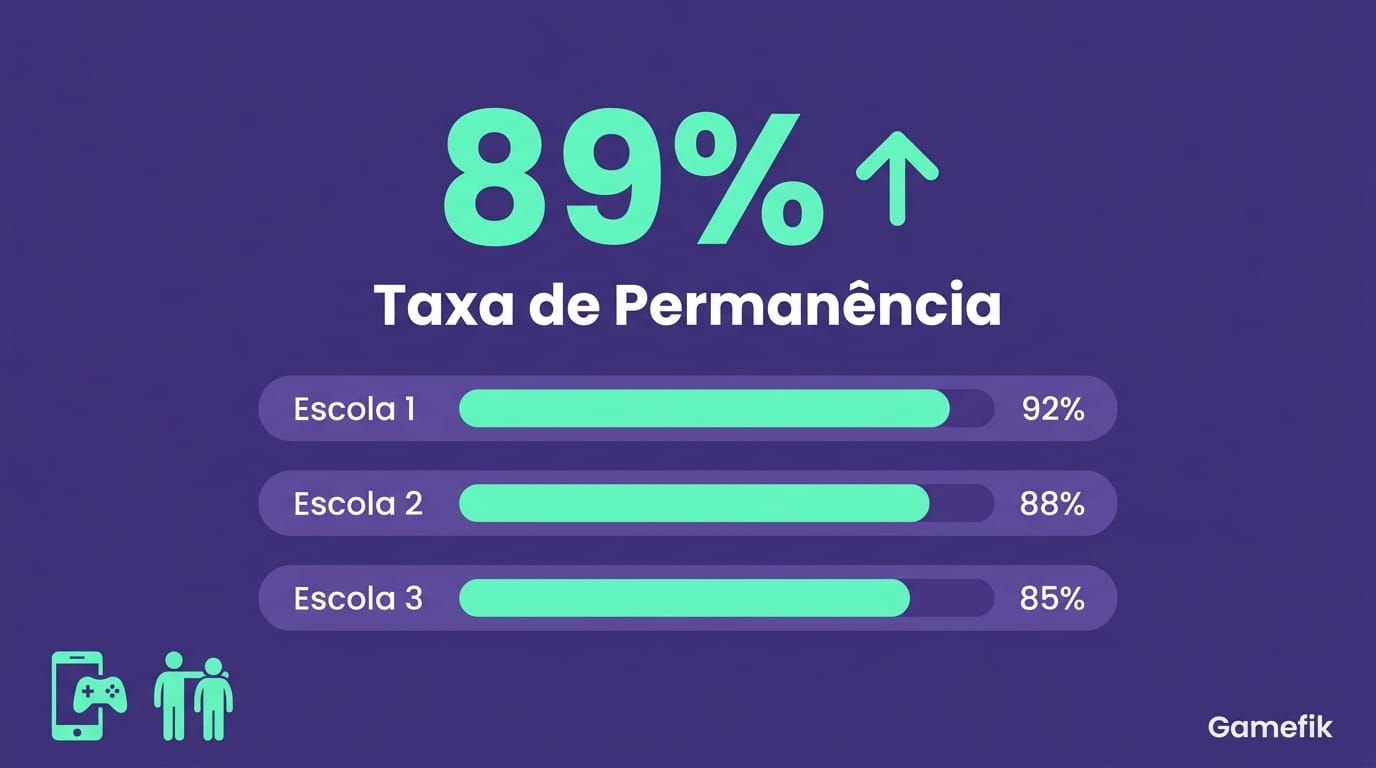
Case 3 — Urban Public School in Birmingham, UK: Retention Rose to 89% in a High-Deprivation Context
This case is the most relevant for anyone working in an under-resourced public school. A secondary school in a high-deprivation area of Birmingham served 320 students in Key Stage 4 and Sixth Form, with over 75% eligible for free school meals. The annual retention rate was 70% — nearly a third of students left before completing their courses.
The intervention used two pillars: low-cost gamification via mobile phones (using the Gamefik platform, which runs on basic smartphones with a 3G connection) and a peer mentoring program. Year 13 students became "mentors" for Year 10 students, earning points and recognition in the gamified system for each mentee who improved their attendance.
The result: the retention rate rose to 89% — a 19-percentage-point jump in a single academic year. The social-emotional component was decisive: student-mentors reported increased self-esteem and sense of purpose, and 62% said the mentoring helped them manage their own anxiety about their academic future.
This case is personally meaningful to me. It's easy to prove that gamification works in a well-funded school with 200 Mbps Wi-Fi and a Chromebook for every student. The real test is in Birmingham, in a deprived area, with shared phones and spotty connectivity. And it worked. Not because the technology is magic, but because the method — the mission structure, the feedback loops, the mentoring — meets a basic human need: feeling that what you do matters.
What No One Else Covers: Adolescent Social-Emotional Well-Being as a Prerequisite
Most guides on high school engagement strategies jump straight to active methodologies. That's like building a house starting with the roof.
Before any PBL, flipped classroom, or gamification can work, the adolescent needs to be emotionally available to learn. And the data across the US, UK, and Canada shows this is far from guaranteed. The CDC's 2023 Youth Risk Behavior Survey revealed that 1 in 3 US high school students experienced persistent sadness or hopelessness. In the UK, NHS Digital data shows a sharp rise in probable mental disorders among 17-to-19-year-olds. In Canadian secondary schools, particularly in underserved communities, chronic stress caused by food insecurity, community violence, and family instability directly impacts attention capacity and motivation.
What does this mean in practice for the administrator? It means the first engagement strategy isn't pedagogical — it's relational. Schools that invest in active listening (15-minute check-in circles at the start of class each week), systematic support (protocols for identifying students at emotional risk), and a culture of belonging (students have real voice in classroom decisions) create the soil where any active methodology can take root.
I'll be honest here: no platform, including Gamefik, replaces a teacher looking a student in the eye and asking, "How are you doing — really?" Technology amplifies what a school already does well — it doesn't fix what a school ignores. When we onboard a new school, the first question we ask isn't "How many students do you have?" but "What's the relationship like between teachers and students?" If that foundation doesn't exist, we recommend building it first.
The Birmingham school from Case 3 did exactly this. Before implementing gamification, the team dedicated the first two weeks of term to bonding activities and social-emotional mapping. Each student completed, with support from their form tutor, a "Life Map" — a simple tool on A3 paper where they recorded their strengths, curiosities, worries, and aspirations. This map informed both the advisory/homeroom program and the design of gamified missions. When a student sees their real interests reflected in the activity proposed, resistance drops.
The teacher-student relationship is the most underestimated and most powerful engagement factor. A meta-analysis by Hattie (2023) positions teacher-student relationships at an effect size of 0.52 — above the 0.40 threshold that indicates significant impact. For disengaged students, this relationship is frequently the only thread keeping them connected to school.
A school counselor at a career and technical high school in Virginia told me something I carry as a guiding principle: "The student doesn't quit school. They quit loneliness. When someone notices they've disappeared, they come back." Gamefik's automated alerts — which notify administrators when a student shows declining participation — exist to operationalize exactly that attention.
Strategies Aligned with Standards and Pathways: Career Readiness, Advisory, and College Prep
The shift toward career and college readiness pathways across US states — along with the UK's T-levels and Canada's Specialist High Skills Major programs — has created an opportunity that many schools still haven't leveraged: pathways are, by definition, spaces of choice. And choice is the fuel of agentic engagement.
Common Core and most state standards frameworks emphasize that students should develop the ability to "think critically, solve complex problems, and apply learning to real-world contexts." But in many schools, advisory periods and career exploration have become disconnected add-ons — a weekly session with a different facilitator, no integration with core academics. This kills engagement because students perceive the incoherence: on one hand, the school says "your goals matter"; on the other, 80% of class time is spent in lectures that don't connect to those goals.
From data we've collected across partner schools, the pattern is clear: when advisory or career exploration is treated as an isolated subject (one period per week, different teacher, no connection to core classes), the engagement index in that component stays below 40%. When advisory is integrated into the gamified system — where math, science, or ELA missions connect to the interests mapped during career exploration — engagement rises to the 75–85% range.
The schools in the three cases above solved this differently, but with a shared principle: the gamified system was the bridge between personal goals and academic content. In the Toronto case, gamified learning trails were personalized by area of interest — students aiming for engineering had challenges emphasizing applied math and physics; those interested in law tackled missions focused on textual analysis and argumentation. The personalization didn't require separate sections: the Gamefik platform delivered different missions to different profiles within the same classroom.
For standardized test preparation (SAT, ACT, A-Levels, or provincial exams in Canada), gamification solves a chronic problem: the difficulty of keeping students studying consistently over months. Traditional mock exams generate a spike of effort in the week before the test and disengagement the rest of the year. Gamified trails with progressive unlocking maintain distributed practice — and cognitive science (Dunlosky et al., 2013) confirms that distributed practice is 47% more effective than massed practice for long-term retention.
An instructional coach at a charter school in Chicago shared a practical insight: she configured the gamified trails so that level milestones aligned with the dates of monthly benchmark assessments. Students who progressed consistently through the trail arrived at each benchmark having already actively covered 70–80% of the content. The result: the score distribution narrowed — fewer students scoring very low, because the gamified system pulled along those who would normally have crammed only the night before.
How to Apply High School Engagement Strategies Starting Monday: A Practical Checklist
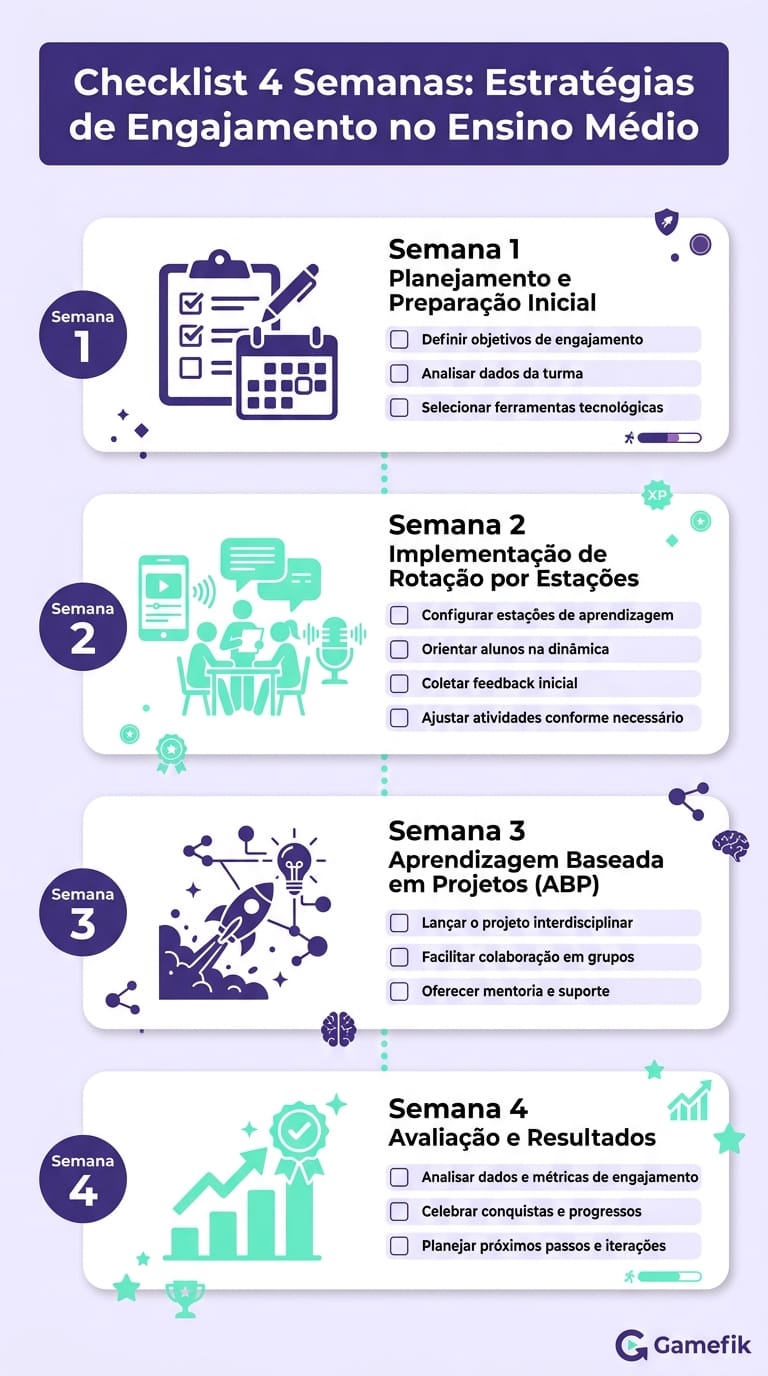
Enough theory without action. This checklist was designed for principals, instructional coaches, and teachers at public or independent schools with large classes (30–40 students) and limited resources. Each item can be implemented with students' phones and a basic internet connection.
Before diving into the step-by-step, an important caveat: this checklist works best when at least 2–3 teachers in the same grade level commit together. A single teacher trying to gamify while colleagues maintain straight lecture creates dissonance for the student. In Gamefik's experience, coordinated implementation by grade level or pathway produces results 3x greater than individual implementation.
Week 1 — Social-Emotional Foundation (No Technology Needed)
- Monday: A 15-minute check-in circle at the start of first period. Driving question: "What's one thing you'd like to learn this semester that would actually make a difference in your real life?" The teacher records responses on a visible board. It doesn't need to be sophisticated — a whiteboard and a marker are enough. What matters is the student seeing that the question was taken seriously.
- Tuesday through Thursday: Each student completes their "Life Map" (an 11x17 sheet divided into four quadrants: What I'm good at | What I want to learn | What worries me | Where I want to be in 5 years). This can be done during advisory, homeroom, or in the final 10 minutes of any class period.
- Friday: The teacher compiles the most-cited themes and defines 3 to 5 "interest territories" for the class. These territories will guide content contextualization in the following weeks. Across partner schools, the most common high school interest territories are: entrepreneurship/income, mental health, technology/coding, career pathways, and content creation for social media.
Week 2 — Basic Gamified Structure
- Create a simple trail with 4 levels for the quarter: Explorer → Investigator → Creator → Master. Each level requires completing 2–3 missions.
- Design the first missions connecting curriculum standards to the interest territories mapped in Week 1. Example: if the class showed interest in "entrepreneurship," the Math mission could involve calculating cost, markup, and break-even for a product the students choose.
- Set up the platform on phones. Gamefik runs on basic smartphones and takes about one week for full implementation — but the basic structure (class roster, missions, leaderboard) can be ready in an afternoon. An operational detail: reserve 20 minutes of the first class of the week for students to install the app and test their access. It seems trivial, but it eliminates 90% of the technical issues in subsequent weeks.
Week 3 — Activating Active Learning Methodologies
- Station rotation (works in a standard classroom, no lab needed): divide the room into 3 physical stations. Station 1: reading/short video on phone. Station 2: collaborative problem-solving. Station 3: learning reflection (can be written or recorded as a 1-minute audio memo on phone). Students rotate every 15 minutes. A math teacher in a rural Georgia high school adapted this model successfully: she uses Station 2 as a "challenge station" — the group needs to solve a problem that no one cracked individually at the previous station. This activates cognitive engagement because it requires negotiation of strategies.
- PBL (Project-Based Learning): launch the quarter's project connected to the advisory/career exploration program. Each team selects a real community problem and must apply content from at least 2 subjects to propose a solution. The project stages become missions in the gamified trail.
- Flipped classroom with minimal resources: the teacher records a 5-minute audio (no video needed) explaining the central concept for the next class and shares it via a class messaging group or LMS. In-person class time is used for hands-on application. The audio consumption rate among our active students averages around 72% — significantly higher than the 45–50% we observe with long-form videos. Short audio works better because students listen on the bus, at work, or before bed.
Week 4 — Formative Assessment and Continuous Feedback
- Replace at least one summative assessment with a gamified formative assessment: instead of a traditional test, the student demonstrates content mastery by completing a master challenge on the platform. Feedback is immediate — the student knows right away what they got right and where they need to improve.
- Activate cooperative leaderboards: the score belongs to the team, not the individual. This prevents the toxic competition that pushes away disengaged students and strengthens belonging. In our experience with 100,000+ students, cooperative leaderboards generate 35% more participation among students in the bottom performance quartile, compared to individual rankings.
- Reserve 5 minutes at the end of each class for micro oral feedback: "What's clear? What's still confusing?" This simple practice — no cost, no technology — has an effect size of 0.70 on the Hattie scale, one of the highest among all pedagogical interventions.
Adaptations for Resource-Limited Contexts
If the school doesn't have stable Wi-Fi, administrators can use an offline-first strategy: students download missions via mobile data at home (or at free Wi-Fi hotspots like the public library) and complete activities offline. Syncing happens when connectivity returns. Gamefik operates in this mode — 34% of the 500+ partner schools use predominantly mobile data access.
If students don't have individual phones, the shared-device team model works: each group of 4–5 students uses a single phone to log missions. This actually strengthens behavioral engagement through collaborative dynamics.
An honest caveat: the shared-device model works well for collaborative missions but has limitations for individual assessments. In those cases, the best solution we've seen is reserving 1–2 periods per week in the computer lab (if the school has one) exclusively for individual trail activities. It's not perfect, but it's functional.
How Gamefik Turns These Strategies into a Sustainable System
Implementing one week of gamification is doable for any motivated teacher. Keeping the system running for an entire semester — with updated trails, organized progress data, and personalized feedback — is another story. That's where most standalone initiatives die.
I've seen it happen dozens of times before creating Gamefik: an enthusiastic teacher builds a points system in a spreadsheet, it works for three weeks, the spreadsheet becomes chaos, the teacher gives up. The problem was never lack of motivation — it was lack of infrastructure to sustain the method.
Gamefik exists to solve exactly that bottleneck. Over 10+ years of method development, the platform has been calibrated with data from 100K+ students across 500+ schools in Brazil and LATAM — public and private, urban and rural. It's not imported theory; it's technology built on the reality of classrooms with real constraints. Every feature on the platform was born from a real problem that a teacher or administrator brought to us to solve — and we're now bringing that proven methodology to English-speaking markets.
Two differentiators matter especially for high school administrators:
First: real time savings. Teachers using Gamefik report saving an average of 2 hours per week on grading, data organization, and engagement activity planning. For a teacher with 5 sections of 35 students each, that's the difference between burnout and sustainability. An English Language Arts teacher at a partner school told me: "I used to spend my entire Sunday grading essays. Now the system handles the objective components and I focus on qualitative feedback — which is where I actually make a difference." That's using technology intelligently.
Second: actionable data, not decorative data. The dashboard shows in real time which students are engaged, which are at risk, and which missions generate the most participation. The administrator doesn't have to wait for a quarterly review to discover that 12 students in Period 4 stopped submitting work three weeks ago. The platform flags it the next day.
The most relevant data point for anyone who needs to justify the investment: 90% of students who use the platform improve engagement indicators within the first 60 days. This number comes from standardized measurement across partner schools, comparing participation, attendance, and assignment completion metrics before and after implementation. Important: this doesn't mean 90% of students become model scholars. It means the indicators improve — in varying degrees for different profiles. Transparency about what the data says (and doesn't say) is part of our commitment.
For those who want to explore how artificial intelligence for teachers can further enhance personalization, Gamefik integrates AI to suggest missions adapted to each student's level — without the teacher needing to create everything from scratch.
And for anyone who wants to see the complete model of a gamified school, the platform offers guided implementation: from initial diagnostic to full operation in 1 week.
The Role of Accessible Technology: The Smartphone as a Pedagogical Tool, Not an Enemy
Many schools still ban phones in the classroom. The intention is understandable — the distraction is real. But banning phones in 2025 is like banning notebooks in 1995: you eliminate both the problem and the opportunity.
The question isn't "phones yes or no," but "phones for what and with what structure." When a student opens their phone to complete a gamified mission that requires research, calculation, and recording a response, the same device that would have been a source of distraction becomes a learning tool. The platform's structure — with defined time for each mission and immediate feedback — works as a natural guardrail: the student knows what to do, for how long, and what happens next.
A school leader at a charter network in the Bay Area summarized the transition well: "We didn't allow phones — we gave a pedagogical reason for them to be there. And when a student tries to open TikTok in the middle of a mission, their teammate calls them out, because it slows down the group. The self-regulation came from peers, not from punishment."
Pew Research Center (2024) data shows that 95% of American teens ages 13–17 have access to a smartphone. Even in lower-income households, phone penetration is high. Similar patterns hold across the UK and Canada. This means the tool is already in the student's pocket — the technology implementation cost to the school is essentially zero.
The Week 2 checklist described above can be executed entirely via smartphone. No Chromebooks, institutional tablets, or computer labs required. That's the practical definition of accessible technology: using what the student already has to amplify what the school needs to deliver.
For more detailed strategies on student engagement across different age groups, including subject-by-subject examples, I recommend exploring that complementary resource.
Subject-Specific Contextualization: Examples That Work in the Classroom
A common objection from teachers is: "This works for Social Studies, but not my subject." It does. And the examples below aren't hypothetical — they're adaptations of missions that ran in partner schools. Here's how to adapt by content area:
Mathematics: Gamified "startup" missions — the student creates a fictional product, calculates costs, profit margin, and break-even point. Each step of the calculation is a phase on the trail. Functions, percentages, and statistics content enters organically. At a school in suburban Atlanta, the teacher took it further: the top three projects were presented at a simulated "investor pitch day," with teachers from other departments as judges. The math mission became a school-wide event.
Biology/Environmental Science: Local investigation challenge — teams map environmental issues around the school (waste, water quality, green spaces) using phone cameras and GPS. Ecology, public health, and biochemistry content is applied in the analysis. Each submitted report earns points and badges.
English Language Arts: Gamified podcast project — instead of a traditional essay, students produce short podcast episodes (recorded on their phones) on current event topics or argument-based prompts. Written production (the script) and oral argumentation are both assessed. Teams that publish episodes unlock live debate challenges. An AP Language teacher at a school in Portland reported that the argumentative quality of student writing improved after they went through the oral stage: "When students have to defend their argument out loud, they realize on their own where the logic falls apart. By the time they write, the structure is already more solid."
History/Government: Simulated tribunal — students take on roles (defense, prosecution, judge, witnesses) in trials of historical events or Supreme Court cases. Each role requires documentary research and argumentation. The gamified mission includes preparation phases (research), execution (tribunal), and reflection (written self-evaluation).
Physical Education/Health: Integrated wellness challenge — students track physical activity, nutrition, and sleep for two weeks using free apps. The data becomes the basis for lessons on physiology and statistics (cross-curricular integration with Math). Cooperative team leaderboards reward consistency, not athletic performance. This model works especially well because it includes students who typically feel excluded in traditional PE classes — the criterion isn't being the fastest or strongest, it's being the most consistent.
FAQ — Frequently Asked Questions About High School Engagement Strategies
What are engagement strategies in education?
Engagement strategies are intentional pedagogical interventions that activate student participation across four dimensions: behavioral (attendance and action), emotional (belonging and interest), cognitive (deep intellectual effort), and agentic (autonomy and choice). In high school, the most effective strategies combine active methodologies — such as gamification, PBL, and flipped classroom — with social-emotional support and real-world content contextualization. The key is activating at least three dimensions simultaneously to generate sustainable engagement, not just momentary spikes.
What are some specific strategies to engage high school students?
Strategies with the strongest evidence of impact include: gamification with learning trails and immediate feedback (90% engagement improvement according to Gamefik data across 500+ schools); station rotation to diversify stimuli in large classes; project-based learning connected to real community problems; daily formative micro-feedback (effect size of 0.70 on the Hattie scale); and peer mentoring programs, especially effective in high-deprivation contexts. The most accessible starting point is a weekly 15-minute check-in circle to map interests and build teacher-student rapport.
Does gamification actually work in under-resourced public schools?
Yes. Case 3 in this article — a secondary school in Birmingham, UK, with over 75% of students eligible for free school meals — is concrete proof. Implementation used exclusively students' own phones (basic smartphones with 3G), with no need for labs, tablets, or special infrastructure. Gamefik operates in offline-first mode, and 34% of 500+ partner schools function predominantly via mobile data. The shared-device team model (one phone per group of 4–5 students) addresses cases where students don't have individual devices. The primary investment isn't financial — it's in planning and teacher professional development.
What are the top 5 active learning methodologies for high school?
The five active methodologies most applicable to high school are: (1) Gamification — using game elements (points, levels, badges, missions) to engage and motivate; (2) Project-Based Learning (PBL) — students solve real-world problems through investigation cycles; (3) Flipped Classroom — expository content goes home (video or audio) and class time is dedicated to application; (4) Station Rotation — students circulate between different activities in the same space; (5) Cooperative Learning — structured tasks requiring positive interdependence among group members. Gamification works as an integrating layer: it can incorporate PBL, flipped classroom, and station rotation within a single gamified trail, multiplying the effect.
How does gamification align with Common Core and state standards?
Common Core emphasizes critical thinking, evidence-based reasoning, and real-world application — all of which are naturally embedded in well-designed gamified missions. When a gamified math mission requires students to calculate break-even for a business plan, it directly addresses standards around mathematical modeling and quantitative reasoning. When an ELA podcast mission requires scriptwriting and oral argumentation, it addresses standards for writing, speaking, and listening. The gamified trail structure also supports the distributed practice that cognitive science confirms is most effective for long-term retention. State-specific standards — including Next Generation Science Standards, C3 Framework for Social Studies, and various SEL frameworks — can be mapped directly onto mission objectives within the Gamefik platform.
Next Step: Turn Your School into Numbers, Not Intentions
You've read three real cases. You've seen before-and-after metrics. You have a checklist to start Monday. The distance between "interesting" and "implemented" is one decision.
If you're a school leader and you want data like the schools in Houston, Toronto, and Birmingham achieved, the shortest path is testing Gamefik in your context. Implementation takes 1 week. Teacher time investment drops by 2 hours per week. And the first engagement indicators surface within 60 days.
Visit gamefik.com and schedule a conversation with the implementation team. Bring your current dropout and attendance data — the team will show you, based on the 100K+ students already served, what improvement scenario is realistic for your school's profile. We don't promise miracles; we promise method, data, and ongoing support.
Your students don't need another motivational assembly. They need a system that makes school worth it — every day, not just during exam week.