
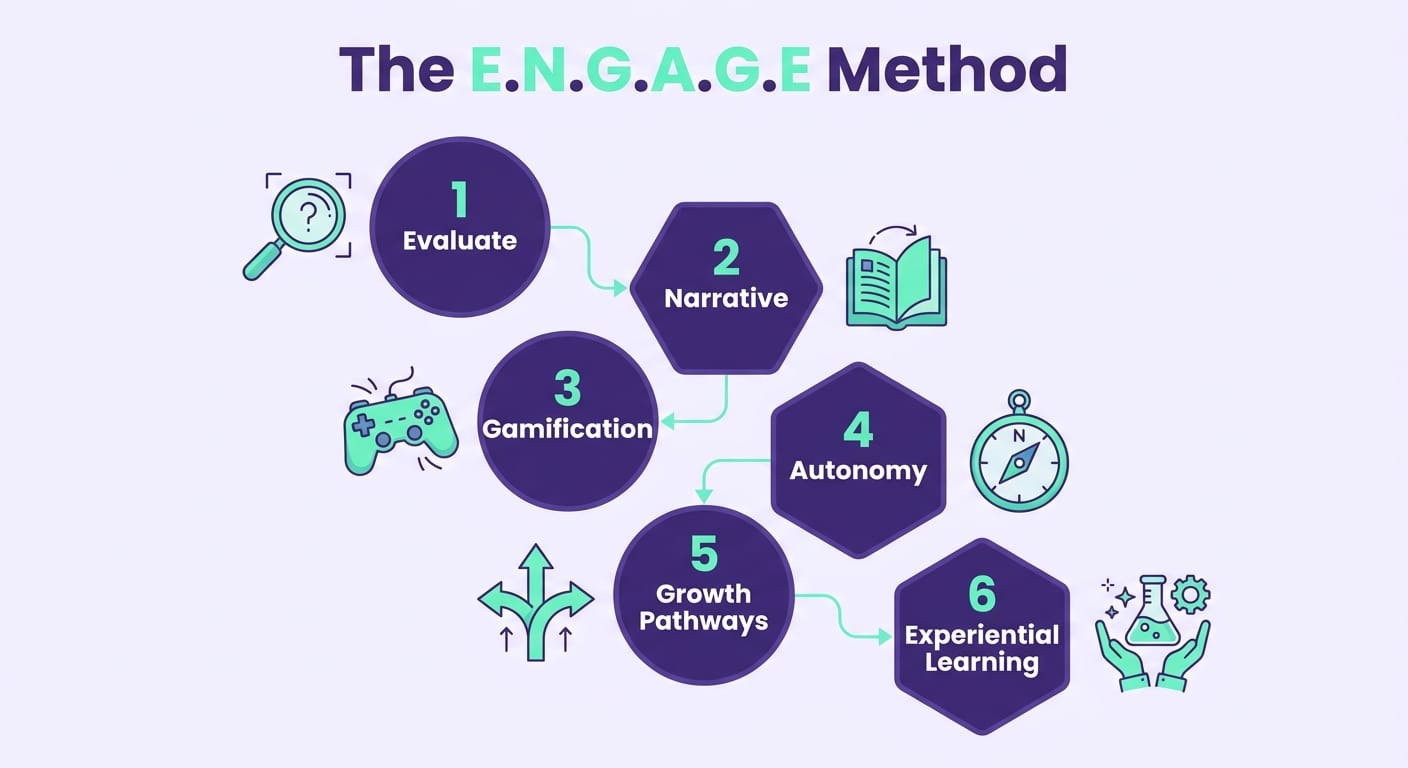
To engage students effectively, apply the E.N.G.A.G.E Method: Evaluate with diagnostics, Narrative hooks, Gamification with purpose, Autonomy for learners, Growth through personalized pathways, and Experiential active learning. This framework combines neuroscience and edtech, validated across 500+ schools in Brazil and LATAM.
You plan the lesson, organize the materials, walk in with energy — and find 30 blank faces staring at their phones. If that describes your Tuesday (or any other day), know this: the problem isn't you. The United States faces a structural student engagement crisis. According to a 2023 Gallup Student Poll, barely half of U.S. students feel engaged at school, and engagement drops sharply between 5th and 12th grade. But the good news is that engagement doesn't depend on charisma or luck. It depends on method.
I've seen this scene play out hundreds of times over more than a decade working with schools across the Americas. A 7th-grade math teacher in Houston once told me: "I have 18 years of classroom experience, and I've never felt more invisible to my students than I do right now." She wasn't an unmotivated professional — she was someone without the right tools for a new kind of problem. It was for educators like her that we developed the E.N.G.A.G.E Method.
In this guide, you'll discover 12 practical strategies that work from elementary through high school and the E.N.G.A.G.E Method — a 6-step framework that combines neuroscience, gamification in education, and active pedagogy. Before we detail each one, here's a quick preview of three strategies you can use right away:
- Short attention cycles (Strategy #3): Break 50-minute blocks into 12–15-minute modules with a change of stimulus — neuroscience shows that sustained attention in adolescents drops dramatically after this interval.
- Descriptive immediate feedback (Strategy #7): Replace "good job" with "your hypothesis got stronger because you brought evidence to support it" — this activates the prefrontal cortex and strengthens metacognition.
- Gamification with purpose (Strategy #5): Points and achievement systems work when connected to real learning objectives, not as empty rewards. Platforms like Gamefik automate this with dashboards that save teachers roughly 2 hours per week.
Let's get into the full guide.
Why student engagement has become the biggest challenge in American schools
Disengagement isn't laziness. It's a symptom. When a student checks out, they're signaling that something in the equation — content, method, environment, perceived relevance — isn't working for them. And the numbers confirm the scale of the problem: the National Center for Education Statistics (NCES) reports that chronic absenteeism affected over 14 million U.S. students in the 2021–22 school year, while high school dropout rates in underserved districts remain stubbornly high.
In practice, those aggregate numbers hide very real stories. At a Title I high school in rural Mississippi that I visited in 2023, the assistant principal showed me attendance records for a 10th-grade class: out of 32 enrolled students, 11 had stopped attending regularly by October. This wasn't quiet disengagement — it was hemorrhaging. And the pattern repeated across neighboring classrooms. Engagement hadn't dropped there: it had never been built.
The picture worsened after the pandemic. The generation that lived through nearly two years of improvised remote learning returned to classrooms with cumulative learning loss, weakened social-emotional skills, and a dramatically lower tolerance for boredom. According to the World Bank's "Learning Loss" report (2022), students globally lost the equivalent of 0.7 school years in reading proficiency during the pandemic — and U.S. students were not spared, with NAEP scores in reading and math dropping to levels not seen in decades. Meanwhile, many teachers remain locked in a 50-minute continuous lecture format — a structure that neuroscience has already shown to be ineffective for long-term retention.
After supporting engagement strategy implementation in 500+ schools, one thing has become crystal clear to me: the teacher who still asks "how do I force students to pay attention?" is asking the wrong question. The right question is: how do I design learning experiences that make disengagement harder than engagement? That's what a structured framework solves — and that's what separates a school that reacts from a school that prevents.
What student engagement really means — the 4 dimensions
When we talk about student engagement, most teachers think of visible participation: raising hands, answering questions, turning in assignments. That's only one of four dimensions. The education research literature (Fredricks, Blumenfeld & Paris, 2004) describes four elements that need to operate together:
Behavioral engagement is the most observable: attendance, participation in activities, meeting deadlines. Important, but insufficient on its own — a student can be present and completely absent. A principal at a charter school in Atlanta shared with our team that their attendance rates were 95%, but only 28% of students completed extension activities. Physical presence without real investment is a vanity metric. Emotional engagement involves a sense of belonging, connection with peers and teachers, and enjoyment of the school experience. It's what makes a student want to be there, not just need to.
Cognitive engagement measures intellectual investment: does the student seek deep understanding, or just memorize for the test? Do they use self-regulation strategies? Connect concepts across subjects? And the most neglected dimension in many American schools is agentic engagement — the student's capacity to influence their own learning, make choices, propose pathways, and question the process. When you give a student even two options for a project topic, you're already activating this dimension.
In Gamefik's internal data across 500+ schools, we've observed a revealing pattern: schools that measure only behavioral engagement (attendance and task completion) tend to overestimate their students' well-being by 40–60%. When we add cognitive engagement indicators — such as depth of responses in open-ended activities — the real picture emerges, and it's often far less optimistic.
Measuring all four dimensions requires distinct indicators. Task completion rate captures the behavioral. Quick pulse surveys (educational NPS) capture the emotional. Depth of responses in open-ended activities reveals the cognitive. And the frequency with which students ask questions or propose alternatives signals the agentic. Without measuring all four, you're looking at only a slice of the problem.
What neuroscience says about attention, dopamine, and real engagement
You can't talk about how to engage students without understanding what happens in the brain during a lesson. Three neurological mechanisms drive engagement:
Sustained attention cycles. The prefrontal cortex — responsible for voluntary attention — has physiological limits. In adults, sustained attention lasts 15 to 20 minutes before needing a "recharge." In adolescents, this window is shorter. In elementary-age children, it runs between 8 and 12 minutes. This isn't a lack of discipline — it's biology. The practical implication is direct: long blocks of continuous lecture work against the student's brain. When I present this data in teacher professional development sessions, the most common reaction is a mix of relief and frustration — relief at understanding that students "zoning out" has a physiological basis, frustration at realizing that the 50-minute lecture format is structurally inadequate. The good news: you just need to restructure the blocks, not reinvent the entire lesson.
Dopaminergic system and reward. Dopamine isn't the "pleasure hormone," as it's often popularized. It's the neurotransmitter of anticipation. The brain releases dopamine when it detects that a reward is possible but uncertain. This is exactly what well-designed gamification systems leverage: points, unpredictable achievements, challenges with escalating difficulty. When a student doesn't know if they'll succeed — but believes they can — dopamine keeps cognitive engagement active. It's the same mechanic that makes video games irresistible. The difference? In a school gamified with purpose, the "game" is connected to a Common Core standard or state learning objective, not an empty entertainment loop.
Working memory and cognitive overload. Working memory processes 4±1 items simultaneously (Miller, 1956 — later refined by Cowan, 2001, to approximately 4 chunks). Presenting 12 new concepts on a single slide is the fastest path to disengagement. Strategies like chunking (grouping information), visual anchors, and spaced retrieval practice respect this limit and can improve retention by up to 200%, according to studies on Ebbinghaus's forgetting curve.
The message is simple: sustainable engagement respects the brain's physiology. Any strategy that ignores these three mechanisms will have a short shelf life. And it was precisely by integrating these principles into practice that we built the framework below.
The E.N.G.A.G.E Method: a 6-step framework to engage students
The E.N.G.A.G.E Method is a mnemonic acronym that organizes best practices into 6 sequential, cumulative steps. It was developed based on implementation data from Gamefik across 500+ schools, serving over 100,000 students over 10 years. Each letter represents an engagement lever:
What sets this framework apart from a generic list of "engagement tips" is that it was born in the field, not from theory. Each step was calibrated based on what worked — and what failed — in real contexts: Title I schools in rural communities, private college-prep academies, mid-size suburban districts, and urban charter networks. The sequence matters because each step creates the conditions for the next.
E — Evaluate and diagnose. Before applying any strategy, measure where you are. Use a quick 5-question survey (educational NPS) in the first week to map: "On a scale of 0 to 10, how much do you want to participate in this class?" This creates a baseline, communicates to the student that their opinion matters, and provides data to personalize your approach. A high school history teacher at a suburban school outside Chicago shared with us that upon running the diagnostic, she discovered 58% of students rated her class as "boring" — yet the class average was a B+. Without the diagnostic, she never would have realized she was dealing with behavioral engagement without emotional engagement.
N — Narrative hooks. Every lesson needs a "why" before the "what." Start with a real-world problem, a story, a surprising data point. For elementary students, it could be an adventure with a fictional character. For high schoolers, it might be an ethical dilemma or a headline from the news. The point is the same: the brain retains up to 22 times more information when it's wrapped in narrative (research from Paul Zak's neuroeconomics lab, adapted and cited in educational contexts by Stanford, 2019).
G — Gamification with purpose. Points, levels, and achievements only generate sustainable engagement when connected to real learning objectives. Don't gamify for the sake of gamifying. A gamified school defines clearly: what behavior is each mechanic reinforcing? If points reward only completion (not quality), you're incentivizing minimum effort. This is a mistake we see frequently — and one we address at Gamefik by linking scoring to qualitative criteria configurable by the teacher, not just task completion.
A — Autonomy for learners. Offer real choices. It could be the format of a deliverable (video, essay, podcast), the topic within a thematic unit, or the difficulty level of a challenge. Autonomy activates agentic engagement and reduces the perception of external control — a factor that, according to Self-Determination Theory (Deci & Ryan, 2000), is one of the three pillars of intrinsic motivation (alongside competence and relatedness). In practice, what we observe in partner schools is that offering 2–3 options is enough — not 10. Excessive choice paralyzes rather than engages, especially in elementary grades.
G — Growth through personalized pathways. Not every student is at the same point. Artificial intelligence for teachers enables adaptive learning pathways without requiring you to build 30 different lesson plans. Gamefik, for example, adjusts difficulty and challenge type based on individual performance — and provides dashboards for teachers to monitor each student in real time. A curriculum director in a mid-size district in Ohio told me that before the platform, teachers spent 3 hours a week trying to "guess" who was falling behind. With the dashboard, that identification now takes 5 minutes.
E — Experiential active learning and continuous monitoring. The final step closes the loop: the student does, not just listens. Flipped classrooms, station rotation, PBL (Project-Based Learning), structured debates — any format that pulls the student out of passivity. And continuous monitoring ensures the teacher adjusts course weekly based on real data, not intuition. Here's a principle I repeat in every PD session I lead: data without action is dashboard decoration. The teacher needs to look at the data on Monday and change something on Tuesday.
12 practical strategies to engage students — from elementary through high school
Each strategy below maps to at least one step of the E.N.G.A.G.E Method and is segmented by grade level when relevant.
Strategy #1 — Engagement diagnostic in the first week (Step E)
Administer an anonymous 5-question survey on the first day of class. Ask: "What makes you want to participate in a class?" and "What makes you tune out?" Use the results to calibrate every strategy that follows. This works at any grade level — with younger children, use emojis as a scale (happy face to sad face). I've seen schools turn this diagnostic into a ritual: a private school network in the Northeast runs the survey on the first day of each quarter and compares progress over the year. In 2024, they identified that emotional engagement consistently dropped in Q3 — and began concentrating their most engaging projects in that period. Result: the Q3 NPS dip went from -18 points to -4 points.
Strategy #2 — Opening with a narrative hook (Step N)
Start every lesson with a provocation that lasts no more than 90 seconds. For elementary: "What if dinosaurs had survived?" For high school: "The TikTok algorithm knows more about you than your teacher does — let's understand why." The hook creates epistemic curiosity, and dopamine does the rest. One detail many teachers overlook: the hook must connect to the lesson content, not just be disconnected entertainment. A 10th-grade biology teacher in Phoenix shared with us that when she opened her genetics unit with "Your DNA is 8% virus material — you're part virus," the rate of spontaneous student questions tripled during that class.
Strategy #3 — 12-minute attention blocks (Neuroscience)
Divide the lesson into 12–15-minute modules with a change of stimulus between them. Direct instruction → partner activity → short video → whole-class discussion. This respects attention cycles and reduces cognitive fatigue. For elementary students, blocks should be 8 minutes. The stimulus change doesn't need to be elaborate: switching from "teacher talking" to "students discussing in pairs for 3 minutes" is enough to reset the attention cycle. In partner schools using Gamefik that adopted this structure, teachers report a 35–40% reduction in disciplinary interventions related to off-task behavior — simply because the format stopped fighting the student's biology.
Strategy #4 — Station rotation (Step E — Experiential learning)
Set up 3 to 4 stations in the classroom with distinct activities on the same topic: one for reading, one digital (tablet or Chromebook), one for hands-on building/manipulation, and one with the teacher for personalized facilitation. Students rotate every 10–15 minutes. This works especially well in middle school and can be adapted for high school with research, debate, and production stations. A Title I school in rural Georgia — with classes of 30 students and only 8 Chromebooks — adapted the rotation using students' personal phones at the digital station and poster boards at the hands-on station. Lack of 1:1 devices didn't prevent implementation. What would have prevented it was keeping the lecture-only model.
Strategy #5 — Gamification with progressive mechanics (Step G)
Implement a system of points, levels, and achievements aligned with the unit's learning objectives. The key is progression: easy challenges at the start (to build confidence), escalating difficulty (to maintain engagement), and variable rewards (to activate the dopaminergic system). The Gamefik platform automates this progression and generates reports showing the teacher where each student is on the engagement curve. An important observation based on 10 years of implementation: progression must be visible to the student. If they can't see that they've moved from level 2 to level 3, the motivational effect disappears. That's why in Gamefik, every bit of progress has a visual representation — progress bar, earned badge, leaderboard position. It's not cosmetic; it's neurochemistry.
Strategy #6 — Student choice in deliverable format (Step A — Autonomy)
Instead of always requiring a "five-paragraph essay," allow the student to choose: written paper, 3-minute video, podcast, infographic, or presentation. The competency being assessed is the same; the channel changes. This respects different learning styles and activates agentic engagement. An honest caveat: not every competency can be assessed in any format. If the objective is developing argumentative writing, a video doesn't replace the essay. The teacher needs to distinguish between skills that allow format flexibility and skills that require a specific format. Autonomy with criteria, not unrestricted autonomy.
Strategy #7 — Descriptive feedback within 24 hours (Step E — continuous monitoring)
Hattie's research (2009, Visible Learning) places feedback among the interventions with the highest effect on learning (d=0.73). But generic feedback ("nice work") has near-zero effect. Descriptive feedback ("your graph analysis became more precise because you compared two time periods") strengthens self-regulation. The 24-hour window is critical: delayed feedback loses 60–80% of its cognitive impact. In the reality of an American teacher with 5 periods of 25–30 students each, giving individual descriptive feedback within 24 hours to everyone is humanly impossible without automation. That's why Gamefik automates feedback for objective activities — freeing the teacher to invest time in qualitative feedback on the open-ended activities that truly require a human eye.
Strategy #8 — Flipped classroom with short videos (Step N + E)
Record or curate 5–8-minute videos for students to watch before class. In the classroom, use the time for application activities, discussion, and clearing up misconceptions. For schools where students lack home internet access, make videos available via USB drive or during a study hall period. A physics teacher at a private school in Denver told me that after flipping his classroom, hands-on activity time in class went from 12 to 35 minutes per period. "I stopped competing with YouTube and started using YouTube's logic to my advantage," he said. The rate of student questions in the following class doubled.
Strategy #9 — PBL (Project-Based Learning) with milestone deliverables
Long-term projects lose engagement when the student only receives feedback at final submission. Break the project into 3 to 4 milestone deliverables with feedback at each one. A "Social Entrepreneurship" project in high school might include: (1) problem identification, (2) field research, (3) solution prototype, (4) final presentation. Each milestone earns points in the gamified system. The most common mistake I see in PBL is the teacher making the project too "open." Without clear milestones, half the class procrastinates until the last week and submits mediocre work. Milestone deliverables aren't bureaucracy — they're the mechanism that keeps dopamine active over weeks, not just the night before the deadline.
Strategy #10 — Classroom rituals (Step E + N)
Create predictable routines that foster belonging. It could be a "mood check" in the first 2 minutes, a weekly "lightning challenge" with a class leaderboard, or a "wins circle" on Fridays. Rituals reduce anxiety, build group identity, and give students a sense of safe structure — especially important in elementary school. In Gamefik partner schools, the most popular ritual is the "weekly leaderboard": every Monday, the top 5 students from the previous week are recognized. It's simple, takes 2 minutes, and according to school leaders we work with, generates a disproportionate effect on engagement — because peer recognition activates a sense of belonging (emotional engagement) and the desire to maintain standing (behavioral engagement) simultaneously.
Strategy #11 — Adaptive learning pathways with AI (Step G — Growth)
Platforms like Gamefik use artificial intelligence to adjust challenge difficulty based on individual student performance. Students who advance quickly receive more complex activities; those who need reinforcement are redirected to support content — without requiring the teacher to manually intervene in each case. This is especially effective in remote and hybrid learning models. A point of honesty: adaptive AI pathways work well for content with verifiable answers (math, grammar, science). For subjective competencies — argumentation, critical analysis, creative work — AI assists with curation, but it doesn't replace teacher mediation. There's no algorithm that evaluates nuance.
Strategy #12 — Spaced retrieval practice with micro-challenges (Neuroscience + G)
Ebbinghaus's forgetting curve shows that we retain less than 20% of content after 7 days without review. Daily micro-challenges of 3–5 minutes (quick quiz, open-ended question, gamified flashcard) reverse this curve. Gamefik programs these reviews automatically, freeing the teacher from creating manual reminders. Internal data from partner schools show that classes using gamified spaced retrieval practice have 47% greater content retention on quarterly assessments compared to control groups from the same school — a finding we collected in 2024 across 23 schools that agreed to participate in an internal comparative study.
Engagement by modality: in-person, remote, and hybrid compared
The 12 strategies above work across all three modalities, but with different calibrations. And that calibration isn't intuitive — it needs to be intentional.
In in-person settings, the advantage is visual contact and immediate body-language reading. Use it: circulate the room, make rotating eye contact, adjust pacing in real time. Station rotation and classroom rituals reach maximum effectiveness here. In-person also allows something no screen reproduces: the teacher noticing that a student is "present but absent" — blank stare, withdrawn posture — and intervening on the spot. That emotional micro-intervention is worth more than any push notification.
In remote learning, the biggest risk is student invisibility. Strategies that depend on autonomy (Strategies #6, #8, #11) work best with rigorous data monitoring — platform dashboards are indispensable. Short synchronous sessions (30 minutes) with asynchronous activities between them maintain engagement without generating "Zoom fatigue." In Gamefik's data, schools that adopted the model of 30-minute synchronous sessions + gamified asynchronous activities had a task completion rate 2.3 times higher than schools that maintained 50-minute synchronous classes mirroring the in-person format.
In hybrid settings, the temptation is to treat both groups (in-person and remote) as one. It doesn't work. Plan activities that complement each other: the in-person group does the hands-on activity, the remote group observes and contributes analysis via chat. Alternating roles each week creates equity and prevents the remote group from feeling like an "audience." A curriculum coordinator at an international school in Toronto shared with us that she only managed to balance the experience for both groups when she assigned explicit roles: "in-person group, you're the doers; remote group, you're the critical analysts." That simple reframing reduced the remote group's disconnection rate from 45% to 12%.
Real case: how a school district increased participation from 38% to 79%
Data without context is just marketing. So let's break down a case with granular metrics.
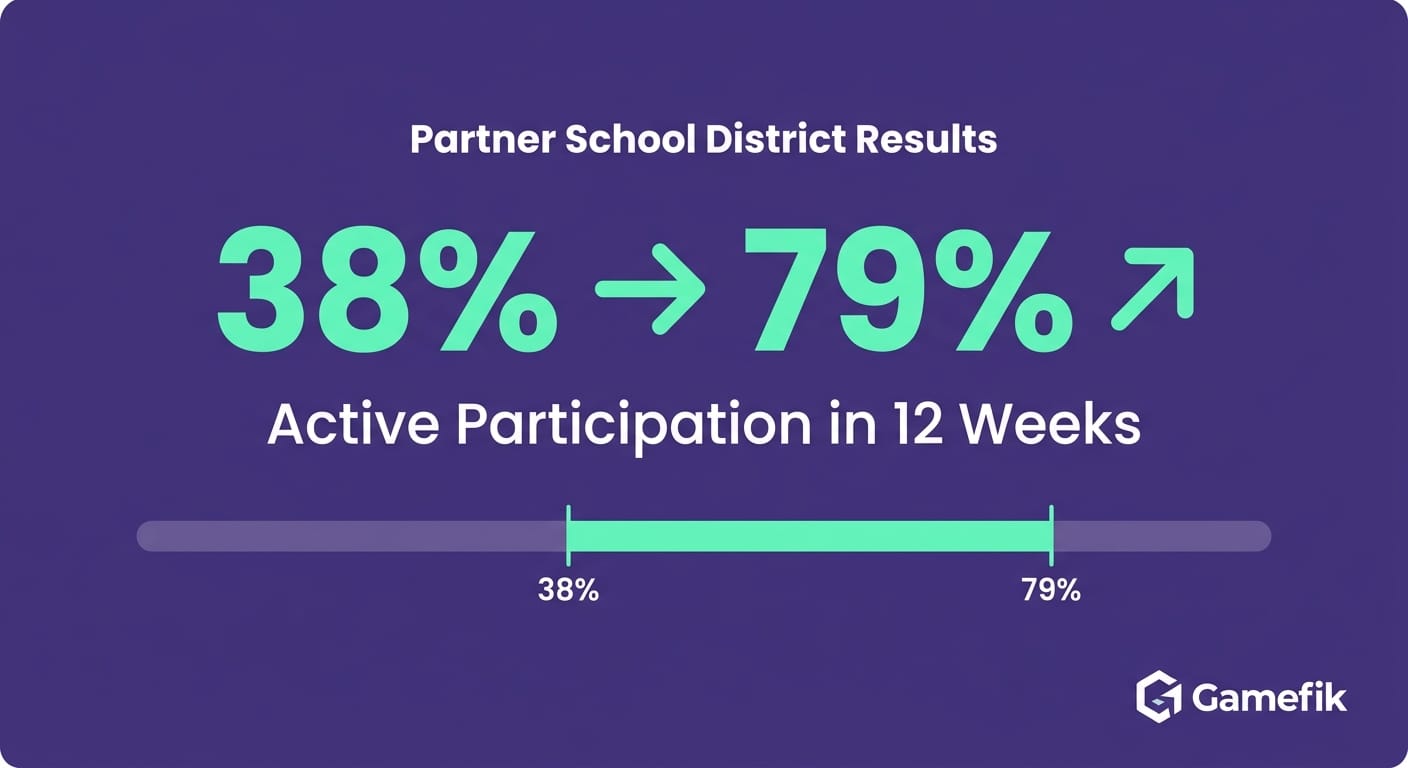
In August 2023, a municipal school district in Brazil implemented the Gamefik platform across 14 sections of 8th grade — totaling 420 students. The initial diagnostic (Step E of the E.N.G.A.G.E Method) revealed that only 38% of students were completing assigned classroom activities, and the rate of voluntary participation in discussions was below 15%.
Implementation took 1 week between platform configuration and training for the 18 teachers involved. A detail that makes a difference: the training wasn't about "how to use the software" but about "how to integrate gamification into the lesson planning you already have." When teachers see that they don't need to throw out their lesson plans — just enrich them — adoption rates climb. The core mechanics were: a gamified pathway with 4 levels per quarter, weekly challenges with a class leaderboard, and automated feedback on objective activities.
In 12 weeks, the activity completion rate rose to 79% — a 108% increase. Voluntary discussion participation went from 15% to 41%. The educational NPS (student survey) moved from 32 to 67. Teachers reported saving an average of 2 hours and 10 minutes per week on administrative tracking tasks, time they redirected toward individualized student support.
What struck me most about this case wasn't the numbers — it was something a language arts teacher said at the end of the quarter: "For the first time in 8 years, I had time to sit down with the 5 students who needed me most. Before, I was spending that time filling out spreadsheets." That sums up what intelligent engagement automation should do: give the teacher back to the role only they can fill.
The district case isn't an outlier. Aggregated data from Gamefik across 500+ partner schools shows that 90% of students improve engagement indicators within the first 90 days of use (internal Gamefik data, consolidated 2024, measured by activity completion rate and platform access frequency). But it needs to be said: results vary. Schools with engaged leadership and teachers who completed the full training see superior outcomes. The tool amplifies what the school is already willing to do — it doesn't save negligent implementations.
When the E.N.G.A.G.E Method isn't enough
No framework is a silver bullet. Ignoring limitations is editorial dishonesty — and you deserve transparency to make informed decisions. There are at least four scenarios where the E.N.G.A.G.E Method needs supplements or significant adjustments:
1. Overcrowded classrooms with zero digital devices. The method works with analog technology (poster-board leaderboards, manual point cards), but the personalization in Step G (Growth pathways) and feedback automation lose real efficiency. In classes above 35 students with no access to tablets or Chromebooks, the teacher would need support from aides or student teachers to sustain all 12 strategies simultaneously. Without that support, prioritize Strategies 1, 2, 3, 7, and 10 — which don't require technology. I've seen teachers in under-resourced schools maintain an effective points system with poster board and stickers. Does it work? It works. Does it scale? No. And scale is what separates a heroic practice from a sustainable one.
2. High teacher turnover. Schools with teacher turnover above 30–40% per year face a structural problem: each new teacher needs to be trained in the framework, and the student-teacher trust relationship (the foundation of emotional engagement) restarts with every change. In these contexts, the method works best when institutionalized by school leadership — not dependent on an individual teacher. The Gamefik platform helps because it retains student history regardless of the teacher, but the human bond isn't replaceable by software. That's a real limitation, and I'd rather state it explicitly than sell an illusion.
3. Contexts of extreme vulnerability. When a student arrives at school hungry, experiencing domestic violence, or without stable housing, pedagogical engagement is a secondary layer. The E.N.G.A.G.E Method doesn't replace public policy, free and reduced lunch programs, or psychological support services. In these scenarios, Step E (Evaluate) takes on disproportionate weight — and the teacher needs to act as a bridge to the support network, not just a learning facilitator. At a partner school in an underserved community, the school counselor explained that she needed to adapt the initial diagnostic to include questions about meals and sleep before any questions about academic engagement. "You can't gamify a lesson if the kid hasn't eaten lunch," she said. She's right.
4. Institutional resistance to using data. The method depends on diagnosis and continuous monitoring. In schools where leadership doesn't value data or where there's no culture of peer feedback, implementation stalls at the surface level. Administrator training is a prerequisite, not an add-on. In cases where Gamefik was implemented only with teachers, without active buy-in from the principal and instructional coaches, results were 50–60% below cases with full institutional support. Leadership makes a measurable difference.
Acknowledging these limits doesn't weaken the framework — it strengthens the confidence of those who decide to adopt it.
How to measure engagement with concrete metrics
You can't manage what you don't measure. Three indicators form the minimum tracking dashboard:
Active Participation Rate (APR). Percentage of students who complete at least 80% of assigned activities in a given week. Typical baseline in U.S. schools: 35–50%. Reasonable target after implementing structured gamification: 70–85% within 12 weeks. This data comes from 500+ Gamefik partner schools — it's not a theoretical benchmark; it's an average observed in the field. Schools that start from an APR below 30% typically take longer (16–20 weeks) to reach the 70% range, and that's normal. Progress matters more than speed.
Educational NPS. Single question administered every 4 weeks: "On a scale of 0 to 10, how likely would you recommend this class to a friend?" Scores of 0–6 are detractors, 7–8 passives, 9–10 promoters. An NPS above 50 indicates solid emotional engagement. Below 20, there's a structural problem that gamification mechanics alone won't solve — you need to investigate classroom climate, teacher-student relationships, and perceived content relevance.
Cognitive Depth Index (CDI). Qualitatively evaluate a sample of 5 activities per class each quarter, classifying responses as: reproduction (level 1), application (level 2), and analysis/creation (level 3). If more than 40% of responses are at level 1, cognitive engagement is low — even if the APR is high. This is the indicator most teachers overlook — and the one that reveals the most. An APR of 85% with CDI dominated by level 1 means your students are completing tasks, not learning deeply. That's checklist engagement, not cognitive engagement.
Gamefik generates automatic dashboards with APR and NPS equivalents, saving the 2 hours per week a teacher would spend compiling spreadsheets manually. The CDI, by its qualitative nature, still requires human analysis — but the platform facilitates sample selection and historical tracking.
How Gamefik turns these strategies into a system
The distance between knowing what to do and being able to do it is time. American teachers are stretched thin — many working across multiple preps, handling large class sizes, and managing increasing administrative demands. There aren't enough hours in the day to manually gamify lessons, create personalized pathways, and analyze engagement data. That's exactly the bottleneck Gamefik solves.
The platform implements the 6 steps of the E.N.G.A.G.E Method in a single interface. In practice: the teacher sets up the class in 1 week (including training), defines the learning objectives, and the platform automatically generates gamified pathways with progressive challenges, immediate feedback for objective activities, and tracking dashboards by student, class, and school.
The most relevant data point isn't about technology — it's about pedagogical impact. Over 10 years of operation, Gamefik has accumulated data from 100,000+ students across 500+ schools. The consistent pattern: 90% of students improve engagement indicators (APR + access frequency) within the first 90 days. This doesn't happen because the platform is magic. It happens because it automates what works — freeing the teacher for what technology cannot do: make eye contact, mediate conflicts, inspire.
One thing I've learned over these 10 years is that teachers don't need more content about engagement — they need less operational burden. When you remove 2 hours of weekly administrative work from a teacher's plate and return that time as hours of mediation, the impact multiplies in ways no dashboard fully captures: the student who received individualized attention on Tuesday engages more on Thursday. That doesn't show up on the graph, but it shows up in the light in their eyes.
FAQ — Frequently asked questions about how to engage students
What are the 4 types of student engagement?
The four types are: behavioral (participation in activities), emotional (sense of belonging and connection to school), cognitive (intellectual effort and deep thinking), and agentic (student initiative and voice in learning decisions). A truly engaged student activates all four simultaneously. Measuring only one — like attendance — gives an incomplete picture.
How do you engage disengaged students?
Connect content to students' real lives through relevant narratives, offer genuine choices within activities, and use immediate feedback — such as gamification in education systems — to create motivation loops. Varying formats (video, debate, project) also reduces the monotony that drives students away. The E.N.G.A.G.E Method organizes these practices into a replicable sequence.
How do you keep students interested in class?
Use short attention cycles (12–15-minute blocks with a change of stimulus), incorporate progressive challenges that respect the zone of proximal development, and make progress visible to the student. Gamification platforms like Gamefik automate this visibility with leaderboards and achievements.
What should teachers say to motivate students?
Replace generic praise ("good job") with descriptive, specific feedback ("your argument improved because you supported it with concrete data"). Recognize effort and process, not just the result. Questions like "what would you do differently?" stimulate metacognition and return ownership of learning to the student.
How do you measure student engagement with data?
Use 3 key metrics: active participation rate (% of students completing activities), educational NPS (quick satisfaction survey every 4 weeks), and cognitive depth index (quality of responses in open-ended activities). Gamefik generates automatic dashboards with these indicators.
Next step: bring the E.N.G.A.G.E Method to your school
You've read 12 strategies, a 6-step framework, neuroscience-backed insights, and a real case study with verifiable metrics. Now the decision is yours: apply them manually (it's possible, and Strategies 1, 2, 3, 7, and 10 don't require any technology) or accelerate results with a platform that's already been tested in 500+ schools.
If you want the second option, explore Gamefik. Implementation takes 1 week, training is done alongside your instructional team, and the first engagement data appears within 15 days.
Visit gamefik.com and schedule a demo →