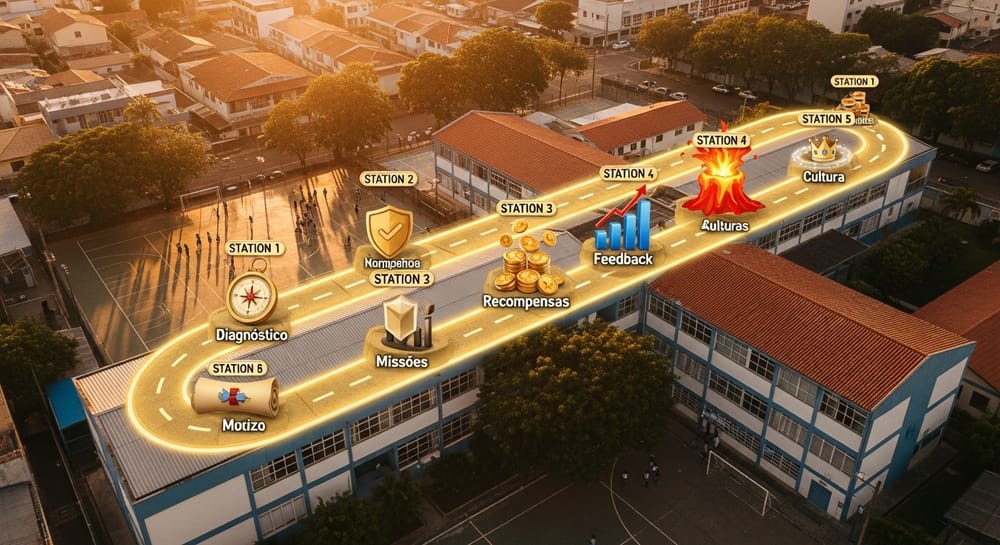
To gamify a school, administrators should follow five steps: diagnose current engagement levels, define measurable learning objectives aligned to standards, select game mechanics that support curriculum goals, train teachers effectively, and implement using a platform like Gamefik. The process takes about one week to launch and produces measurable results in 90% of cases, validated across 500+ partner schools in Brazil and LATAM.
Why Student Engagement Has Become the Biggest Challenge in School Leadership
You pull up your attendance dashboard and the numbers don't lie: chronic absenteeism is climbing, participation in extracurriculars is dropping, and teachers report growing difficulty holding students' attention. This isn't unique to your school or district. According to a 2023 Gallup survey, only about 47% of U.S. students feel engaged at school — a figure that has been declining steadily since the pandemic. In the UK, Ofsted reports similar concerns, and Canadian provinces are wrestling with the same trends. The problem is systemic — and it won't resolve on its own.
What changed in recent years is the speed at which student attention migrated to digital stimuli. Social media, mobile games, and short-form video have trained the brains of children and teenagers for rapid reward cycles. The traditional classroom — with its 50-minute lectures and static worksheets — competes at a brutal disadvantage. Principals and coordinators who ignore this reality end up blaming teachers or families, when what they really need to do is redesign the school experience itself.
This is where gamification enters as a leadership strategy — not as a trend, but as a structured response to a structural problem. Schools investing in gamification in education are already showing strong results in retention, participation, and academic performance. The real question is: how do you do this in an organized way, without relying on one heroic teacher or a pilot project that dies by the second quarter?
What Gamifying a School Actually Means in Practice
Gamifying a school does not mean turning classes into video games. That misconception still derails many implementations. School gamification means using game mechanics — such as points, quests, leaderboards, narratives, and rewards — within real instructional processes to achieve concrete educational outcomes. The game is the vehicle, never the destination.
When a coordinator or principal understands this, the entire perspective shifts. Instead of asking "which app should we buy," they start asking "which behavior do we want to encourage." Want to increase independent reading? Create reading quests with XP accumulation. Want to reduce tardiness? Build a streak system for on-time arrival. Want to foster cross-classroom collaboration? Design guilds with collective challenges. Each mechanic serves a specific pedagogical purpose — and can be aligned directly to Common Core standards, state frameworks, or district-level goals.
A gamified school operates with an integrated system where teachers, administrators, and students see progress in real time. This isn't about sticker charts or gold stars on a bulletin board — though those analog versions have their place in early elementary. This is about a digital ecosystem that connects effort to recognition in a way that's transparent, fair, and scalable. It's educational leadership meets experience design.
The difference between an amateur attempt and a professional implementation comes down to systematization. Schools that truly gamify document their mechanics, train their teams, measure results, and iterate. Schools that "try gamification" hand out random badges and give up in three weeks. As a coordinator or administrator, your job is to make sure your school lands in the first group.
The Mistake Most Schools Make When Trying to Gamify
The most common failure I see in schools attempting gamification is starting with the tool instead of starting with the problem. An administrator discovers a platform, gets excited about the features, presents it to teachers in a 30-minute staff meeting, and expects everything to work. Two weeks later, half the faculty has abandoned it. Sound familiar?
The issue is architectural, not technological. When gamification is introduced without a clear diagnosis of what needs to change, it becomes just another demand on already overwhelmed teachers. The natural reaction is resistance. And teacher resistance is the number-one factor that kills school gamification projects across North America and beyond. Not because teachers are opposed to innovation — but because nobody appreciates receiving a solution for a problem they weren't consulted about.
Another recurring mistake is gamifying only one subject or one isolated project. This creates a fragmented experience for the student, who engages in the "fun class" and returns to apathy in every other period. Effective gamification is institutional. It needs administrative backing, collective faculty buy-in, and a platform that unifies the experience across the building. Without that, you'll have islands of innovation in an ocean of tradition — and the islands sink fast.
The good news: these mistakes are completely avoidable. The step-by-step process below was built from experience accumulated across 500+ partner schools validated in Brazil and LATAM. This isn't theory. It's a tested method with over 100,000 students in diverse contexts — public schools, private academies, elementary through high school — now being adapted for K-12 districts in the United States, the United Kingdom, and Canada.
How to Gamify a School: 5 Practical Steps for Administrators
Let's get to the actionable part. This roadmap is designed for coordinators, principals, and district leaders who want to implement gamification in an organized way, with team buy-in and measurable results. Each step includes concrete actions and realistic timelines.
Step 1 — Engagement Diagnosis
Before gamifying anything, you need to know where you stand. Administer a short survey (5 questions) to teachers and another to students measuring their perception of engagement, motivation, and belonging. Use attendance data, assignment completion rates, participation in extracurriculars, and grades from the most recent grading period as your quantitative baseline. Set aside two days for this step. Without a diagnosis, you'll have no way to prove results later — and proving results is what secures continued funding and administrative support for the project.
Step 2 — Define Measurable Learning Objectives
Bring your instructional leadership team together and answer this question collectively: what do we want to change? Be specific. "Improve engagement" is too vague. "Increase assignment completion rates by 20% in 7th grade" is a gamifiable objective. "Reduce disciplinary referrals by 30% in grades 9–12" is another. Choose no more than three objectives for the first cycle. More than that disperses energy and makes measurement difficult. Align objectives to your school improvement plan and relevant standards — Common Core, state benchmarks, or provincial curriculum expectations in Canada.
Step 3 — Design Game Mechanics
Now it's time for mechanics. For each objective, define: which student action will be rewarded, with what type of reward (points, badges, access to privileges, public recognition), and at what frequency. A structure that works well across K-12: weekly quests with individual XP + monthly team challenges with group scoring + quarterly leaderboard with symbolic prizes. The combination of individual and collective rewards activates both intrinsic motivation and social belonging. Where possible, weave in a thematic narrative that connects quests across the semester — students engage more when they feel they're on a journey, not plodding through a disconnected sequence of tasks.
Step 4 — Teacher Training and Buy-In
This is the step that separates success from failure. Do not throw teachers onto a platform and hope for the best. Conduct a professional development session of at least two hours focused on three areas: why gamify (data and evidence from peer schools), how the platform works (hands-on practice), and what changes in their daily workflow (spoiler: it saves time, it doesn't add tasks). Teachers need to feel that the tool solves a problem they actually have — not that it's one more mandate from administration. Gamefik offers guided onboarding that covers exactly these points, and administrators report that teachers who complete the training adopt the system at three times the rate of those who don't. Also consider leveraging artificial intelligence for teachers as a complementary resource to automate quest creation and personalized student feedback.
Step 5 — Implementation and Iteration
Launch the system with one pilot grade level or cohort in the first week. Collect structured feedback from teachers and students after 15 days. Adjust mechanics that didn't generate adoption. Expand to the remaining grade levels the following month. The ideal cycle is: launch, measure, adjust, expand. A full implementation takes about one week for technical setup, plus two weeks of piloting. Within 30 days, you can have the system running school-wide.
The secret to this process is discipline in execution. Each step has a clear deliverable. The diagnosis delivers baseline data. Objectives deliver measurable targets. Mechanics deliver system design. Training delivers prepared teachers. Implementation delivers the live system. When you treat gamification as a leadership project — not a loose experiment — results follow.
How Gamefik Solves School Gamification with Scale and Simplicity
Gamefik was built to solve exactly the challenge described throughout this article. With over 10 years of method development, we've created a platform that allows any school — regardless of size or budget — to implement gamification professionally and measurably.
The numbers speak for themselves. More than 500 schools validated in Brazil and LATAM. Over 100,000 students benefited through the platform. Internal data from 2024 shows that 90% of students using Gamefik demonstrate significant improvement in school engagement — measured by attendance, participation, and assignment completion. This isn't a lab number. It's field data collected in real schools with diverse contexts, and the platform is now expanding to serve K-12 schools in the United States, the United Kingdom, and Canada.
For the coordinator or principal, the platform offers a management dashboard with real-time visibility into student engagement by class, grade level, and subject. You quickly identify which groups are responding well and which need mechanic adjustments. For teachers, Gamefik saves an average of 2 hours per week on tracking and feedback tasks, since the system automates scoring, leaderboards, and notifications. Instead of maintaining manual point spreadsheets, teachers focus on what actually matters: teaching.
Technical implementation takes about one week. Gamefik's onboarding team configures the platform, trains the administrative team and teachers, and supports the first weeks of use. We don't require a dedicated IT team, special infrastructure, or prior gamification experience. The process was designed to be simple because schools already have enough complexity.
The differentiator that administrators value most is the institutional approach. Gamefik doesn't gamify one lesson or one project. It gamifies the school as a system. This means students live a cohesive experience, teachers operate within a shared framework, and leadership has consolidated data for decision-making. It's gamification in education built to scale across buildings and districts.
FAQ — Frequently Asked Questions About How to Gamify a School
How long does it take to gamify an entire school?
With Gamefik, technical setup takes approximately one week. The initial pilot with one grade level or cohort runs during the following two weeks. Within 30 days, the system is running school-wide. The actual time commitment from administrators is just a few hours per week during the rollout phase.
Does gamification work for all age groups in K-12?
Yes, but the mechanics must be adapted by developmental stage. Elementary students (K-5) respond best to narratives, visual rewards, and character-based storylines. Middle school students (grades 6-8) engage strongly with leaderboards and team-based challenges. In high school (grades 9-12), mechanics tied to autonomy, real-world relevance, and individual achievement generate the strongest results. Gamefik offers templates by grade band that simplify this adaptation.
Do I need a large budget to gamify my school?
No. Effective gamification depends more on smart design than heavy financial investment. The Gamefik platform operates on an accessible subscription model, and the return in engagement, retention, and reduced absenteeism typically outpaces the investment within the first semester. Many partner schools — including Title I schools and publicly funded institutions — have implemented successfully on limited budgets with strong outcomes.
How do I get reluctant teachers on board with gamification?
The key is showing that the tool solves a real problem teachers already face — not that it's another top-down initiative. Present data on time savings (2 hours per week on average), share success stories from peer educators, and offer hands-on professional development, not just theory. Resistant teachers typically shift their perspective once they see the system actually reduces their administrative workload rather than adding to it.
How do I measure whether gamification is working?
Compare the indicators from your initial diagnosis (attendance, assignment completion, participation rates, disciplinary referrals) with the same indicators at 60 and 90 days of use. The Gamefik platform generates automatic reports with these comparisons. One simple and powerful indicator: ask students whether they feel more motivated to participate in class. Their perception validates the quantitative data and provides qualitative insights for continuous improvement.
The Next Step Is Yours
You've read this far because you know something needs to change in how your school engages students. The diagnosis is clear, the method exists, and results from 500+ schools prove that gamification works when implemented with intention and structure.
Don't wait for the next staff meeting or board review to take action. Visit gamefik.com, explore the platform, and talk with our team about how to adapt the method to your school's or district's specific reality. Implementation starts in one week. Results show up in the first month.
Your school doesn't need more theories about innovation. It needs a system that works. Gamefik is that system.