
To motivate disengaged students, first identify whether the disengagement is emotional, cognitive, or contextual — then apply the matching strategy. The D.A.R. Method (Diagnose, Act, Recognize) structures this into 3 sequential steps, preventing the most common mistake: using generic techniques without first understanding the root cause of student apathy.
You've tried everything with that student slouched in the back row. You praised them, redirected them, offered a different activity. Nothing stuck. After a decade of implementing gamification across K-12 schools and districts, one lesson keeps surfacing: the problem is almost never the strategy itself — it's that the strategy was applied before any real diagnosis. A student who disengages because they're afraid to fail needs something entirely different from a student who's bored because the content isn't challenging enough. This article organizes intervention into three clear steps so you can stop guessing and start seeing results.
Why Diagnosing the Type of Disengagement Changes Everything
There are three root causes behind most classroom apathy, and they rarely appear together with the same intensity. Across 500+ school partnerships validated in Brazil and LATAM, we found that the majority of interventions fail not because teachers aren't working hard enough, but because the root cause was misdiagnosed from the start.
Emotional disengagement stems from a fractured sense of belonging. The student feels invisible, fears making mistakes in front of peers, or lacks a genuine connection with their teacher. No instructional technique works here until that relationship is rebuilt first. At a rural K-12 school in the Midwest we partnered with, a 7th-grade student only began participating again after her teacher started asking her to help distribute materials at the opening of class — the content didn't change, but her sense of belonging did.
Cognitive disengagement is a calibration problem. The content is either too easy (boredom) or too hard (frustration). Neuroscience supports this: the brain releases dopamine — the neurotransmitter tied to motivation — only when it perceives a challenge that feels winnable. Too easy offers no reward signal; too hard shuts the system down. In practice, the same student might be completely bored in ELA and overwhelmed in math — which is exactly why the diagnosis must be subject-specific, not just student-specific.
Contextual disengagement originates outside the classroom: poor sleep, family conflict, food insecurity, or excessive screen time. It's the most frustrating type because teachers have less direct control — but adjusting your approach still matters. To be straightforward: the school alone cannot resolve every contextual factor, and relying solely on instructional strategies without involving families rarely produces lasting change.
The practical difference is enormous. If you introduce gamification with a student who is emotionally disengaged without addressing the relationship first, they'll participate out of compliance and drop off at the first real challenge. Diagnose first, always. That's why so many student engagement strategies that actually produce results only become visible when you observe students individually — not just the class as a whole.
How to Apply the D.A.R. Method in Your Classroom
The D.A.R. Method turns diagnosis into sequential action. There are three steps, executed in order — skipping one is typically why well-intentioned strategies fall flat.
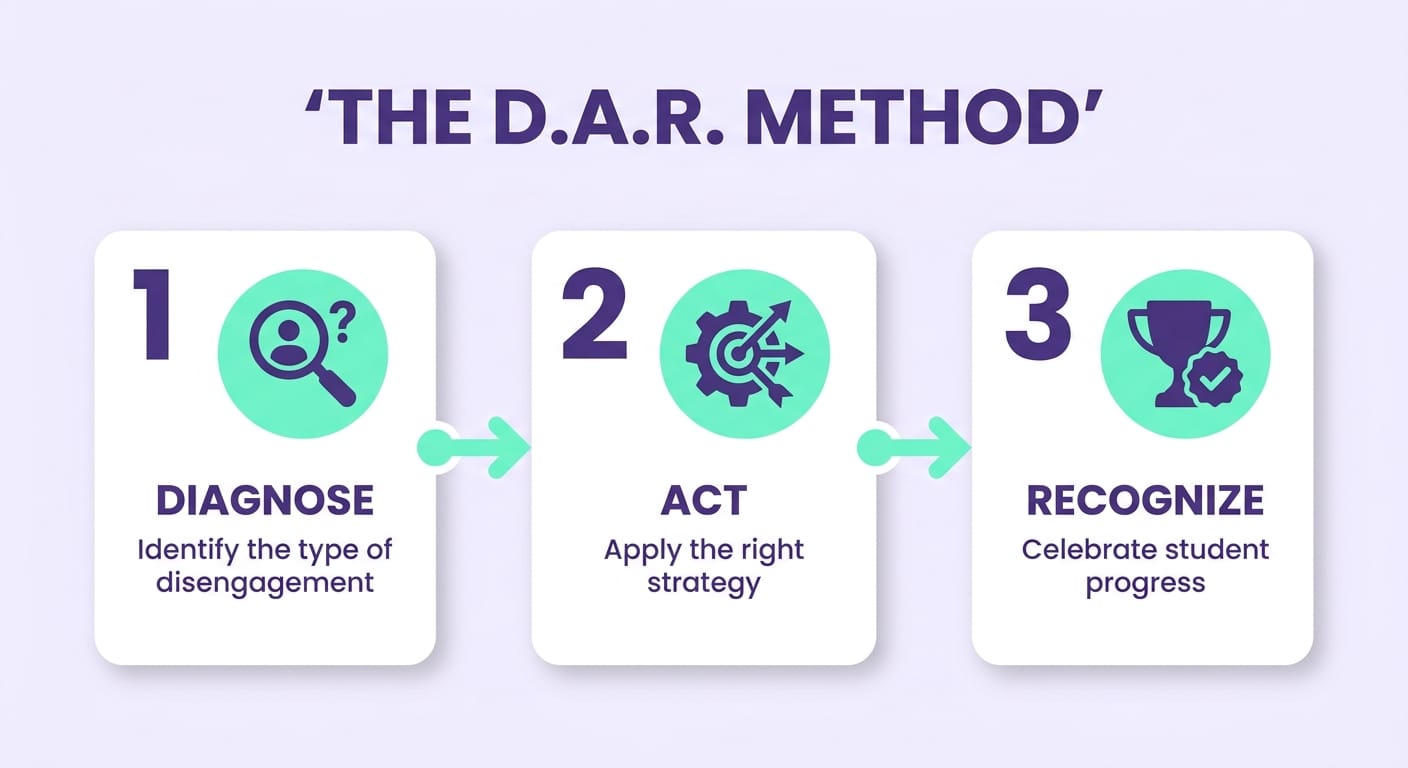
1. Diagnose (1–2 weeks of observation). Before any intervention, observe. Does the student engage when the subject changes? Do they freeze after making a mistake, or do they simply not try? Are they more distracted at certain times of day? A five-minute one-on-one conversation reveals more than a month of trial and error. Record the patterns — you'll need them to evaluate whether the strategy is actually working. A 9th-grade math teacher we spoke with discovered during this phase that the student she'd labeled "checked out" simply couldn't see the whiteboard from the back of the room. A routine diagnosis, an immediate result.
2. Act (strategy by type). After the diagnosis, choose the right response:
- For emotional disengagement: invest in connection. Call students by name, acknowledge small contributions publicly, and assign responsibilities that generate a sense of belonging. Fear of mistakes fades when the classroom becomes a psychologically safe environment.
- For cognitive disengagement: recalibrate the challenge. Break complex tasks into small, sequential wins — each completion releases dopamine and reinforces the drive to continue. Offer differentiated difficulty levels when possible, consistent with Common Core scaffolding and your state's standards frameworks.
- For contextual disengagement: adjust the format. Short activity blocks of 10–15 minutes help students who are distracted and those showing signs of ADHD. Reduce environmental distractors and bring families in early — student engagement also depends on what happens outside the school building.
3. Recognize (specific feedback). This is where the most common mistake happens. Empty praise — "great job," "I know you can do it" — loses its effect within days. Specific recognition tied to effort and decision-making — "I noticed you tried a completely different approach on that problem" — activates intrinsic motivation, the kind that doesn't depend on external rewards. That's the difference between a student who works for the grade and one who works because they genuinely want to understand.
A note on grade bands: in elementary school, recognition works best with visual, immediate feedback; in middle and high school, autonomy and personal purpose matter far more than sticker charts or point totals. A department coordinator at a district in the Chicago area told us that the points system that captivated 5th graders was being quietly ignored by 9th graders by the second semester — the shift came when high schoolers began choosing their own challenges. For a deeper breakdown by grade level, explore how gamification in education adapts across the K-12 continuum.
How Gamefik Accelerates Classroom Motivation
The neuroscience of motivation — small wins, immediate feedback, a visible sense of progress — is exactly what gamification in education puts into structured, repeatable practice. Rather than depending solely on your daily energy, the system keeps the reward cycle active for every student. To be clear about the limits: gamification amplifies the Act and Recognize steps, but it does not replace diagnosis and relationship-building. Skip the D step, and no platform can compensate.
In our 2024 internal data, 90% of students in schools that adopted the Gamefik platform showed measurable improvement in engagement. These aren't controlled lab results: they reflect outcomes from 500+ school partnerships validated in Brazil and LATAM, with more than 100,000 active students.

The benefit for teachers is twofold. Beyond the engagement increase, teachers save an average of 2 hours per week through automated grading and progress tracking — time that returns to where it matters most: the Diagnose and Recognize steps of the D.A.R. Method. Implementation takes less than a week and doesn't require rebuilding your lesson plans from scratch. A gamified school doesn't replace the teacher; it gives the teacher back the time to observe each student closely.
Frequently Asked Questions
How do you motivate a disengaged student? Start by diagnosing the type of disengagement: emotional (fractured sense of belonging), cognitive (content too easy or too challenging), or contextual (external factors such as poor sleep or family stress). Only then apply the matching strategy. There is no universal motivational approach that works across every case simultaneously.
What should you say to motivate students? Replace empty praise with specific feedback tied to effort and process: "I noticed you took a completely different approach to solve that problem" is far more effective than "you can do it." Concrete recognition builds intrinsic motivation; generic phrases lose their impact within days.
How do you work with a distracted student? Structure lessons into 10–15 minute activity blocks with stimulus variety, assign tasks with a clear objective, and reduce environmental distractors. For students showing signs of ADHD, this format helps — but it does not substitute a professional evaluation. Loop in families and your school counselor or SENCO as appropriate.
Start with the Diagnosis This Week
Choose one disengaged student, observe for a few days, and classify the type of apathy before taking any action. That single step is what separates an intervention that works from advice that doesn't land. If you want to scale that process — with immediate feedback, per-student progress data, and fewer hours spent on grading — find out how Gamefik supports 500+ schools in turning apathy into real engagement.