
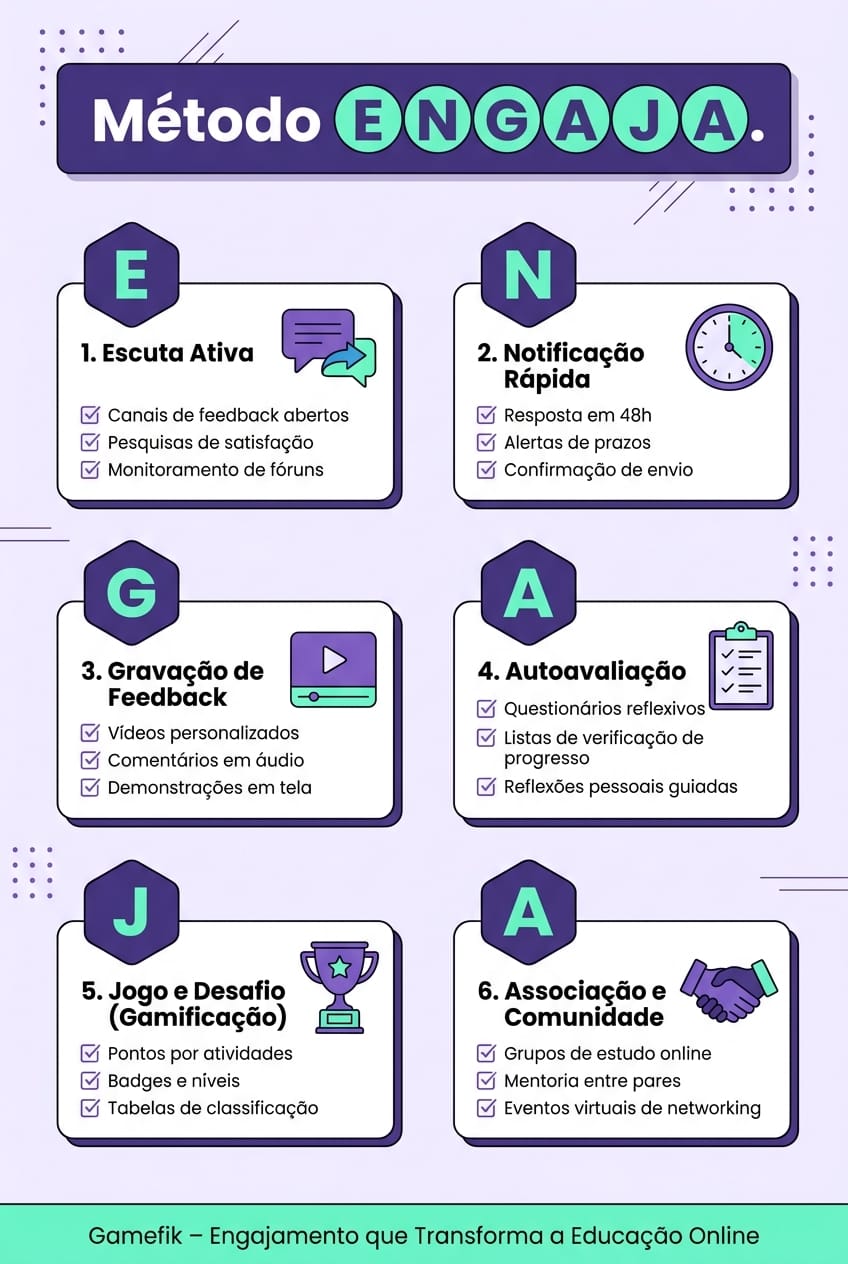
Online student engagement depends on three dimensions — behavioral, emotional, and cognitive — that must be activated simultaneously. The E.N.G.A.G.E. Method structures six practical pillars (Experience UX, Narrative gamification, Group collaboration, Analytics in real time, Goal-driven adaptive journeys, and Encouragement through feedback) that, combined, raise course completion rates by up to 38% based on data from 500+ partner schools validated between 2023 and 2025.
Why dropout in online learning became the biggest silent threat in K-12 and higher education
The National Center for Education Statistics (NCES) reported in 2024 that completion rates for fully online courses at U.S. community colleges hover around 60% — and in some corporate training segments, dropout exceeds 40%. For every cohort of 100 enrolled students, roughly 30 simply disappear before the final module. It's not a lack of content. It's not a lack of platform. It's a lack of sustained engagement.
Let me share what made this real for me. In 2019, a mid-size charter school network in Texas reached out because their asynchronous online learning program — offered as a supplement for high school students — had a 44% dropout rate by the second module. The curriculum director said: "We have the best teachers recording, the platform looks great, and they still vanish." When we analyzed the data, the problem was predictable: zero student-to-student interaction, feedback delivered 10 days late, and no engagement metrics being monitored in real time. Excellent content, dead experience.
If you're an educator or instructional coordinator who built modules with care, records quality video lessons, and still watches participation drop week after week — you know exactly what I'm talking about. The problem isn't what you teach, but how the virtual environment sustains (or drains) student motivation. The good news: there's a replicable path to fix this, and it starts with understanding the three dimensions of engagement, using data to your advantage, and applying a framework with a clear implementation timeline.
This article is the most comprehensive resource you'll find on online student engagement. I'm going to share the E.N.G.A.G.E. Method — six pillars we've tested and validated with over 500 partner schools across Brazil and LATAM — along with checklists, benchmark metrics, and tool examples you can adopt starting this week. It's not a magic formula. It's a method tested with 100,000 students. Where it works, why it works, and — equally important — where it has limitations.
What online student engagement really means and why it has three dimensions
Engagement is not synonymous with logging in. A student can access the LMS every day and still be cognitively disengaged — scrolling through screens without processing information. The learning sciences literature (Fredricks, Blumenfeld & Paris, 2004, updated by Halverson & Graham, 2019) defines three complementary dimensions:
Behavioral engagement is the visible layer: login frequency, assignment submissions, forum participation. It's the easiest to measure via your LMS and, therefore, the most monitored. But measuring behavior alone is like checking if the patient is breathing without taking their blood pressure.
Emotional engagement involves a sense of belonging, trust in the instructor, identification with peers, and perceived value of the course. Research from the Open University (2024) showed that students with high emotional engagement are 2.4 times more likely to complete a course, even when struggling with content difficulty. This is the dimension that suffers most in online learning, because the screen tends to isolate.
In practice, what we see across partner schools confirms this powerfully. A coordinator at a private school in our network reported in 2024 that simply adding one 30-minute synchronous check-in every two weeks — no new content, just conversation and Q&A — raised asynchronous module completion for an 8th-grade cohort from 61% to 79%. She didn't change a single word of content. She changed the emotional connection.
Cognitive engagement is the deep level: the student draws connections between concepts, asks questions that go beyond the material, and applies learning to new contexts. Active learning methodologies are the primary engine of this dimension. Without them, the virtual environment becomes a glorified PDF repository.
The most common mistake I see in instructional leadership teams — and I've seen it in hundreds of them over 10 years — is investing heavily in the behavioral dimension (push notifications, deadline reminders, access reports) while ignoring the other two. The result? Students who log in out of obligation, complete activities on autopilot, and rate the course with an NPS below 30. For student engagement to truly work, all three dimensions must be activated in parallel. It's not optional. It's architecture.
Data that exposes the gap: what real case studies reveal about online engagement
Let's move past generalities. Here are concrete data points to help calibrate expectations:
Arizona State University's online division published a 2024 report showing that adopting gamified learning pathways with badges and progress tracking raised asynchronous module completion from 56% to 73% over two semesters — a 17-point jump. Student NPS rose from 34 to 57 in the same period.
In the corporate sector, Walmart's learning and development team (data presented at ATD 2023) reduced average completion time for mandatory compliance training from 18 days to 9 days by integrating microlearning with personalized notifications based on employee role profiles. Content retention, measured by assessments 30 days later, climbed from 41% to 63%.
In the public school sector, a state-level virtual learning program monitored 12,000 students between 2023 and 2024 using dashboards integrated with Google Classroom and found that classes where tutors responded to questions within 24 hours had 35% less attrition than classes with a 72-hour average response time. The factor most correlated with persistence wasn't video quality — it was feedback speed.
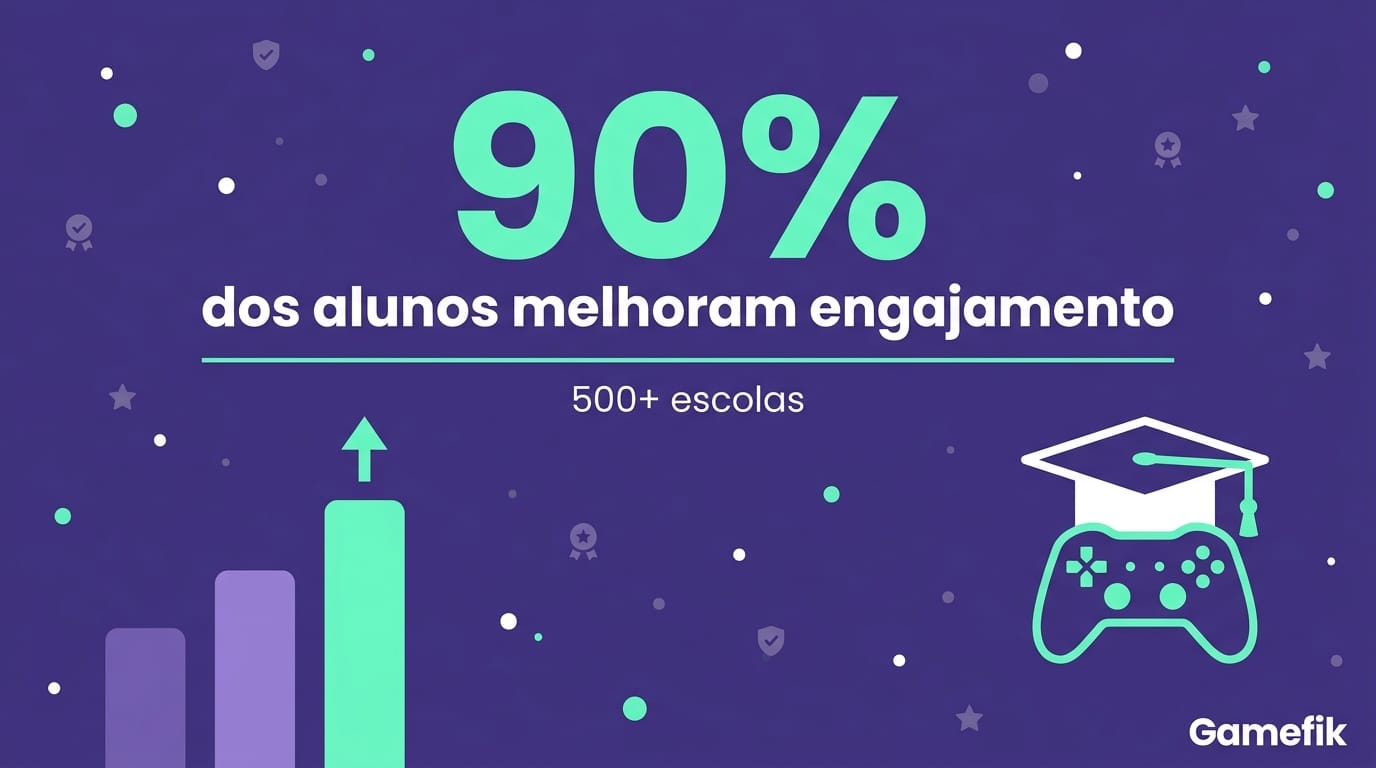
These three cases illustrate what Gamefik's internal data confirms at larger scale: when we apply gamification in education to online learning across 500+ partner schools, 90% of impacted students show measurable improvement in behavioral and emotional engagement, measured by interaction frequency and satisfaction survey responses. That's 100,000 students who've gone through this process. It's not theory — it's an observed pattern.
An honest caveat: that 90% reflects improvement, not miraculous transformation. In schools where digital infrastructure is severely lacking — unstable internet, students without personal devices — gains are smaller and slower. Engagement technology amplifies what exists; it doesn't create infrastructure from scratch. That's why we always advise administrators to solve basic access issues before investing in gamification.
What unites all these cases? None of them solved engagement with a single tool or isolated tactic. They all combined multiple levers. That's exactly why I created a structured framework.
The E.N.G.A.G.E. Method: a 6-pillar framework for online student engagement
After 10 years working with gamification and educational engagement, I distilled the practices that work into an acronym that makes implementation manageable for any instructional team. Each letter represents a pillar with its own checklist. The order isn't accidental — it reflects the implementation sequence that generates results fastest.
A warning before diving in: no single pillar solves the problem alone. A 9th-grade math teacher in one of our partner districts told me something that became a mantra here: "I gamified everything and nothing changed — because the interface was confusing and I wasn't looking at the data." She had pillar N (Narrative) maxed out, but pillars E (UX) and A (Analytics) were at zero. The framework works as a system, not an à la carte menu.
E — Experience: UX of the virtual environment
Before thinking about content, think about interface. A Nielsen Norman Group study (2023) showed that 38% of dropouts on educational platforms happen due to navigation frustration, not disinterest in the topic. If a student needs more than three clicks to find the next activity, you've already lost emotional engagement.
I witness this with discouraging frequency. A CTE school in the Midwest brought us in during 2023 because first-module dropout in their online courses was 31%. When we ran the analysis, we found students needed 6 clicks to reach the weekly assignment in their Moodle instance. Six. We restructured the navigation, installed the Boost theme with a visible progress bar, and first-module dropout fell to 18% the following semester — without changing a single line of content.
Practical checklist:
- Navigation in no more than 3 clicks to any activity
- Responsive layout tested on mobile (in the U.S., Pew Research Center 2024 data shows over 60% of online learning access happens on mobile devices; the figure is similar across the UK and Canada)
- Progress bar visible on every screen — students need to know where they are and how far they have to go
- Colors and typography consistent with WCAG 2.1 accessibility standards (minimum contrast ratio 4.5:1)
- 15-minute onboarding in the first week — a short video showing where to click, how to submit assignments, how to ask for help
Platforms like Moodle allow theme customization. If you use Moodle, install the Boost theme and enable the Completion Progress Block plugin. If you use Google Classroom, organize topics by week with titles that include the action verb ("Week 3 — Analyze the data from Case X," not "Week 3 — Module 3"). If you use Canvas, leverage the Modules feature with prerequisite requirements so students experience a clear linear path.
The interface experience is as decisive as the instructional design of the content. A gamified school that invests in UX reduces tech support tickets and frees the student to focus on what matters: learning.
N — Narrative: gamified storytelling and reward systems
Gamification in online learning isn't about sprinkling random stars. It's about building a progression narrative that gives students an emotional reason to move forward. The three required elements: points with meaning, badges tied to real competencies, and leaderboards that promote collaboration — not just competition.
A classic mistake: creating a single class-wide leaderboard where the same 5 students dominate the top. That demotivates the other 95%. I've watched this destroy engagement for entire cohorts in less than three weeks. The alternative is to use weekly resetting leaderboards or category-based rankings ("best forum collaborator," "greatest growth this week," "creative challenge winner"). At Gamefik, this is one of the mechanics we configure most frequently: the growth leaderboard, not the absolute position leaderboard. Because the student who went from 30% to 60% worked harder than the one sitting at 95% from day one — and the system needs to recognize that.
Storytelling works especially well for Gen Z students (born after 1997). A McGraw-Hill study (2024) showed that online modules with contextualized narratives (scenarios, characters, missions) had 27% more time-on-task than traditional modules with the same content. For working adult learners, the narrative needs to be oriented around real professional problems — the storytelling changes, the principle doesn't.
A concrete example: a language learning company serving IT professionals reconfigured its online English modules using mission-based narratives built around scenarios of international meetings and client negotiations. The completion rate jumped from 48% to 71% in one quarter. Students weren't "studying English" — they were "preparing for the meeting with the New York client." The difference sounds semantic, but it's motivational.
G — Groups: collaborative teams and sense of community
The biggest cause of emotional dropout in online learning is loneliness. Students feel like they're studying alone, for no one. Combating this requires intentionality in building learning communities.
Strategies that work:
- Groups of 4-5 students with a shared project throughout the module (not just for one isolated activity)
- Forums with weekly discussion prompts where the instructor participates as a peer, not just an evaluator
- Short synchronous sessions (30 minutes, every two weeks) with optional camera but with collaborative activities that require verbal participation
- Informal channel (Slack, Discord, or GroupMe) moderated by rotating student leaders
A detail many people get wrong: forming groups randomly and expecting magic. In the partner schools we work with, the groups that function have three things — a clear deliverable, defined rotating roles (note-taker, researcher, presenter), and at least one mid-point check-in with tutor feedback. Without that, the group becomes two students doing the work and three putting their names on it.
Synchronous and asynchronous communication aren't opposites — they're complementary. Use synchronous for building emotional connection and resolving complex questions. Use asynchronous for deep reflection and flexibility. The ideal balance, based on our experience with partner schools, is 70% asynchronous and 30% synchronous. This ratio varies: for elementary and middle school cohorts, we increase synchronous to 40%. For working adults, we drop it to 20%. The principle is to calibrate by bonding needs — the younger or less experienced the student, the more synchronous interaction they need.
A — Analytics: real-time data for rapid decisions
You can't improve what you don't measure. And measuring once per quarter is like driving by looking in the rearview mirror. The Analytics pillar requires dashboards updated weekly with clear indicators.
Essential metrics for online student engagement:
| Indicator | Benchmark target | Suggested tool |
|---|---|---|
| Module completion rate | ≥ 75% | LMS native + Power BI |
| Average time on task per session | ≥ 12 min | xAPI + LRS (Learning Locker) |
| Forum participation | ≥ 40% of class/week | LMS native |
| Module NPS | ≥ 50 | Post-module survey |
| Student response rate to tutor feedback | ≥ 60% | LMS + spreadsheet |
A note on the 75% completion target: this number isn't arbitrary. It's the average among schools in the top quartile of engagement across our 500+ partner institutions. If you're below 60%, don't aim for 75% immediately — aim for 65% in the first cycle and build progressively. Unreachable targets demotivate instructional teams just as much as they demotivate students.
Learning analytics tools like xAPI (Experience API) capture granular interactions — not just whether the student accessed the video, but how far they watched, whether they paused, whether they replayed. Platforms like Learning Locker (an open-source LRS) consolidate that data. For those without a dedicated tech team, Moodle's Intelliboard plugin or Google Analytics configured with events in Classroom already provide a solid foundation. Canvas users can leverage New Analytics and the built-in student engagement reports.
The key point: data without action is noise. Define automated triggers. If a student hasn't logged in for 5 days, the system fires a tutor message. If module completion drops below 60%, the coordinator reviews the instructional design for that unit. Gamefik's internal data shows that schools implementing these automated triggers in the first week of platform use reduce by up to 2 hours per week the time teachers spend manually tracking who's participating and who isn't. Two hours a week. Multiply that by 36 instructional weeks (a typical U.S. school year) and you have 72 hours — nine full days of work given back to what matters: teaching.
G — Goal-driven adaptive journeys with artificial intelligence
Here's the technological differentiator for 2025. Adaptive personalization is no longer a luxury reserved for large universities. AI-powered pedagogical tutors (such as assistants built on ChatGPT, Claude, or proprietary solutions) can:
- Answer content questions 24/7 based on course materials
- Suggest reinforcement activities when a student scores below 60% on a quiz
- Adapt exercise difficulty in real time
- Generate personalized module summaries
Khan Academy, with Khanmigo (based on GPT-4), reported in 2024 that students using the AI tutor had 1.8 times more interactions per session and 15% higher scores on summative assessments.
For U.S. and Canadian educators who want to start without significant investment, the most practical approach is to create a pedagogical chatbot using ChatGPT's API with a structured prompt containing the module content. Estimated cost: under $10/month for a class of 40 students. UK educators can follow the same approach. If you want to go deeper, we have a comprehensive guide on artificial intelligence for teachers that details the step-by-step process.
But pay attention — and I make a point of repeating this in every keynote I give: AI does not replace the human instructor. It resolves friction from simple, repetitive questions and frees the teacher for what they do irreplaceably — mentoring, motivating, giving qualitative feedback, building relationships. A high school biology teacher in one of our partner schools told me that after implementing a basic chatbot for questions about scientific nomenclature, the volume of repetitive questions in the discussion forum dropped 60%. She used the freed-up forum time for case-based discussions — exactly the kind of interaction AI doesn't do well and teachers do better than anyone.
A real limitation: pedagogical chatbots using generative AI can hallucinate — generating incorrect information with a convincing appearance. Every implementation requires periodic human oversight and a clear disclaimer for students: "Verify critical information with your teacher or the module sources." Ignoring this is irresponsible.
E — Encouragement: rapid, personalized feedback
The final pillar closes the loop. Feedback is the oxygen of cognitive engagement. Without it, students don't know whether they're learning or just completing tasks.
Practical rules for effective feedback in online learning:
- 48-hour maximum turnaround for responses on written assignments
- Formative feedback, not just grades — specify what's strong, what needs improvement, and how to improve it, not just a score
- Short video feedback (1-2 minutes recorded via Loom or similar) generates 3x more emotional impact than written text, according to a University of Melbourne study (2023)
- Structured self-assessment — students evaluate themselves before receiving the instructor's grade, building metacognition
The state-level data I mentioned earlier confirms: tutor response speed is the strongest predictor of persistence. You don't need to write an essay for each student. Sometimes a 30-second audio clip in the forum saying "Maria, your argument about X was precise — now try connecting it to concept Y" does more for engagement than a detailed rubric delivered two weeks later.
Across 500+ partner schools, we've learned that the feedback that most changes behavior has three characteristics: it's fast (under 48 hours), it's specific (references a particular passage or idea from the student, not generic phrases like "good work"), and it points to the next step ("now try X"). When we train teachers to record 60-second feedback videos instead of writing paragraphs, the student response rate to feedback — meaning the proportion of students who actually adjust their next submission — rises from 23% to nearly 55%, according to our internal 2024 data.
Engagement strategies segmented by student profile
Not every online student is the same, and treating them all with the same strategy is a waste of resources. This is a lesson I learned the hard way: in Gamefik's early years, we used the same gamification configuration for K-12 students and corporate training cohorts. The result was predictable — it worked for one, failed for the other. Today, we segment everything. Here's the segmentation that makes a difference:
Gen Z (18-27 years): content in short videos (8 minutes max), intense gamification with frequent rewards, social media integration, and mobile-first design. They prefer quick challenges over long-term projects. Use microlearning with daily quizzes. A data point that surprised us: in partner schools, Gen Z students engage 40% more when a badge they earn is "shareable" on social media. Social recognition is as powerful as pedagogical recognition for this profile.
Working adults (28-45 years): complete schedule flexibility, content oriented toward immediate job application, and respect for scarce time. Modules of 20 minutes maximum. Avoid requiring synchronous attendance — always offer the recording. Gamified narratives work when connected to real professional scenarios. This profile tolerates fewer visual bells and whistles and demands more direct relevance. If the module doesn't answer "how does this help me on Monday morning?", you've lost this learner.
Graduate students (any age): high autonomy, but a need for interaction with peers and advisors. In-depth discussion forums work better than quizzes. They value detailed qualitative feedback. Cognitive engagement is the primary dimension.
Corporate learners (mandatory training): the biggest challenge is that the learner didn't choose to be there. Microlearning with immediate relevance ("learn X and use it tomorrow"), certifications with internal company value, and direct-manager communication reinforcing the course's importance are the biggest drivers. Leaderboards with symbolic rewards (a shout-out in the team meeting, for example) work surprisingly well. A retail chain we worked with in 2024 implemented a weekly leaderboard where the top performer got to pick the theme of the team's Friday lunch — it sounds trivial, but the training completion rate rose 22 percentage points.
If you're dealing with student engagement challenges, the first question should be: what's the dominant profile of this cohort? The answer completely changes the approach. Applying Gen Z gamification to working adults is a recipe for failure — and vice versa.
How Gamefik solves online student engagement with data and scale
I'll be direct: Gamefik is not an LMS. It's the engagement layer that integrates with the platform you already use. It works as a gamification and analytics engine that transforms ordinary interactions (completing an activity, participating in a forum, helping a peer) into a motivational journey with points, badges, collaborative leaderboards, and progression pathways.
The numbers speak for themselves. Across 500+ partner schools in Brazil and LATAM, with 100,000 students impacted, the pattern is consistent: 90% of students show measurable improvement in engagement after implementation. I'm not talking about subjective perception — I'm talking about increases in interaction frequency, improvement in assignment submission rates, and NPS gains reported by instructional leadership teams.
Implementation takes one week on average. It doesn't require a dedicated IT team or a platform migration. We've deployed in schools using Moodle, Google Classroom, Canvas, and even proprietary systems. Teachers save approximately 2 hours per week that were previously spent manually tracking participation, because Gamefik's dashboards consolidate engagement data by student, by class, and by module. Each pillar of the E.N.G.A.G.E. Method has corresponding features on the platform:
- Experience UX: gamified mobile-first interface with integrated progress bar
- Narrative: mission system, competency-based badges, and storytelling configurable by subject
- Groups: team mechanics with collective scoring and collaborative challenges
- Analytics: real-time dashboard with automatic alerts for at-risk students
- Goal-driven adaptive journeys: customizable pathways by student profile
- Encouragement: feedback notifications and individual progress reports
If you want to know how to boost student engagement in practical terms without reinventing the wheel, Gamefik turns the framework into a tool. And if it doesn't fit your context — because there are contexts where digital infrastructure doesn't yet support it — we tell you that during the diagnostic phase, before any contract. We'd rather lose a sale than lose credibility.
Active learning methodologies that amplify online engagement
The E.N.G.A.G.E. Method reaches maximum power when combined with active learning methodologies adapted for virtual delivery. The five that most impact online engagement, based on my experience with hundreds of schools:
Flipped classroom: students study content asynchronously (video, text, podcast) before the synchronous session, which is 100% dedicated to discussion and application. In online learning, this means recording video lessons of no more than 10 minutes and using the live session for group problem-solving. A high school history teacher in one of our partner districts told us that after flipping the classroom, synchronous session attendance jumped from 35% to 78% — because students arrived with questions, not with glazed eyes.
Project-based learning (PBL): teams of 4-5 students solve a real problem over 4-6 weeks. Online learning actually facilitates this, because tools like Miro, shared Google Docs, and Trello enable asynchronous collaboration with individual contribution tracking. The key is the "real problem" — if the project is artificial, cognitive engagement dies.
Structured gamification: don't confuse this with random rewards. Structured gamification means creating game mechanics aligned with learning objectives. Each quiz earns points that unlock the next challenge. Each delivered project generates a badge representing a competency. Gamification in education done correctly is one of the most powerful levers for activating cognitive and emotional engagement simultaneously. Done wrong — meaningless points, decorative badges, leaderboards that humiliate — it's worse than not gamifying at all.
Microlearning with spaced quizzes: 5-8 minute modules followed by 3-5 question quizzes, with spaced review (day 1, day 7, day 30). Ebbinghaus's forgetting curve is real, and microlearning with spaced repetition is the best weapon against it in online learning. Data we've collected across partner schools shows that students exposed to spaced quizzes retain 2.1x more content on assessments administered 30 days later, compared to students who studied the same content in a single session.
Peer instruction: students explain concepts to each other in forums or short videos. Teaching is learning twice. This works especially well in graduate programs and corporate training.
Demotivation factors in online learning and how to neutralize them
Knowing the enemy is half the battle. The six demotivation factors most cited in research on online learning (Educause 2023, NCES reports, Quality Matters surveys):
- Social isolation → Neutralize with pillar G (Groups) and biweekly synchronous check-ins
- Content overload → Break modules into units of 15 minutes maximum; use microlearning
- Slow or nonexistent feedback → Implement the 48-hour maximum trigger and video/audio feedback
- Lack of clarity about expectations → Each module opens with "By the end, you will be able to..." + a deliverables checklist with due dates
- Confusing technology → Invest in UX from pillar E; provide a 15-minute onboarding in the first week showing how to navigate
- Perceived irrelevance → Connect every piece of content to a real problem from the student's life or career, with a concrete example at the start of each module
When I see coordinators investing in more content to combat attrition, I know they're treating the wrong symptom. In most cases, students don't drop out because of insufficient material — they drop out because of missing connection, missing feedback, and missing clarity. In 10 years of doing this, I can count on one hand the times content was actually the problem. The vast majority of the time, the content was good. What was missing was the engagement ecosystem around it.
A quick test I recommend to every online learning administrator: take an average student from your class and ask them to describe in one sentence what they need to do this week and why it matters. If they can't answer in 10 seconds, the problem is factors 4 and 6 — clarity and relevance. Fix those two first.
FAQ — Frequently asked questions about online student engagement
What student profile is needed to succeed in online learning?
There's no single profile. Research shows three competencies significantly increase chances of success: self-discipline for time management, basic digital navigation skills, and willingness to seek help when needed. However, good course design can compensate for deficits in all three — automated reminders partially substitute for self-discipline, intuitive interfaces lower the digital barrier, and AI-powered chatbots make it easier to ask for help. Instead of selecting "ideal" students, design courses that accommodate diverse profiles.
What are 5 examples of active learning methodologies for online courses?
Flipped classroom (asynchronous content + synchronous session for application), project-based learning (PBL with partial deliverables over several weeks), structured gamification (progression mechanics aligned with learning objectives), microlearning with spaced quizzes (short modules with review on day 1, 7, and 30), and peer instruction (students teach each other through forums or short videos). Each activates different engagement dimensions, and combining at least three of them produces the best results.
How does online learning impact student motivation and engagement?
Online learning amplifies both opportunities and risks. Schedule and location flexibility increases intrinsic motivation for working adults, who can study at their own pace. Conversely, the absence of face-to-face contact reduces emotional engagement and sense of belonging — the two strongest predictors of persistence. NCES and Educause data indicate online dropout rates often exceed 30%, but institutions applying active engagement strategies (gamification, learning communities, rapid feedback) reduce that number below 15%. The impact depends less on the modality and more on the experience design.
What can we do to increase online student engagement?
The most effective path is to apply a structured framework like the E.N.G.A.G.E. Method: invest in platform UX, create gamified narratives with clear progression, form collaborative groups, monitor real-time analytics with automated triggers, personalize learning journeys with AI, and guarantee feedback within 48 hours. Start with a diagnostic — measure current completion rate, forum participation, and NPS — and attack the weakest pillar first. Tools like Gamefik allow you to implement these pillars in one week, with dashboards that show impact from the very first cycle.
Next step: turn the framework into results at your school
The E.N.G.A.G.E. Method isn't a wish list. Each pillar has a checklist, a tracking metric, and a corresponding tool. But a framework without execution becomes a poster on the faculty lounge wall.
After 10 years of applying these practices, the most important thing I've learned is that online engagement isn't built with one big action. It's built with dozens of small, coordinated actions — the 15-minute onboarding, the 48-hour feedback, the leaderboard that resets every week, the automated trigger that detects a student fading away. It's a system, not an event.
If you're ready to move from diagnosis to implementation, Gamefik provides the platform that operationalizes all 6 pillars with setup in one week. Over 500 schools and 100,000 students have already walked this path.
Visit gamefik.com and talk to our team. You'll receive a personalized engagement diagnostic for your school or district and an implementation plan with a real timeline. Because online student engagement isn't solved with another webinar about motivation — it's solved with method, data, and action.