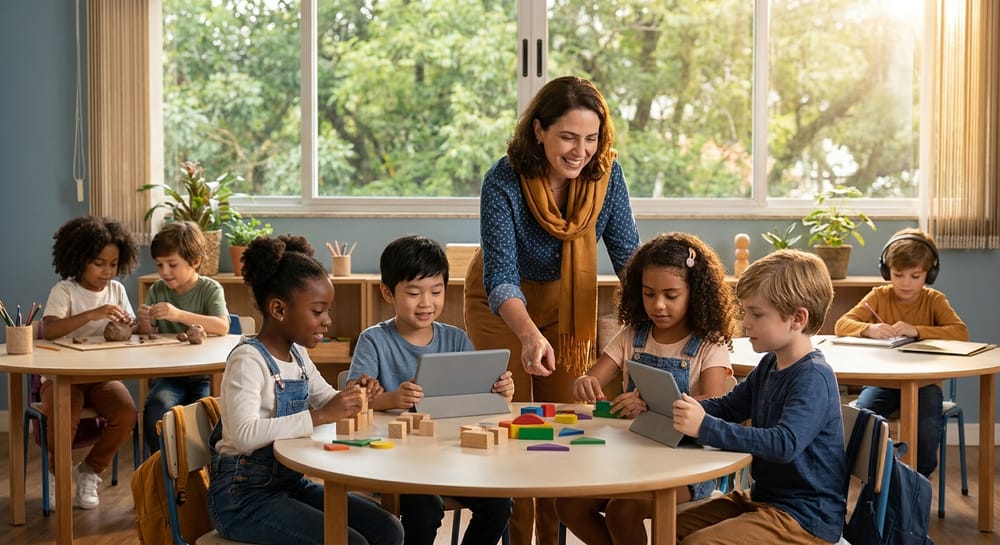
Personalized learning adapts teaching strategies, pacing, and resources to each student's profile while maintaining shared learning objectives for the class. In practice, K-12 teachers combine diagnostic assessment, flexible grouping, and varied pathways to serve diverse learners — without requiring one device per student or expensive technology.
Personalized learning is the practice of adapting strategies, pacing, and resources to each student's profile. In practice, teachers combine diagnostic assessment, flexible grouping, and technology to serve heterogeneous classrooms — something achievable even in large public school classes without a device for every student.
Have you ever ended a lesson feeling like half the class was lost while the other half had already moved on? That's the problem personalized learning solves. Not through the fantasy of a custom lesson for each of your 35 students, but through deliberate instructional choices that allow different pathways to the same learning goal. This guide is for the frontline teacher — with strategies grounded in real K-12 classrooms across the US, UK, and Canada.
After more than 10 years applying this work in K-12 schools, I've learned one thing that cuts against most of what's marketed out there: personalized learning doesn't start with technology — it starts with a planning decision. Across 500+ partner schools validated in Brazil and LATAM, the schools that made the most progress weren't the best-equipped ones. They were the ones that understood the method before purchasing any platform.
What Personalized Learning Is (and What It Isn't)
There's a lot of confusion between three terms. It's worth separating them before discussing any strategy.
Personalized learning adjusts the pathway, pace, and type of activity to each student's profile, while maintaining common learning objectives for the class. The teacher remains central as the facilitator.
Adaptive learning is a technology-driven subset: platforms that automatically adjust question difficulty based on student performance. It's a tool within personalized learning, not a synonym for it.
Individualized education goes further — each student has distinct learning objectives, common in special education or one-on-one tutoring. It's not feasible as the standard model for a general education classroom.
When someone promises an individual lesson plan for every student in a class of 40, they're selling individualized education under the label of personalization. These are different things, and that distinction shapes what you can realistically do on Monday morning. I'll be direct: I've watched schools stall entire initiatives because they promised teachers something impossible, and the frustration killed the project within the first two months. Real personalized learning is more modest in its promises and more consistent in its results.
The 5 Pillars of Personalized Education
The most widely applied models converge on five practical pillars:
- Student Profile — knowing what each student already understands, their interests, and their knowledge gaps. No software required: a 15-minute diagnostic at the start of a unit already guides your groupings.
- Flexible Pacing — allowing students who've mastered content to move forward while those who need more time receive it, without holding the entire class back or rushing students who need extra support.
- Varied Pathways — offering two or three routes to the same objective: video, reading, hands-on activity. The destination is the same; the route changes.
- Continuous Formative Assessment — replacing the single high-stakes test with short, frequent check-ins that reveal who needs what while learning is still in progress.
- Student Ownership — involving students in goal-setting and self-assessment. Students who understand where they're headed learn with greater autonomy.
None of these pillars require a computer lab. They require intentional planning. A 9th-grade math teacher at an under-resourced public school in Ohio told me that the third pillar transformed her lessons most — offering a video and a hands-on activity for the same algebra unit. Cost: nothing. What changed was releasing the expectation that 35 different learners would all learn the same way.
How to Personalize Learning in Practice — Step by Step
Personalized learning lives or dies in execution. Here's a tested roadmap for large classrooms, including underfunded public schools and districts where time and materials are limited.
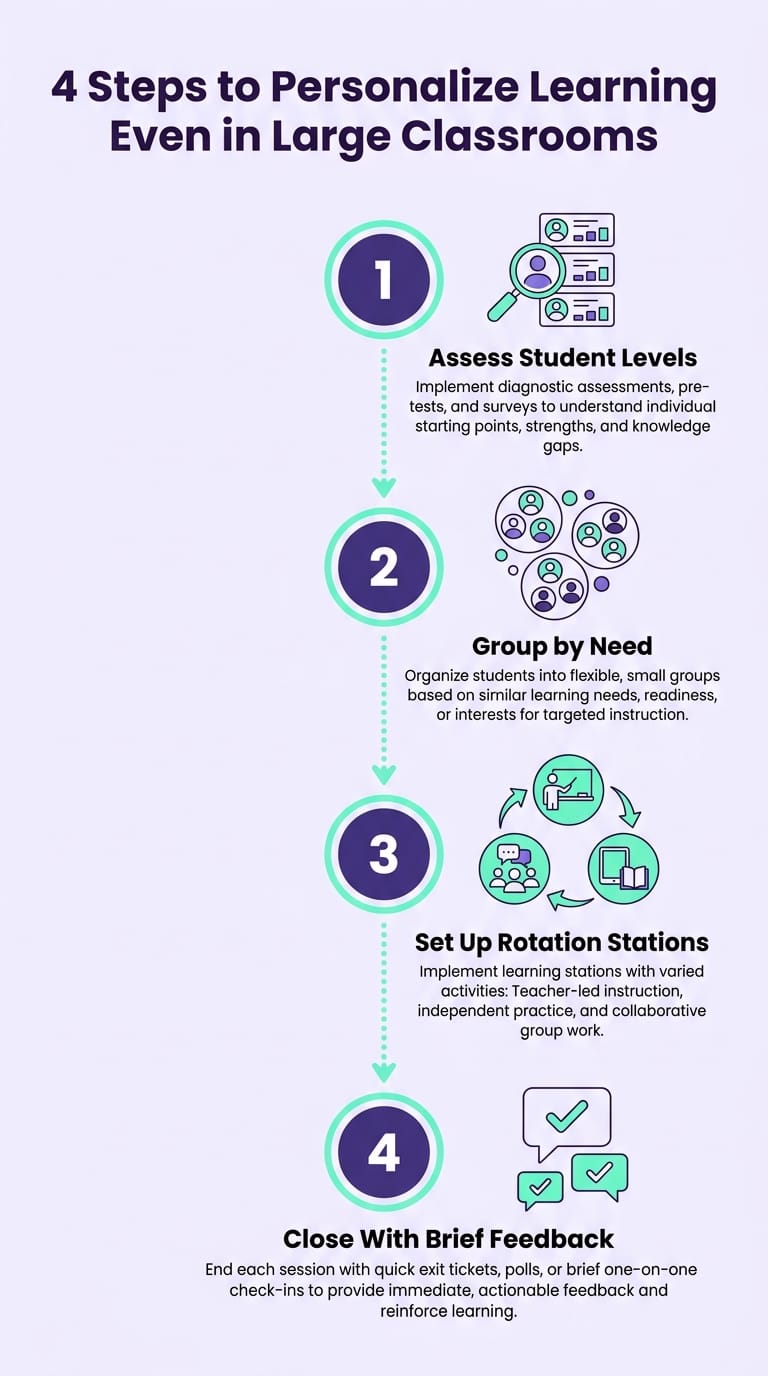
Step 1 — Diagnose before you plan. Give a quick pre-assessment (5–8 questions) covering the next unit's content. You'll typically uncover three groups: students who already have it, students who are on track, and students with prior-knowledge gaps.
Step 2 — Use flexible grouping. Form groups based on current need, not fixed "ability levels." A student can be in the advanced group for fractions and in the support group for geometry the following week. This prevents the stigmatization that concerns administrators and supports a growth-mindset culture aligned with Common Core and state standards.
Step 3 — Set up rotation stations. Divide the lesson into three stations: one with you (direct instruction for those who need it most), one for independent practice, and one for collaborative work. Groups rotate. You teach intensively to the students who need the most support without neglecting the others.
Step 4 — Close with brief feedback. Instead of returning corrected work days later, deliver immediate feedback in one or two sentences per group. Frequent, specific feedback is what most accelerates performance.
On technology: it amplifies but doesn't replace the method. Artificial intelligence for teachers platforms automate diagnostics and suggest tiered learning pathways, saving time on manual review. EdTech tools built for adaptive practice support the independent station work. But if you have only a projector and a whiteboard, the four steps above already deliver real personalization. The gap between well-funded and under-resourced schools rarely lies in the method — it lies in the number of hours teachers can dedicate to planning. That's exactly where digital tools give time back.
I'll be honest about the limits: across 500+ schools, the rotation station step is the one that fails most often at the start. Not because it's hard to understand, but because the first lesson with rotation usually turns chaotic while students learn how to move between stations. Teachers who give up on day one never see the results. Give your instructional coach or department head a heads-up that the first two or three sessions are an adjustment period — after that, the classroom nearly runs itself.
How Gamefik Helps Personalize Learning Through Gamification
Gamification in education is one of the most direct ways to differentiate challenges without multiplying teacher workload. Instead of a single activity, students choose missions at different difficulty levels — all leading to the same learning objective. Students who need reinforcement tackle foundational challenges; those who've already mastered the content move on to application-level tasks.
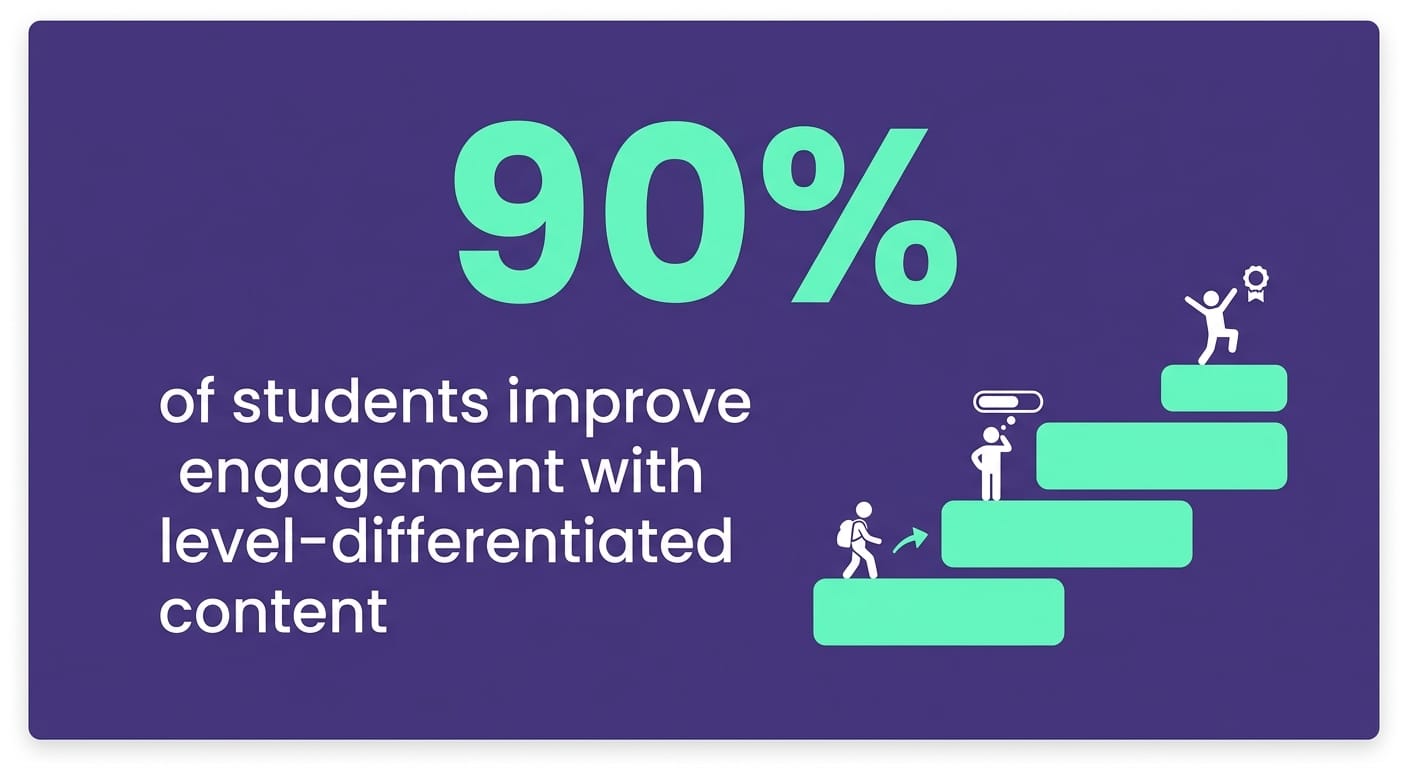
Across 500+ partner schools validated in Brazil and LATAM, serving more than 100,000 students, we recorded a 90% average improvement in engagement (Gamefik internal research, 2024) when content is differentiated by level within a gamified learning pathway. That figure matters because engagement is the gateway to performance — a connected student is a student who practices more.
There's a behind-the-scenes benefit that rarely gets mentioned: the platform aggregates data from each mission and automatically shows who got stuck and where. That dashboard turns the flexible grouping decision in Step 2 from an afternoon of manual review into a two-minute task. Full implementation takes less than a week, and teachers report saving an average of 2 hours per week previously spent on manual tasks.
A curriculum coordinator at a district in Texas shared an effect that wasn't part of the original plan: once she started forming groups using platform data instead of instinct, she stopped misplacing students. Previously, she'd place students in the support group who had simply missed a class, while overlooking students who were genuinely stuck on foundational content. The data corrected that blind spot — and that's what separates personalization from guesswork.
In practice, what we see is that gamification solves a problem the method alone doesn't: the motivation for students to follow a learning pathway all the way through. But be clear about the prerequisite — if you skip the diagnostic assessment and flexible grouping steps first, gamification becomes attractive point-scoring without pedagogical direction. A tool without a method doesn't personalize anything.
If student disengagement is your current challenge, it's worth pairing this article with our resources on student engagement strategies, our guide on re-engaging disconnected learners, and our 12 practical strategies to engage students. A gamified school uses personalization as its foundation, not as decoration — and the results show up in state assessments and college-readiness metrics, because tiered pathways ensure more students arrive prepared for the content covered in standardized exams.
Frequently Asked Questions About Personalized Learning
How can teachers personalize learning in the classroom? Start with a short diagnostic assessment of what each student already knows, group students by current need (not fixed ability level), offer different pathways to the same learning objective, and use brief check-ins to adjust pacing. Technology helps, but the starting point is knowing your students.
What are the 5 pillars of personalized education? Student profile, flexible pacing, varied learning pathways, continuous formative assessment, and student ownership. None of these pillars require expensive infrastructure — all of them require intentional planning.
What are the best strategies for personalized learning? The highest-impact strategies include rotation stations, flexible grouping, tiered assignments, short and frequent feedback, and gamification to differentiate challenges. They work in large public school classrooms and improve student engagement without increasing the correction workload.
Start With Your Next Unit, Not the Whole School
Personalizing learning doesn't require restructuring your school — it requires choosing one class and applying diagnostic assessment, flexible grouping, and brief feedback in your next unit. That's how we guide every new partner school: one teacher, one class, one unit. Schools that try to transform everything at once almost always stall. If you want to do this with gamified pathways that automatically differentiate challenges and give you planning time back, explore the platform at gamefik.com and see how 500+ partner schools structure personalization in less than a week.