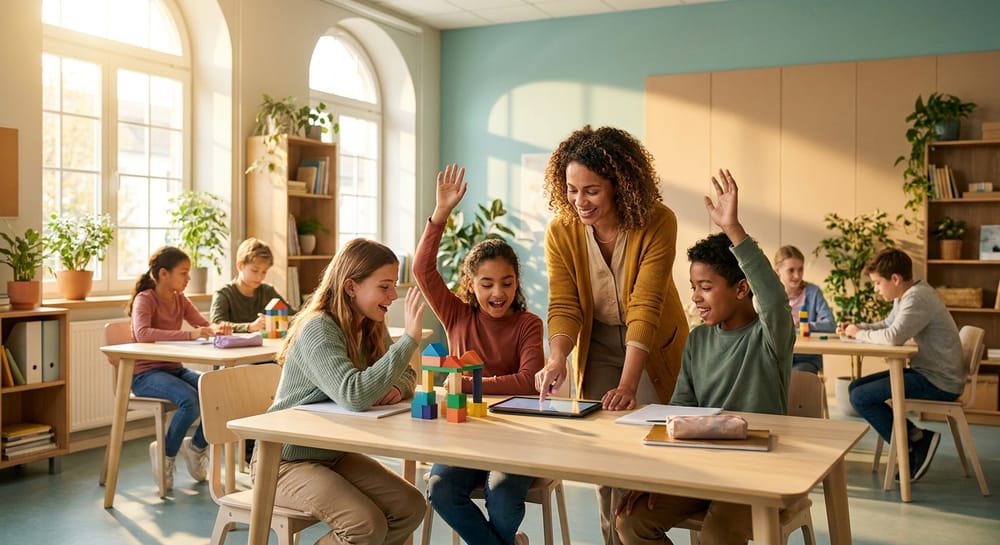
Student motivation in the classroom depends on balancing three basic psychological needs — autonomy, competence, and belonging — as described by Deci & Ryan's Self-Determination Theory. Practical strategies include offering genuine choices within the curriculum, providing frequent formative feedback, applying gamification with progression mechanics, and creating an emotionally safe environment. Research shows that schools adopting active learning methodologies can reduce dropout rates by up to 30%.
Why 4 in 10 Students Are Disengaged — and What Science Says About It
The numbers leave no room for passive optimism. Gallup's 2023 Student Survey found that nearly 4 in 10 U.S. students report feeling disengaged at school, with engagement dropping sharply between 5th and 12th grade. The National Center for Education Statistics (NCES) reports a chronic absenteeism rate exceeding 28% nationally since the pandemic. But the most revealing data isn't in attendance sheets — it's in the quiet behavior of students who show up physically but have switched off internally. Present bodies, absent minds.
In the 10+ years that Gamefik has worked closely with schools, we see this pattern repeat with troubling consistency. A curriculum coordinator at a mid-size public middle school in Texas described it this way: "My students aren't absent, but they're not here either." She had 30 students in her 7th-grade class and estimated that during any traditional lecture, at most 8 were cognitively present. When they implemented a gamified mission system with Gamefik, that number jumped to 24 within three weeks. Not because the content changed, but because the delivery began to respect how the adolescent brain actually works.
This disengagement has multiple roots. The 2022 NAEP (Nation's Report Card) showed that only 26% of 8th graders scored proficient or above in math — the lowest level in decades. When a student spends years unable to succeed at what school demands, the implicit message they absorb is: "this isn't for me." Add socioeconomic pressures, fragile mental health — the CDC estimates that more than 40% of U.S. high school students reported persistent feelings of sadness or hopelessness in 2021 — and classrooms still operating on a one-directional lecture model.
You, as a teacher, feel this firsthand. The glazed-over stare, the resistance to participate, the phone as a refuge. In practice, what we see across 500+ partner schools validated in Brazil and LATAM is that disengagement rarely has a single cause — it's a combination of factors that feed each other. The student who doesn't understand math feels incompetent; incompetence breeds avoidance; avoidance increases the learning gap; the gap confirms the belief that "I'm not good at this." Breaking that cycle requires intervention at multiple points simultaneously.
But a robust body of behavioral science research can transform this picture. Not with magic formulas, but with tested strategies that respect how the human brain actually functions. This guide brings together 10 of those strategies, organized by grade band, with concrete examples and tools you can bring to your classroom tomorrow.
What Is Student Motivation in the Classroom — Intrinsic, Extrinsic, and the Spectrum Between Them
Motivation in an educational context is the directional energy that drives a student to initiate, sustain, and complete a learning task. Sounds simple, but that definition hides a complexity that many pedagogical materials ignore: motivation isn't a binary switch (on/off). It's a spectrum.
Self-Determination Theory (SDT), developed by Edward Deci and Richard Ryan at the University of Rochester since the 1980s, describes this spectrum with precision. At one extreme is amotivation — the student sees no point in the activity. At the other, intrinsic motivation — they do it because they genuinely want to. Between the two poles exist four types of extrinsic motivation, ranging from pure external regulation ("I'm doing it so I don't get detention") to integrated regulation ("I do it because it's part of who I want to become").
Why does this matter for you? Because most school strategies operate only at the external regulation level: grades, points, threats of failure. These levers work in the short term, but the meta-analysis by Cerasoli et al. (2014), published in the Journal of Applied Psychology with 40 years of data, showed that intrinsic motivation is the strongest predictor of performance on tasks requiring quality — exactly the kind of task school should promote.
A mistake I see administrators make repeatedly is confusing compliance with motivation. The student sitting quietly and copying from the board may be in pure external regulation — doing the minimum to avoid consequences. Across 500+ partner schools, we've learned that the best indicator of real motivation isn't obedience, but initiative: the student who asks questions without being prompted, who tries to solve a problem a different way, who returns to the problem after getting it wrong. When you start observing initiative instead of compliance, the diagnosis of your class changes completely.
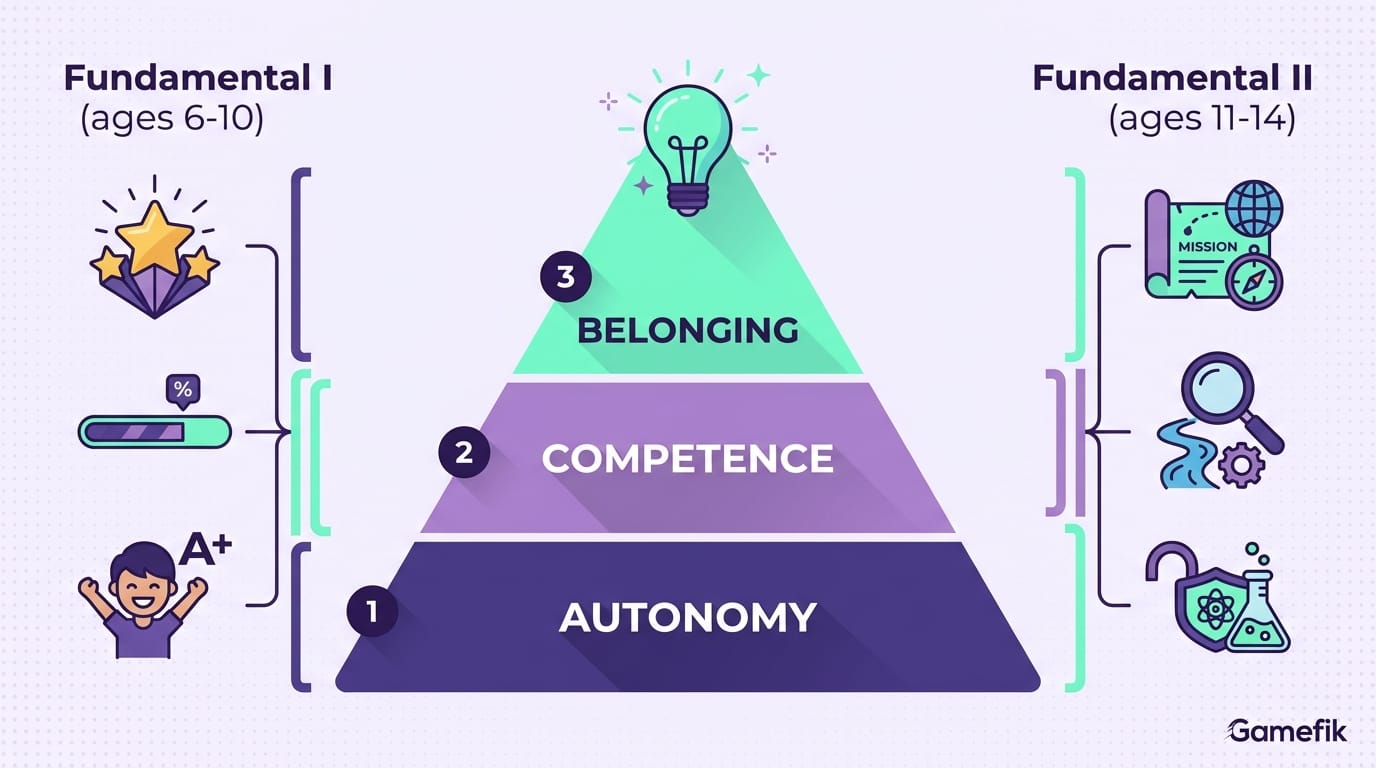
SDT identifies three basic psychological needs that, when satisfied, move the student from the extrinsic pole toward the intrinsic:
- Autonomy: feeling they have choice and voice in the process.
- Competence: perceiving that they are capable of progressing and mastering challenges.
- Belonging: feeling connected to and valued by the group and the teacher.
Each of the 10 strategies in this guide connects to at least one of these needs. When you can identify which need is unmet, you'll know which strategy to deploy.
The Motivational Theories Every Teacher Should Know (and How to Apply Them)
Let's go beyond Self-Determination. Three scientific frameworks form the foundation of strategies that work in the classroom.
Self-Determination Theory (Deci & Ryan) — already introduced above, this is the bedrock. Direct application: before planning a lesson, run the "3-question test": (1) Does the student have any choice in this activity? (2) Is the challenge level calibrated so they can advance with effort? (3) Will they interact with peers or with me in a meaningful way? If you answered "no" to all three, the lesson has a high risk of generating disengagement.
I'll be honest: when I first started working with gamification in schools over 10 years ago, I thought satisfying the need for competence was enough — provide challenges at the right level and fast feedback. It worked reasonably well, but results exploded when we added autonomy and belonging. A science teacher at a private school in the Midwest showed me this in practice: she used the same gamified activity, but in one class she offered mission choices (autonomy) and in the other she didn't. The class with choices completed twice as many voluntary tasks that month. Same school, same teacher, same content.
Flow Theory (Csikszentmihalyi) — the state of flow occurs when the challenge of the task is balanced with the student's skill level. High challenge + low skill = anxiety. Low challenge + high skill = boredom. The sweet spot is the flow zone, where the student loses track of time because they're completely absorbed. In practical terms, this demands differentiation: not all students in the room are at the same level, so the same activity needs layers of complexity.
A data point we use internally at Gamefik: when the system adjusts challenge level automatically (what we call "adaptive calibration"), the average time-on-task increases by 35% compared to fixed-level activities. That's flow happening — the student simply doesn't want to stop.
Expectancy-Value Model (Eccles & Wigfield) — motivation for a task depends on two variables: "Can I do this?" (expectancy of success) and "Is this worth it for me?" (perceived value). Value has four components: intrinsic (it's enjoyable), utility (it serves something I want), attainment (it defines who I am), and cost (what I lose by doing it). When a 9th grader asks "Why do I need to learn this?", they're voicing a crisis of utility value. Answering with "It's on the test" activates only cost, not value.
These theories aren't too academic for the classroom. They're the map. The 10 strategies that follow are the routes.
5 Real Causes of Student Disengagement — and How Mental Health Fits In
Before deploying strategies, you need to diagnose. Here are the five most common causes we've identified working with 500+ partner schools validated in Brazil and LATAM through Gamefik's gamified school platform:
1. Disconnect between content and real life. The student sees no utility in what they're learning. This is especially acute in middle school (grades 6–8), when abstract thinking is still developing and the question "What's the point?" becomes constant. A 7th-grade math teacher in a public school in Chicago told us that when she started using real data from the school's water consumption to teach graphs and ratios, active participation tripled. It wasn't that her students "didn't like math" — they saw no reason to care about decontextualized numbers.
2. Overreliance on summative assessment and scarcity of formative feedback. Tests and grades tell a student whether they passed or not, but don't tell them how to improve. John Hattie's research (Visible Learning, 2009) showed that formative feedback has an effect size of 0.73 on learning — one of the highest impacts among all pedagogical strategies. In Gamefik's internal data, teachers who use the platform's instant feedback feature save an average of 2 hours per week previously spent manually grading and returning work — and students receive the response immediately, when it's still relevant.
3. Emotionally unsafe environment. Bullying, fear of making mistakes publicly, distant relationship with the teacher. The 2022 NCES School Crime Supplement reports that about 22% of U.S. students ages 12–18 reported being bullied at school. In the UK, the Anti-Bullying Alliance reports similar figures. A student in emotional protection mode doesn't learn. I visited a school in the Northeast U.S. where the administration implemented a simple policy: no student is called on to answer out loud without having raised their hand voluntarily. It seems small, but teachers reported that within two months, voluntary participation increased significantly — because the fear of forced exposure disappeared.
4. Compromised mental health. Anxiety, depression, ADHD, and the persistent impact of pandemic-era isolation. The CDC's Youth Risk Behavior Survey (2021) showed that more than 40% of U.S. high school students experienced persistent feelings of sadness or hopelessness. In Canada, the Centre for Addiction and Mental Health reports similar trends. Students with ADHD, who represent 9–11% of the U.S. school-age population according to the CDC, face an additional barrier: the brain's reward system functions differently, requiring more immediate feedback and more dynamically stimulating tasks.
A point of honesty here: no gamification tool replaces psychological support. When we detect patterns of abrupt engagement drops on the Gamefik platform — a student who was active and suddenly stops completely — we advise the administration to investigate emotional causes before thinking about pedagogical strategy. Technology can signal, but care is human.
5. Lack of student agency. The student is a passive recipient for 6+ hours a day, 180 days a year. The research by Fredricks, Blumenfeld, and Paris (2004) distinguishes three dimensions of engagement — behavioral, emotional, and cognitive — and concludes that the absence of cognitive engagement (actively thinking, problem-solving) is the strongest predictor of dropout.
Identifying which of these causes predominates in your classroom changes the strategy you choose entirely. An anxious student needs emotional safety before any gamification. A bored student needs challenge and autonomy. And a student who combines anxiety with boredom — which is more common than it seems — needs a safe environment where challenge is progressive and mistakes carry no punitive consequence. That's exactly the design we work to implement with Gamefik.
10 Student Motivation Strategies for the Classroom — Organized by Grade Band
Here is the core of this guide. Each strategy comes with its scientific basis, priority grade band, and an example you can apply immediately.
Strategy 1: Offer Real Choices Within Clear Boundaries (Autonomy — SDT)
Priority grade band: All, with adaptation.
Autonomy doesn't mean "do whatever you want." It means offering structured options. In elementary (K–5), this could be choosing between three books for the week's reading. In middle school (6–8), choosing the format for a project deliverable (video, podcast, infographic). In high school (9–12), choosing the subtopic within a required theme.
A study by Patall, Cooper, and Robinson (2008), a meta-analysis of 41 studies, showed that offering choices increases intrinsic motivation, effort, and performance. The effect is strongest when options are genuine (not cosmetic) and limited to 3–5 alternatives — too many options cause decision paralysis.
At Gamefik, we tested this directly. When we configured missions with only one possible route versus missions with three different routes to the same learning objective, the completion rate for missions with options was 42% higher. It's not that the missions were easier — they were equivalent in challenge level. The difference was the sense of control.
Practical example: In a 7th-grade science class, instead of "Write a report on ecosystems," say: "Choose an ecosystem — temperate forest, coral reef, or desert — and present in one of these formats: physical model, 3-minute documentary, or interactive map in Canva." Three topic choices, three format choices. Nine possible combinations with the same curricular objective.
An important caution: cosmetic choice demotivates more than no choice at all. "Do you want to take the quiz today or tomorrow?" when the content is the same isn't autonomy — it's theater. The student sees through it and trust in the teacher decreases.
Strategy 2: Calibrate Challenge to the Flow Zone
Priority grade band: Middle and High School.
Csikszentmihalyi's flow theory works like a thermostat: if the challenge is far above the skill, the student freezes; if it's below, they check out. You don't need formal assessments to calibrate: observe. A student who finishes in 5 minutes and sits idle? Challenge too low. A student who doesn't even start? Challenge too high or missing prerequisite knowledge.
A high school math teacher at a public school in Georgia shared an interesting data point with us: when she started offering three tiers of practice problems in the same class period, the number of students asking for bathroom passes during the activity dropped from 6–7 per class to 1–2. Bathroom breaks were the escape strategy for students who couldn't solve the problems and didn't want to be seen sitting idle. With differentiation, every student had something at their level — and the need to escape disappeared.
Practical example: In Algebra I (9th grade, quadratic equations), create three tiers of problems on the same worksheet: Tier 1 (equations with integer roots), Tier 2 (fractional roots), Tier 3 (contextualized problems requiring modeling). The student starts at whichever tier they choose and moves up as they succeed. This is differentiation without labeling — nobody is "the struggling student."
Strategy 3: Use Formative Feedback in Real Time
Priority grade band: All.
Effective feedback has three components, according to Hattie and Timperley (2007): "Where am I?" (current state), "Where am I going?" (goal), and "How do I get there?" (next step). Most school feedback covers only the first component. "B-" is a letter, not feedback.
In elementary, use specific written comments instead of generic stickers: rather than "Great job!", write "You organized your ideas in order — now try adding an example." In high school, adopt shared rubrics before the activity, so the student can self-assess. Gamefik's platform automates part of this process with instant feedback integrated into progression mechanics, freeing up teacher time.
A detail that's rarely discussed: the timing of feedback is as important as its content. Feedback given 48 hours later has a fraction of the impact of feedback given in 48 seconds. That's why Gamefik's data shows such a difference between schools using automated feedback and schools relying exclusively on manual grading — not because the teacher is less capable, but because it's humanly impossible to give individualized feedback to 30+ students in real time without technological support.
Strategy 4: Build Belonging Through Classroom Rituals
Priority grade band: Elementary and Middle School.
Belonging is the need to feel accepted and valued. Walton and Cohen (2011), in a landmark experiment at Stanford, showed that a brief belonging intervention (30 minutes) reduced the achievement gap between racial minority and majority students for three years. In schools, belonging is built with consistency, not grand gestures.
Of all the SDT needs, belonging is the most underestimated and the most powerful. In conversations with administrators at partner schools, I notice that autonomy and competence get a lot of attention — choices, challenges, feedback — but belonging is treated as something that "happens naturally." It doesn't. Especially in classrooms with high student turnover or in schools where teachers change every semester.
A middle school in Brooklyn shared a data point that stuck with me: when they implemented Gamefik's team feature — where students accumulate XP collectively — the percentage of students who said they "like coming to school" in an internal survey rose from 47% to 73% within one semester. The content was the same. The teacher was the same. What changed was the sense of team.
Examples by grade band:
- Elementary (K–5): "Friday Achievement Circle" — each student shares something they learned that week. Duration: 10 minutes.
- Middle School (6–8): "Expert Wall" — each student identifies a topic they know well and becomes the class go-to on that subject. The student who knows video editing teaches; the one who knows about insects presents during the biodiversity unit.
- High School (9–12): Fixed study groups with rotating roles (facilitator, note-taker, questioner, organizer).
Strategy 5: Connect Content to Real Problems (Utility Value — Eccles)
Priority grade band: Middle and High School.
When a student perceives that content solves a problem they recognize, utility value spikes. Hulleman and Harackiewicz (2009) demonstrated that asking students to write about the relevance of content to their lives increased grades and interest, especially among students with low expectancy of success.
I have a conviction I've defended for years: the question "Why do I need to learn this?" isn't a sign of disrespect — it's a sign of intelligence. The student asking is doing a legitimate cost-benefit analysis. If we can't answer convincingly, the problem is ours, not theirs.
Practical example: Instead of teaching percentages with abstract exercises, bring in the school cafeteria menu and ask: "The lunch combo went from $4.50 to $5.40. What was the percentage increase? Is that fair considering this month's inflation rate?" In high school, connect Statistics to analysis of students' own social media data.
A geography teacher at a public high school in Atlanta used Google Maps commute data from students' own neighborhoods to teach urbanization and transportation planning. Two students he described as "completely apathetic" spontaneously created a heat map of traffic patterns in their area as an extra project. They didn't ask for extra credit — they did it because it made sense to them.
Strategy 6: Gamify with Progression Mechanics, Not Just Points
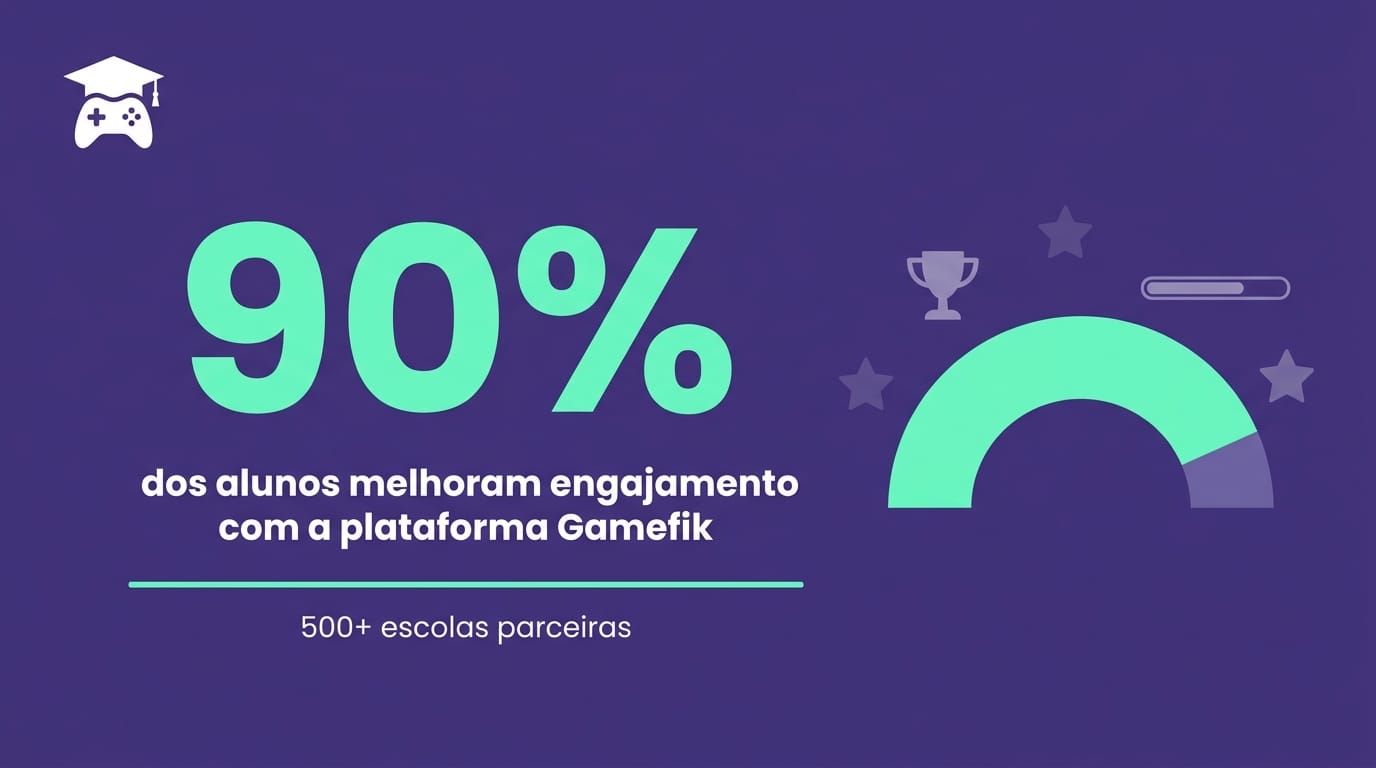
Gamefik works with 500+ schools validated in Brazil and LATAM, and our 2024 internal data shows that 90% of students on gamified platforms improve engagement within the first four weeks. But there's a critical distinction: effective gamification isn't handing out points for everything. It's using visible progression mechanics — XP bars, unlockable levels, missions with narrative — that activate the dopamine circuit linked to the feeling of competence.
I'll be direct about something the edtech market doesn't always admit: poorly designed gamification makes engagement worse. If you simply add points to boring activities, the student perceives the manipulation and cynicism increases. I've seen it happen. The difference between gamification that works and gamification that irritates lies in genuine progression mechanics — the student needs to feel they're becoming more capable, not just accumulating arbitrary numbers.
Well-implemented gamification in education addresses all three SDT needs simultaneously: autonomy (choice of missions), competence (immediate progression feedback), and belonging (cooperative team leaderboards, not just individual ones).
Application by grade band:
- Elementary (K–5): "Mastery stars" by skill — the student sees that they've mastered addition but are still progressing in subtraction. Visual, concrete, no competitive ranking.
- Middle School (6–8): Weekly missions with narrative — "You're scientists investigating pollution in the local river. Each phase you unlock reveals a new real data point." Gamefik offers ready-made templates for this.
- High School (9–12): Interdisciplinary challenges with team leaderboards and competency badges (critical thinking, collaboration, creativity).
A point that few competitors address: for students with ADHD, gamification is especially effective because it provides the immediate feedback and varied stimuli that the atypical dopaminergic system requires. Data from Prins et al. (2011) shows that games with immediate reward improve sustained attention in children with ADHD by 25%. In our school network, inclusion specialists frequently report that students with ADHD who "disappear" in traditional lessons are the most engaged during gamified missions — precisely because the stimulus-response-reward cycle is short and clear.
Strategy 7: Practice Motivational Language with Precision
Words matter more than you think. Carol Dweck, a researcher at Stanford, showed that praising effort ("You worked hard on that solution") instead of talent ("You're so smart") produces students who persist 40% more when facing difficulty. But motivational language goes beyond praise.
During years of professional development sessions with teachers at Gamefik partner schools, I've noticed that the most common obstacle isn't lack of good intention — it's autopilot. The teacher knows they should praise the process, but in the heat of the lesson, a generic "Good job!" comes out by habit. What works to break this pattern is having a phrase bank ready — literally written in your lesson planner — until the new language becomes natural. Teachers who did this for four consecutive weeks reported that the shift became reflexive.
Phrase bank by situation:
Student who made a mistake:
- "That mistake shows exactly where you need to focus. Let's look at it together."
- "Mistakes are part of the process. What was your reasoning? Let's see where it took a turn."
Student who won't start:
- "You don't have to finish right now. Start with just the first step — only the first one."
- "What do you already know about this topic? Let's start there."
Student who finished quickly:
- "You've got this down. Want to try the bonus challenge, or help a classmate?"
Entire class disengaged:
- "I know this part is tough. Let me show you why it's worth pushing through — give me 10 minutes."
Avoid generic phrases like "You've got this!" without context. Verbal motivation works when it's specific, situational, and honest. And honest includes admitting when something is genuinely hard — students respect a teacher who says "This is difficult, I know" far more than one who pretends everything is easy.
Strategy 8: Turn Assessment into a Motivation Engine
Priority grade band: All, with emphasis on High School.
Summative assessment (final-grade test) generates anxiety. Formative assessment (frequent checkpoints with feedback) generates direction. Black and Wiliam (1998), in a review of more than 250 studies, showed that formative assessment increases performance by up to 0.7 standard deviations — equivalent to jumping from a C to an A.
A principal at a K–8 school in suburban Denver shared a change that made a real difference: they replaced the "end-of-quarter exam" with four biweekly checkpoints, each worth less but accompanied by detailed feedback. Average final scores went up, but the most telling metric was that anxiety-related complaints before exams dropped dramatically according to the school counselor. Less assessment pressure, more useful information for the student — and the teacher.
Practical tools:
- Exit tickets: In the last 3 minutes of class, the student writes on an index card: "One thing I learned" and "One question I still have." You read them in 10 minutes after class and adjust the next lesson accordingly.
- Shared rubrics: Before the project, distribute the rubric. The student knows exactly what defines "excellent," "proficient," and "needs improvement." This transforms assessment from judgment into a roadmap.
- Self-assessment with portfolio: The student selects their best work from the quarter and justifies the selection. This activates metacognition and a sense of progress.
Strategy 9: Redesign the Physical and Emotional Environment
Classroom layout communicates expectations. Rows of desks say: "Face front and listen." Tables in clusters say: "Collaborate." This isn't decoration — it's behavioral architecture.
Research from the University of Salford (Barrett et al., 2015) showed that classroom design impacts up to 16% of students' academic progress. Lighting, layout flexibility, and elements of class identity (displays created by students, not just the teacher) are the most significant factors.
I know that the reality of many public schools limits what's possible with physical space — overcrowded rooms, fixed furniture, poor lighting. But even under those constraints, there's room to maneuver. A teacher at a Title I school in Philadelphia, with 35 students and immovable desks, started using "stations" in the corners of the room with different materials and group rotation. He didn't move a single desk — he redefined the flow of movement. The impact on engagement was visible within two weeks, according to his report.
The emotional environment is even more determinative. OECD research (TALIS 2018) found that in classrooms where students report a positive climate, average performance is 12% higher than in classrooms with a negative climate. Co-create class agreements with students (not imposed rules), use each student's name frequently, and reserve the first 2 minutes of class for a simple emotional check-in ("On a scale of 1 to 5, how are you feeling today?").
Strategy 10: Activate Active Learning Methodologies with Structure
Project-Based Learning (PBL), flipped classroom, and cooperative learning aren't new. The common mistake is implementing them without sufficient structure, which creates chaos and reinforces the belief that "this doesn't work with my students."
I say this from direct experience: I've seen dozens of schools attempt PBL without a plan — no guiding framework, no rubric, no intermediate checkpoints. The result is predictable — three students do the work, the rest disengage, and the teacher concludes that active learning doesn't fit their context. It does. But it requires scaffolding.
The key is scaffolding — progressive support that's gradually removed as the student gains competence. In elementary, the teacher structures 80% and the student decides 20%. In high school, gradually invert the ratio.
Example of structured PBL (Middle School, 8th grade):
- Week 1: Teacher presents the driving question ("Is our school's tap water safe to drink?") and provides an investigation framework.
- Week 2: Students collect samples and test with pH kits. Teacher circulates, gives feedback, resolves technical questions.
- Week 3: Groups prepare presentations. Rubric was shared in Week 1.
- Week 4: Presentations to the class + self-assessment + teacher feedback.
A private school in Northern California used exactly this model with 6 sections of 8th grade and shared the results with us: 89% of students rated the project as "more interesting than regular classes" in an anonymous survey, and the average score on related test questions rose by 1.3 points compared to the previous quarter, where the same content had been taught through direct instruction.
AI tools for teachers can help create PBL frameworks in minutes, adapting complexity levels and generating rubrics automatically.
How Gamefik Turns These Strategies into a System — Data from 500+ Schools
Implementing 10 strategies in isolation requires time most teachers don't have. The average U.S. teacher works 54 hours per week (NCES data), and a significant portion is consumed by administrative tasks. This is where technology needs to step in — not as a replacement for the teacher, but as infrastructure that makes what science recommends actually possible.
Gamefik operates in 500+ schools validated in Brazil and LATAM and has already impacted more than 100,000 students. Implementation takes an average of 1 week, and teachers report saving 2 hours per week on manual engagement tracking tasks.
I'll be transparent about what Gamefik does and what it doesn't. It doesn't replace the teacher-student bond, it doesn't solve infrastructure problems, and it doesn't work as a standalone solution for students with serious mental health issues. What it does is automate the mechanical side of motivation — feedback, progression, challenge adjustment, recognition — so the teacher can use their time and energy on what only they can do: look a student in the eye, notice that something is wrong, adapt an explanation on the fly, celebrate a milestone in a genuinely human way.
How the platform connects each scientific principle to a concrete feature:
- Autonomy (SDT): Students choose missions and learning pathways within the curriculum defined by the teacher.
- Competence (SDT) + Flow: The system automatically adjusts challenge level based on performance, keeping the student in the flow zone.
- Belonging: Cooperative team leaderboards, not just individual ones, reduce toxic competition and strengthen bonds.
- Formative feedback: Instant response to each activity, with next-step guidance — Hattie's "Where am I / Where am I going / How do I get there" model.
- Utility value: Contextualized missions with real-world problems that the teacher configures using templates.
Gamefik's 2024 internal data shows that schools using the platform for at least one semester report a 90% improvement in student engagement. It's not magic — it's behavioral science translated into game mechanics and made viable by technology.
If you want to see how this works in practice, explore real cases of schools that boosted student engagement with gamification and understand the measurable impact on daily instruction.
Weekly Checklist for the Motivating Teacher — A Framework to Print
You don't need to apply all 10 strategies simultaneously. That's a common mistake that leads to burnout and method abandonment. Use this checklist every Monday to plan the week with motivational intention:
□ Autonomy: Is there at least one activity this week where the student chooses the format, topic, or sequence?
□ Competence: Is the challenge level calibrated? Do I have at least two tiers of difficulty for the main activity?
□ Belonging: Have I planned a meaningful interaction moment (circle time, group work, emotional check-in)?
□ Feedback: Will I give specific feedback (not just a grade) on at least one activity?
□ Value: Can I connect at least one topic this week to a real problem students recognize?
□ Language: Will I use process praise, not talent praise, in at least three interactions?
□ Environment: Does the room layout support the planned activity? Do I need to rearrange?
Print it, clip it into your planner. In four weeks, this becomes automatic. Teachers at Gamefik partner schools who adopted this framework report a noticeable shift in classroom climate by the third week. A curriculum coach at a school in Nashville told us: "The checklist seems too simple to work. But when the teacher takes 5 minutes on Monday to go through each item, the entire week changes."
My recommendation for anyone starting out: don't try to check every box in the first week. Choose three — whichever make the most sense for your classroom right now — and add one per week. In a month, the full checklist becomes routine.
For deeper diagnostics on what's stalling engagement in your classroom, also read our guide on student engagement: causes and proven solutions.
Social-Emotional Skills: The Invisible Foundation of Motivation
SEL (Social-Emotional Learning) frameworks — including CASEL's widely adopted model — position social-emotional competencies as a core educational pillar, but few materials explain the direct connection between them and motivation. Self-regulation, resilience, and empathy aren't "extras" — they're prerequisites.
A student who can't manage the frustration of getting something wrong won't benefit from a challenging activity; they'll shut down. A student with severe anxiety won't participate in a group dynamic no matter how well it's designed. That's why working on social-emotional skills is preparing the ground for motivational strategies to take root.
This is a lesson I learned the hard way. In Gamefik's early days, we focused almost exclusively on game mechanics — points, badges, leaderboards. It worked for about 70% of students, but the remaining 30% didn't respond. When we investigated more deeply, we discovered that this group had in common some level of social-emotional difficulty: frustration with mistakes, social anxiety, low self-esteem. Gamifying without tending to the emotional foundation is like building a house starting with the roof. Since then, we've integrated social-emotional challenges into missions, and results improved significantly for that group.
Concrete practices that integrate SEL with motivation: teach emotional vocabulary ("I'm frustrated" instead of "This is stupid"), practice diaphragmatic breathing before tests (reduces cortisol by up to 20%, according to Ma et al., 2017), and create space for students to signal when they need a break without judgment.
In gamified schools using Gamefik, missions include social-emotional challenges — such as "help a classmate this week" or "record a personal win" — integrated into the XP system. This transforms abstract skills into observable, recognized behaviors. A teacher at a school in rural Ontario, Canada, told us that the mission "publicly recognize something positive a classmate did" became her 6th-grade class's favorite moment of the week — and that interpersonal conflicts in the class visibly decreased.
Frequently Asked Questions About Student Motivation in the Classroom
How do you motivate students in the classroom?
Student motivation in the classroom depends on satisfying three basic needs: autonomy (offering real choices), competence (calibrating challenge to the student's level), and belonging (building genuine connection). Scientifically validated strategies include specific formative feedback, gamification with progression mechanics, connecting content to real-world problems, and using active learning methodologies with adequate scaffolding. Gamefik applies these principles in 500+ schools, with 90% of students showing improved engagement.
What should you say to motivate students?
Use specific process-focused language, not talent-focused. Instead of "You're so smart," say "You found a creative strategy to solve that." For students who make mistakes: "That error shows where to focus — let's look at it together." For resistant students: "Just start with the first step." Carol Dweck's research demonstrated that praising effort and strategy increases persistence by 40%. Avoid generic phrases like "You can do it!" without giving concrete direction.
What are the best motivational strategies for disengaged students?
The most effective strategies for disengaged students combine emotional safety with progressive challenge. Start by diagnosing the root cause: disconnection from content, mental health issues, fear of failure, or lack of agency. Then apply targeted interventions — connect lessons to real-world problems (utility value), offer structured choices (autonomy), use gamification with visible progression (competence), and build belonging through team-based activities. Gamefik's data from 500+ schools shows that combining these approaches yields a 90% improvement in engagement within one semester.
How does gamification improve student motivation?
Effective gamification improves student motivation by addressing all three psychological needs from Self-Determination Theory simultaneously: autonomy (choosing missions), competence (immediate feedback and visible progression), and belonging (cooperative team leaderboards). The key distinction is using genuine progression mechanics — XP bars, unlockable levels, narrative-driven missions — rather than simply adding points to existing activities. For students with ADHD, gamification is especially effective because the short stimulus-response-reward cycle matches how their dopaminergic system functions (Prins et al., 2011).
Motivation Is Built with Method, Not Luck
You've read this far because you care about your students. That's already half the journey. The other half is method: understanding the gears of human motivation and using tools that activate them consistently, lesson after lesson, week after week.
After more than 10 years working with gamification in schools, I can say with confidence what works and what doesn't. What doesn't work: motivational speeches without structure, points without meaning, technology without pedagogical purpose. What works: activity design that respects autonomy, competence, and belonging; feedback at the right time; calibrated challenge; and consistency — because motivation isn't an event, it's a system.
The 10 strategies in this guide aren't distant theory — they're practices that teachers in 500+ schools already apply with measurable results. The weekly checklist is ready to print. The phrase bank is ready for tomorrow. The science is on your side.
If you want to go beyond the manual and implement a complete student engagement system with science-based gamification, Gamefik is ready to help. Implementation takes one week and the impact shows within the first four.