
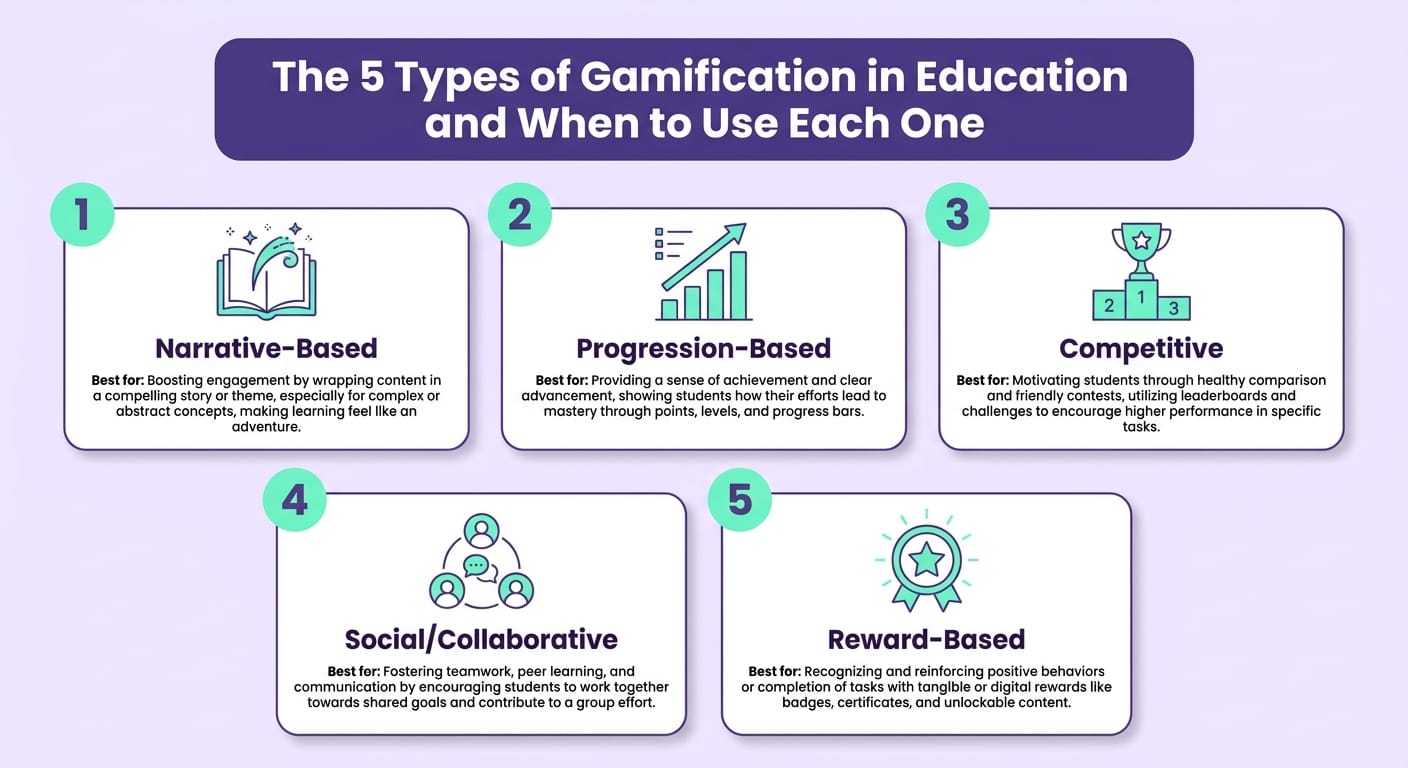
The 5 types of gamification in education are: competitive (leaderboards), collaborative (group missions), narrative (stories and scenarios), progression (levels and points), and social (peer recognition). The right choice depends on grade level, learning objective, and your specific classroom profile — there is no universal model.
The 5 types of gamification in education are: competitive (leaderboards), collaborative (group missions), narrative (stories and scenarios), progression (levels and points), and social (peer recognition). The right choice depends on grade level, learning objective, and your specific classroom profile — there is no universal model.
If you've ever tried a game mechanic in your class and watched it work brilliantly with one group and fall flat with another, that's not a failure of your teaching. Every classroom responds differently, and applying the wrong gamification model in the wrong context is the most common cause of student disengagement. Across 500+ schools validated in Brazil and LATAM, this is the pattern that appears in almost every early diagnostic: an enthusiastic teacher launches a school-wide leaderboard expecting it to motivate everyone, and three weeks later half the class has quietly stopped participating. This article breaks down the five models and shows precisely when to use each one, backed by data from real schools.
What Are the 5 Types of Gamification in Education and What Does Each One Do?
Let's get straight to it. The five models don't compete with each other — they solve different problems.
1. Competitive. Leaderboards, scoreboards, and head-to-head challenges between students or groups. This works when students already have sufficient emotional maturity and the content allows for genuinely fair comparison. The risk is clear: students who land at the bottom of the list tend to disengage. That's why the design of the leaderboard matters far more than simply having one. At a bilingual charter school in South Florida that we work with, competitive mechanics only took hold after the school replaced the whole-class ranking with smaller leagues of 4–5 students at similar performance levels — the competition became fair, and no one felt permanently stuck at the bottom.
2. Collaborative. Group missions, collective goals, and achievements that require everyone to contribute. Here, a struggling student isn't penalized — they're lifted by the team. This model is ideal for interdisciplinary projects and for classes with wide gaps in academic performance, where an absolute ranking would do more harm than good.
3. Narrative. The lesson becomes a story. Students are characters, the content is the journey, and each chapter delivers a new challenge. This is the strongest model for elementary grades and for subjects students tend to find abstract, like history and science. A 5th-grade science teacher in a rural district in Tennessee transformed the water cycle into an "expedition" with distinct stages — the same content that previously produced blank stares became the source of students asking, "What happens in the next chapter?"
4. Progression. Points, levels, and experience bars that rise as students advance. This is the most versatile model, because every student progresses relative to their own previous performance rather than against classmates. It functions as a continuous foundation on which the other models can build.
5. Social. Peer recognition, visible badges, and celebrating achievements within the classroom community. This model works especially well in middle and high school, when peer opinion carries more weight than teacher approval in shaping student behavior and effort.
One pattern the platform data makes unmistakably clear: across 500+ schools validated in Brazil and LATAM, the progression model appears in virtually every successful implementation, while pure competitive mechanics rarely sustain engagement on their own for more than two months. Progression is the foundation; the other models are layers added on top. To be direct: if I had to recommend a single model for a school starting tomorrow, it would be progression — without hesitation. It excludes the fewest students and forgives the most implementation mistakes.
If you want to understand why the brain responds to these mechanics, the article on neuroscience and gamification breaks down the role of dopamine in the reward cycle and what it means for classroom design.
How to Choose and Apply the Right Type of Gamification for Your Classroom
The right question isn't "which model is best" — it's "which model is best for this class, toward this objective, right now." Three variables drive that decision:
- Grade level. Elementary grades (K–5) respond well to narrative and progression. Middle and high school students absorb competitive and social mechanics more effectively once trust and routine are in place.
- Learning objective. Content retention calls for progression. Developing teamwork calls for collaboration. Motivating students in a subject they actively resist calls for narrative.
- Classroom profile. Classes with wide performance gaps struggle with absolute rankings — individual progression or collaborative models work better and produce more equitable outcomes.
In practice, the design of the competitive model is where most teachers go wrong. In Gamefik's dataset of 500+ schools, rankings based on individual growth retain engagement roughly 40% more than absolute-position rankings in grades 6 through 9. The difference is conceptual: in an absolute ranking, only the students already at the top have a real reason to keep pushing; in a growth ranking, every student can move up relative to their own performance the week before. The student who goes from 3 correct answers to 7 earns the same recognition as the student who was already at 10. That middle-of-the-pack student — the one who decides whether gamification actually sticks in your classroom — is the silent majority that an absolute ranking consistently ignores.
A safe starting point: adopt progression as your base — points for assignments completed, levels earned by accumulation — and only then add a narrative or collaborative layer for a specific unit or project. This prevents the most common mistake I see in the field: overwhelming a class with too many mechanics at once. A teacher who rolls out a leaderboard, badges, a group mission, and a storyline in the same week usually sees drop-off before the month is out. One layer at a time, measuring the effect of each.
One honest caveat worth stating plainly: gamification doesn't fix poorly planned content, and it doesn't replace the student-teacher relationship. It amplifies what's already there. A lesson without clear structure becomes a confusing game — and a confusing game demotivates students faster than a traditional lesson ever would.
If you want ready-to-use mechanics you can test this week, the article 12 Gamification Mechanics to Try in Your Classroom This Week walks through each one step by step. And if the goal is to roll this out across your entire school, read about what a gamified school looks like structurally before you scale.
How Gamefik Helps You Apply the Right Types of Gamification
The heavy lifting of choosing and continuously adjusting the right model is what the platform automates. Instead of building leaderboards manually or tracking points in a spreadsheet, the system applies progression, growth-based competition, and social recognition in an integrated workflow — and measures what's actually working in real time.
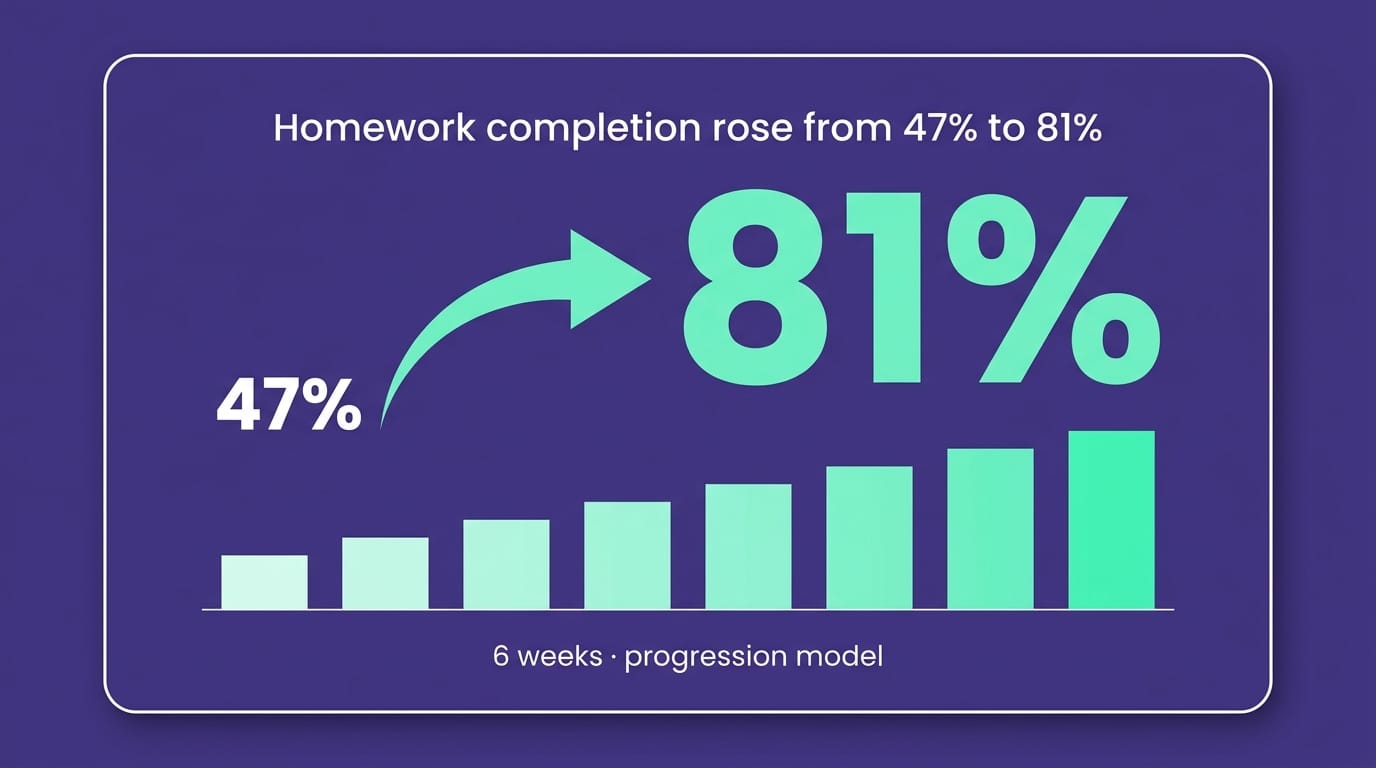
One concrete result: at a partner school district in the Midwest, homework completion jumped from 47% to 81% in 6 weeks after adopting the points-for-progression model (Gamefik partner school data, 2023). It wasn't a competitive leaderboard that moved the needle — it was individual progression, the model that excludes the fewest students and sustains engagement the longest. The school's instructional coordinator had actually come to us asking for "a motivating leaderboard." What solved her problem was the opposite of what she thought she needed.
This pattern repeats across the full platform user base. With more than 100,000 students and 500+ schools using Gamefik, 90% of students show measurable improvement in engagement (Gamefik internal research, 2024) when the gamification model is properly matched to the lesson's objective — not stacked at random. Implementation takes less than a week, and the underlying methodology has been refined across 10 years of direct classroom application.
On the teacher side, the time savings are real: roughly 2 hours per week that would otherwise go toward manually tracking points and updating records become actual instruction time instead. The artificial intelligence for teachers layer proactively suggests which model to adjust when a class begins losing momentum, before disengagement has a chance to set in.
If you're still comparing tools, the comparison of gamification platforms for schools helps you know exactly what criteria to evaluate. And for the full theoretical foundation, the page on gamification in education covers everything from research base to implementation frameworks.
Frequently Asked Questions About Types of Gamification in Education
What is the best type of gamification for elementary school students? For elementary grades (K–5), narrative and progression models work best because young students respond strongly to storytelling and frequent, tangible rewards. In Gamefik's data, students in grades 1–5 maintain more stable engagement with points earned for small achievements than with competitive leaderboards, which tend to demotivate students who fall behind and have nowhere visible to go.
Does competitive gamification hurt struggling students? It can — specifically when the ranking is based on absolute position in the class. In Gamefik's dataset of 500+ schools validated in Brazil and LATAM, growth-based rankings retain engagement roughly 40% more than absolute-position rankings in grades 6–9, precisely because every student can advance relative to their own previous performance rather than against classmates who started further ahead.
Can I combine more than one type of gamification in my classroom? Yes — and in practice, combination is what delivers the most sustained results. Most partner schools use progression as a continuous base running throughout the semester and layer narrative or collaborative mechanics onto specific units or projects. Combining models thoughtfully prevents the novelty effect from wearing off and keeps engagement alive well past the first few weeks.
Start With the Right Model, Not the Most Eye-Catching One
If you've read this far, you already know the answer isn't copying the leaderboard system you saw at a neighboring school. It's matching grade level, learning objective, and classroom profile to the model that actually fits. Start with progression, measure what changes, then add layers deliberately. If you want to do all of this without spreadsheets — with real-time student engagement data at your fingertips — explore Gamefik at gamefik.com. Implementation takes less than a week, and most teachers recover roughly 2 hours per week from the very first month.